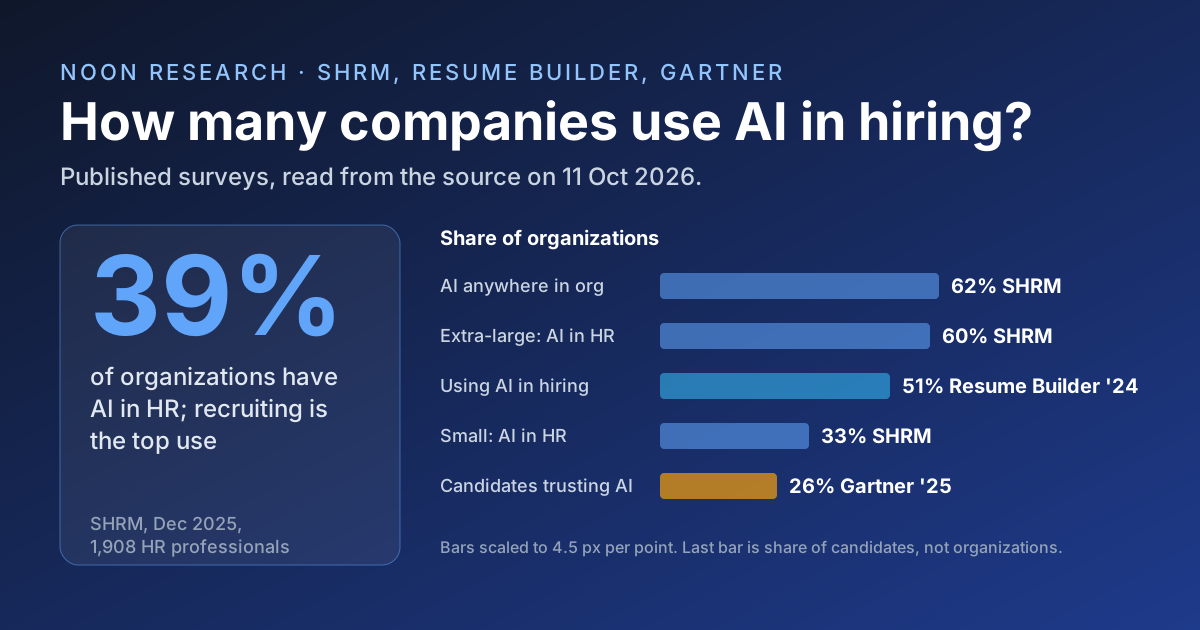
Key takeaway: 39% of organizations have AI adopted in their HR function, and recruiting is the practice area where it shows up most often (SHRM, survey of 1,908 HR professionals fielded December 2025). Count AI used anywhere in the business and the share rises to 62%. Employer surveys that ask about hiring alone land in the same band: 51% of companies said they used AI in hiring (Resume Builder, October 2024). Adoption is real but far from universal, and candidates trust it less than employers do: only 26% believe AI will evaluate them fairly (Gartner, 2025).
"How many companies use AI in hiring?" gets wildly different answers depending on who is asked and how the question is worded. Planning intent, pilots and full deployment are often blended into one headline number. We read seven primary sources on 11 October 2026 and separated what companies say they do from what they plan to do. Every figure below links to the publisher and is recorded in a committed source file.
For the broader hiring benchmarks (time to fill, cost per hire, response rates), see our recruitment statistics roundup. This page answers one question: how widespread AI in hiring actually is.
AI in hiring statistics at a glance
| Measure | Figure | Source, date, sample |
|---|---|---|
| Organizations with AI adopted in HR | 39% | SHRM, fielded Dec 2025, 1,908 HR professionals |
| Organizations using AI anywhere in the business | 62% | SHRM, Dec 2025 |
| Organizations with no plans to launch AI | 31% | SHRM, Dec 2025 |
| Most common HR use of AI | Recruiting (27%) | SHRM, Dec 2025 |
| Extra-large vs small organizations with AI in HR | 60% vs 33% | SHRM, Dec 2025 |
| Companies using AI in hiring | 51% | Resume Builder, Oct 2024, 948 business leaders |
| Companies expecting to use AI in hiring by end of 2025 | 68% | Resume Builder, Oct 2024 |
| Talent teams integrating or experimenting with GenAI | 37% (up from 27%) | LinkedIn Future of Recruiting 2025, 1,000+ talent professionals |
| Talent leaders planning to use AI in 2026 | 84% | Korn Ferry TA Trends 2026, 1,600 talent leaders |
| Candidates who trust AI to evaluate them fairly | 26% | Gartner, 1Q25, 2,918 candidates |
How many companies use AI in hiring right now?
The most recent large sample comes from SHRM. In December 2025 it surveyed 1,908 HR professionals, managers and leaders for The State of AI in HR 2026, published 31 March 2026. The executive summary breaks adoption into four groups:
- 39% currently have AI adopted in their HR functions.
- 7% intend to launch AI in HR this year.
- 23% have AI launched elsewhere in the organization but not in HR.
- 31% are in organizations with no plans to launch AI initiatives.
The first two groups give SHRM's headline that 46% of organizations expect to use AI in HR in 2026. The first and third give 62% using AI somewhere in the business.
SHRM does not report a single "AI in hiring" percentage. It reports that among AI uses in HR, recruiting is the most common practice area (27%), ahead of HR technology (21%), learning and development (17%) and employee experience (14%). So the honest reading is: under four in ten organizations have AI in HR at all, and where they do, recruiting is the first place it lands.
The most direct hiring-specific number is older. Resume Builder surveyed 948 business leaders in October 2024 and found 51% of companies were using AI in their hiring process, with 68% expecting to by the end of 2025. Resume Builder is a career-services company rather than a research institute, and the survey predates SHRM's by more than a year, so treat it as a ceiling on 2024 adoption among companies willing to answer an AI survey.
Is AI adoption in recruiting growing?
Yes, but the growth is in experiments and plans more than in full deployment.
- LinkedIn's Future of Recruiting 2025 found 37% of organizations "actively integrating" or "experimenting" with generative AI tools, up from 27% a year earlier. That is a 10-point rise in one year.
- Korn Ferry's TA Trends 2026 found 84% of talent leaders plan to use AI in 2026, and 52% plan to add autonomous AI agents to their teams.
The gap between 84% planning (Korn Ferry) and 39% adopted in HR (SHRM) is the most useful number on this page. It tells a recruiting leader that most peers intend to use AI, but fewer than half have it running. Korn Ferry's own data points to why: only 22% of its respondents believe their leaders can effectively manage teams that combine humans and AI agents.
If you are deciding what "AI in recruiting" should mean for your team, our explainer on what an AI recruiter actually does breaks the category into sourcing, screening, outreach and scheduling.
Do larger companies use AI in hiring more?
Clearly. SHRM found 60% of extra-large organizations have implemented AI in HR, against 33% of small and 35% of midsize organizations. Extra-large organizations are roughly 1.8 times as likely as small ones to have AI in HR. Recruiting was still the most common practice area for AI at every size.
Resume Builder reported the same direction in 2024: larger companies were more likely to adopt AI in hiring. For a small or midsize team, the takeaway is that most comparable peers have not deployed AI in HR yet, so a well-run rollout is still a differentiator rather than table stakes.
What do companies use AI for in hiring?
Among companies using AI in hiring, Resume Builder (October 2024) reported:
| Hiring task | Share of AI-using companies |
|---|---|
| Reviewing resumes | 82% |
| Reviewing candidate assessments | 64% |
| Scanning social media or personal websites | 42% |
| Chatbots communicating with candidates | 40% |
| Onboarding new hires | 28% |
| Conducting interviews | 23% |
Screening dominates. Sourcing and outreach rarely appear in these employer surveys as separate categories, which is a gap in the research rather than evidence that teams are not automating them. Our guide to the best AI recruiting tools in 2026 covers the tools by stage.
How much human oversight do companies keep?
Less than most candidates would expect. In the same Resume Builder survey of AI-using companies:
- 21% automatically reject candidates at all stages without human review.
- 50% use AI for rejections only at the initial resume screening stage.
- 29% keep human oversight on every rejection decision.
SHRM's governance numbers are also thin: about half of organizations using or about to pilot AI (49%) have a policy regulating workforce AI use. Before buying, ask vendors how they handle data and model access; our AI recruiting software security checklist lists the questions.
Do candidates trust AI in hiring?
Candidates assume AI is screening them, and most do not trust it.
- Gartner (31 July 2025): in a 1Q25 survey of 2,918 candidates, 52% believed AI screens their application, but only 26% trust AI to evaluate them fairly. 25% said they trust an employer less if it uses AI to evaluate them.
- Gartner's 4Q24 survey of 3,290 candidates found 39% used AI themselves during the application process. That arms race feeds the fraud problem covered in our fake job applicant statistics.
- Pew Research Center (April 2023): Americans opposed AI making final hiring decisions by 71% to 7%, and 66% said they would not want to apply to an employer that uses AI to help make hiring decisions.
The pattern is consistent across years: candidates are more comfortable with AI doing the legwork than making the call.
Where AI in hiring earns its keep
The data above points in one direction. Companies get the most value from AI on high-volume, repetitive work, and candidates and recruiters both want people to own the final decision. That matches what we hear from recruiting teams evaluating Noon: one of the most common hesitations is trusting AI to automate the whole workflow, because recruiting is high touch.
Noon's AI Sourcer is built around that split. It searches the open web for candidates autonomously, evaluates them against the role, and calibrates from recruiter feedback so the shortlist gets sharper as you review it. Personalized outreach runs over email and SMS, and the AI Scheduler books interviews, while recruiters decide who moves forward. Noon is sold on a single plan.
Methodology and sources
We fetched each source on 11 October 2026, captured the rendered page text (or PDF text for the SHRM executive summary), and checked every quoted figure against that text with a script. Quotes, URLs, fetch timestamps and publication dates are recorded in seo/research/stats/ai-in-hiring-adoption-2026/sources.json in the noon.ai site repository. Derived values (the 10-point LinkedIn change, the 1.8 times SHRM size ratio) are computed in the same script.
- SHRM, The State of AI in HR 2026, published 31 March 2026; 1,908 HR professionals, managers and leaders surveyed December 2025. Figures from the public executive summary.
- Resume Builder, 7 in 10 companies will use AI in the hiring process in 2025, updated 22 October 2024; 948 business leaders surveyed October 2024.
- LinkedIn, The Future of Recruiting 2025; LinkedIn platform data plus a survey of over 1,000 talent professionals.
- Korn Ferry, TA Trends 2026; 1,600 talent leaders and more than 230 Korn Ferry talent specialists and consultants.
- Gartner, Just 26% of job applicants trust AI will fairly evaluate them, 31 July 2025; 2,918 candidates (1Q25) and 3,290 candidates (4Q24).
- Pew Research Center, AI in hiring and evaluating workers, 20 April 2023.
- SHRM, Navigating AI in the Workplace: 2026; 5,875 U.S. workers surveyed March and April 2026. Used in the FAQ for the worker-side view.
Limitations
- Different questions, different denominators. SHRM asks about AI in the HR function; Resume Builder asks about AI in hiring; LinkedIn asks about generative AI specifically; Korn Ferry asks about plans. The figures are not directly comparable and we have not averaged them.
- SHRM's full report is members-only. We used the public executive summary, which does not give a standalone "share of organizations using AI in recruiting" figure.
- Survey self-selection. Respondents to AI surveys may be more engaged with AI than the average employer, which would bias adoption figures upward.
- Age of some sources. Resume Builder (2024) and Pew (2023) predate the 2026 surveys. We use them because no more recent primary source answers the same question, and we label their dates.
- No Noon data. Nothing on this page comes from Noon customers or the Noon platform.
Frequently asked questions
What percentage of companies use AI in hiring?
About half, depending on the definition. Resume Builder found 51% of companies used AI in hiring in October 2024. SHRM found 39% of organizations had AI adopted in HR in December 2025, with recruiting the most common use.
What percentage of HR departments use AI in 2026?
SHRM's State of AI in HR 2026 found 39% of organizations currently have AI in HR and another 7% intend to launch it this year, so 46% expect to use AI in HR in 2026.
What is AI most used for in recruiting?
Resume review. 82% of companies using AI in hiring use it to review resumes, followed by reviewing assessments (64%) and candidate chatbots (40%), per Resume Builder (2024).
Do job seekers trust AI in hiring?
Mostly not. Gartner found only 26% of candidates trust AI to evaluate them fairly (2025), and Pew found Americans oppose AI making final hiring decisions by 71% to 7% (2023).
How many workers use AI at work in 2026?
SHRM's Navigating AI in the Workplace 2026 survey of 5,875 U.S. workers found 41% use AI in their work and 47% say their organization has implemented AI.
Will most companies use AI in recruiting soon?
Plans say yes. Korn Ferry found 84% of talent leaders plan to use AI in 2026, and LinkedIn found GenAI integration or experimentation rose from 27% to 37% in a year. Deployment still lags plans.