Key takeaway: One in two candidates has ghosted an employer, according to Greenhouse's 2025 survey of 2,200 candidates, and 63% of candidates in the same survey say employers left them in the dark after interviews. On the hiring side, 39% of organizations had candidates disappear midway through a process in the past 12 months, and 59% of HR and talent acquisition professionals say interview no-shows are more frequent than two years ago (LHH and Censuswide, 2026, 500 respondents). Ghosting is a two-way problem, and every survey here with a comparison point shows more of it.
This page collects the figures from eight published surveys, each read at the original source on 11 October 2026, with the publisher, sample and date next to every number. Where two surveys asked different questions, we say so instead of blending them.
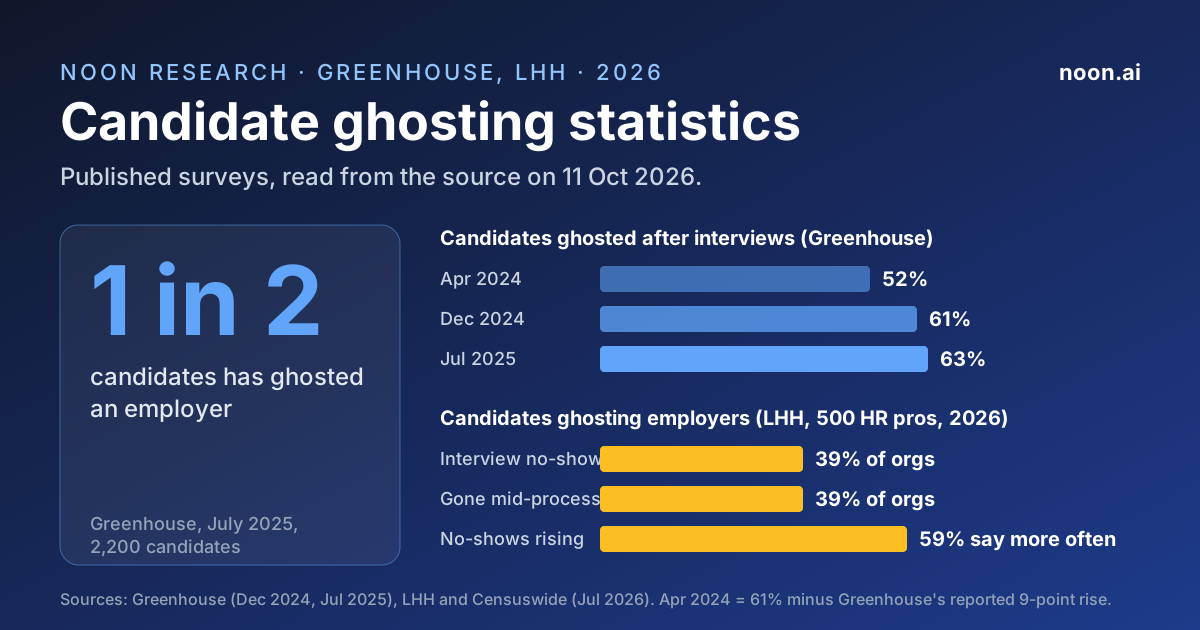
Candidate ghosting statistics at a glance
| Statistic | Source | Sample | Published |
|---|---|---|---|
| 1 in 2 candidates has ghosted an employer | Greenhouse Workforce & Hiring Report | 2,200 candidates, U.S., U.K. and Ireland | Jul 2025 |
| 63% of candidates were left in the dark after interviews | Greenhouse Workforce & Hiring Report | 2,200 candidates | Jul 2025 |
| 39% of organizations had candidates disappear midway through the process in the past 12 months | LHH, fieldwork by Censuswide | 500 U.S. HR and TA professionals | Jul 2026 |
| 39% of organizations had a scheduled interview no-show in the past 12 months | LHH, fieldwork by Censuswide | 500 U.S. HR and TA professionals | Jul 2026 |
| 59% say no-shows happen more often than two years ago (4% say less often) | LHH, fieldwork by Censuswide | 500 U.S. HR and TA professionals | Jul 2026 |
| 54% of hiring managers were ghosted by a Gen Z candidate after extending an offer | ResumeTemplates | 1,115 U.S. hiring managers | 2025 |
| 86% of hiring managers have ghosted candidates because of applicant volume | Resume Genius Hiring Trends Report | 1,500 U.S. hiring managers | 2026 |
| 55% of job seekers say their top frustration is being ghosted after applying | Resume Genius Job Seeker Insights Report | 1,000 U.S. job seekers | Apr 2026 |
| 61% of U.S. job seekers ghosted two to four employers in the past 12 months | Indeed ghosting survey | Job seekers and 4,517 employers in three countries | Jan 2024 |
How many candidates ghost employers?
Roughly half, depending on how the question is asked. Greenhouse's 2025 Workforce & Hiring Report found that one in every two candidates has ghosted an employer. Among Gen Z respondents, 73% have walked away mid-process, and 26% did so after getting an offer.
Indeed's survey, published in January 2024, measured repeat behavior: 61% of U.S. job seekers had ghosted two to four employers in the past 12 months, against 37% in Canada and 36% in the U.K. Seventy percent of U.S. job seekers said ghosting an employer is fair. Employers remember: 62% of U.S. employers in the same survey keep track of job seekers who fail to show up.
The employer-side view is just as consistent. In LHH's 2026 survey of 500 U.S. HR and talent acquisition professionals, 60% said someone on their team had a candidate fail to show up for a scheduled interview. At the organization level:
- 39% had candidates fail to appear for a scheduled interview in the past 12 months
- 39% had candidates disappear midway through the process
- 41% of organizations saw candidates disappear during the interview process in SHRM's 2025 Talent Trends Report, as cited by LHH
Two surveys a year apart, run by different organizations, land within two points of each other on mid-process disappearance. That is about as close to a stable benchmark as this topic gets.
Is candidate ghosting getting worse?
Yes, on every measure that has a comparison point. In the LHH survey, 59% of HR and TA professionals say no-shows happen more often than they did two years ago, and only 4% say less often: a net gap of 55 points.
Part of the reason is volume. LHH found that 79% of respondents say application volume per role has gone up over the same two years, which matches the trend in our applicants per job benchmarks. When an application costs a candidate seconds, a booked interview carries less commitment, and a no-show follows more easily. Some of those applicants are not real people at all; see our fake job applicant statistics for that side of the pipeline.
Employer ghosting is rising too. Greenhouse reported that 61% of job seekers had been ghosted after a job interview in December 2024, a 9 percentage point increase since April 2024, which puts the April 2024 figure at 52%. By July 2025 the share left in the dark after interviews was 63%. The three readings come from different Greenhouse survey waves, so read them as a direction rather than a precise trend line.
How often do employers ghost candidates?
More often than candidates ghost employers, by most measures. Greenhouse's 2025 report found 63% of candidates left in the dark after interviews, with Gen Z hit hardest at 78%, 24 percentage points above Boomers (54%).
The December 2024 Greenhouse survey of 2,500 full-time employees in the U.S., U.K. and Germany shows where in the process it happens. Post-application ghosting peaks after the first live conversations:
| Stage after which candidates were ghosted | Share of job seekers |
|---|---|
| Initial conversation with a recruiter | 47% |
| Initial conversation with a hiring manager | 47% |
| Take-home assignment | 23% |
| Virtual group interview | 18% |
| One-way interview | 17% |
Almost one in every ten candidates in that survey was ghosted by the company after receiving a job offer. Historically underrepresented job seekers reported post-interview ghosting at 66%, compared with 59% for white candidates.
Hiring managers admit it. In Resume Genius's 2024 survey of 625 hiring managers, 80% said they had ghosted candidates: 11% always, 22% frequently and 47% occasionally, with 20% saying they never do. On the candidate side, Resume Genius's 2026 Job Seeker Insights Report found that 55% of 1,000 active U.S. job seekers name getting ghosted after applying as their top frustration, and 46% say not hearing back from employers has hurt their mental health.
Why do hiring managers ghost candidates?
Indecision and volume, in roughly equal measure. Resume Genius's 2026 Hiring Trends Report, a Pollfish survey of 1,500 U.S. hiring managers, found:
| Reason hiring managers have ghosted a candidate | 2026 | 2024 | Change |
|---|---|---|---|
| Still deciding (indecision) | 86% | 81% | +5 pts |
| Too many applicants | 86% | 79% | +7 pts |
| Salary expectations above budget | 82% | 76% | +6 pts |
The same report found that 9 in 10 hiring managers accept that companies post roles they do not plan to fill immediately, which overlaps with the ghost jobs problem. A candidate who applies to a role nobody intends to fill will be ghosted by design.
At which stage do candidates disappear?
Everywhere, but the expensive drop-offs come late. Pulling the stage-level figures together (different surveys, so compare within a row, not across rows):
| Stage | Statistic | Source |
|---|---|---|
| Before first contact | 22% of hiring managers had candidates ghost before they could make initial contact | ResumeTemplates, 2025 |
| After first outreach | 41% say candidates stop replying after the initial outreach | ResumeTemplates, 2025 |
| Scheduled interview | 39% of organizations had a no-show in the past 12 months | LHH, 2026 |
| Mid-process | 39% of organizations had candidates disappear midway | LHH, 2026 |
| After an accepted offer | 27% say Gen Z candidates accepted but never completed the paperwork | ResumeTemplates, 2025 |
| Day one | 26% say Gen Z candidates completed the paperwork but did not show up on day one | ResumeTemplates, 2025 |
| First week | 29% say Gen Z candidates showed up for a few days or a week, then left without notice | ResumeTemplates, 2025 |
The ResumeTemplates offer-stage figures come from its survey of 1,115 U.S. hiring managers, in which 54% said a Gen Z candidate had ghosted them after an offer was extended. A candidate who never answers a first email costs a few minutes; one who vanishes after an offer reopens the search and adds weeks to time to hire.
What does candidate ghosting cost a recruiting team?
Time, mostly. In the LHH survey, 47% of respondents report increased recruiter workload as a result of no-shows and suspected AI-assisted candidates, and 42% report wasted interview time for hiring managers. Every late-stage dropout also restarts sourcing and screening for that seat, which feeds straight into cost per hire.
How do you reduce ghosting on both sides?
The data points to the same few fixes, because both kinds of ghosting grow in the gaps between steps.
- Reply inside a fixed window. Candidates rank silence after applying as their top frustration. Our candidate response time benchmarks cover how fast candidates expect to hear back.
- Book the interview the moment a candidate says yes. A scheduling link sent days later gives a candidate time to accept another process. Noon's AI Scheduler books interviews automatically through its Calendly integration and handles candidate Q&A along the way.
- Close every loop, including rejections. A short no is better than silence; our candidate feedback examples give templates.
- Follow up across more than one channel. With 41% of hiring managers seeing candidates stop replying after first outreach, a single email is rarely enough. Noon's AI Outreach runs personalized follow-up sequences across email and SMS.
- Filter for intent before investing interview time. Knockout questions and a quick screening call cost less than a no-show from a hiring manager's calendar.
Noon is one plan with unlimited sourcing, enrichment, contacts, agents and seats; see pricing for what is included.
Methodology and sources
Every figure on this page was read at its original publication on 11 October 2026, and the exact quoted sentence, URL and fetch time for each one is recorded in our research file for this article. We used eight surveys:
- Greenhouse, 2025 Workforce & Hiring Report, published 17 July 2025: multi-market survey of 2,200 candidates, including 1,032 U.S.-based workers, plus respondents in the U.K. and Ireland.
- Greenhouse candidate survey, published 11 December 2024: 2,500 full-time employees in the U.S., U.K. and Germany, including 1,010 in the U.S.
- LHH, published 29 July 2026: 500 U.S. HR and talent acquisition professionals, fieldwork by Censuswide in 2026.
- Resume Genius 2026 Hiring Trends Report (updated 21 August 2026): 1,500 U.S. hiring managers via Pollfish, compared with its 2024 survey.
- Resume Genius, job ghosting findings from its 2024 survey of 625 hiring managers.
- Resume Genius 2026 Job Seeker Insights Report, published 8 April 2026: 1,000 U.S. job seekers via Pollfish, launched 16 March 2026.
- ResumeTemplates, Gen Z ghosting survey of 1,115 U.S. hiring managers, 2025.
- Indeed, ghosting in hiring insights, published 22 January 2024: job seekers and 4,517 employers across the U.S., U.K. and Canada.
The April 2024 Greenhouse figure (52%) is calculated from Greenhouse's own statement that December 2024's 61% was a 9-point increase. The Boomer figure (54%) is calculated from Greenhouse's statement that Gen Z's 78% was 24 points higher. The SHRM 41% figure is as cited by LHH; we did not read the SHRM report directly. None of these figures are Noon data.
Limitations
- Different questions, different samples. "Has ghosted an employer" (Greenhouse) and "ghosted two to four employers in the past 12 months" (Indeed) measure different things. Do not subtract one from the other.
- Organization-level versus person-level. LHH's 39% is the share of organizations that saw a behavior, not the share of candidates who did it.
- Self-reported and vendor-run. Every survey here was run or commissioned by a company that sells hiring software, recruiting services or career services, and all rely on respondents' own recall.
- The Indeed data is the oldest here. Published January 2024, it is useful for the U.S., U.K. and Canada comparison but predates the 2025 and 2026 surveys.
- Gen Z offer-stage figures from ResumeTemplates describe hiring managers' experiences with Gen Z candidates only, not all candidates.
Frequently asked questions
What percentage of candidates ghost employers?
About half. Greenhouse's 2025 survey of 2,200 candidates found one in every two has ghosted an employer. Indeed's January 2024 survey found 61% of U.S. job seekers had ghosted two to four employers in the previous 12 months.
How common are interview no-shows in 2026?
In LHH's 2026 survey of 500 U.S. HR and TA professionals, 39% of organizations had a candidate fail to appear for a scheduled interview in the past 12 months, and 59% said no-shows are more frequent than two years ago.
What percentage of candidates are ghosted after an interview?
63% of candidates in Greenhouse's July 2025 survey said they were left in the dark after interviews, up from 61% in December 2024 and 52% in April 2024 across Greenhouse's survey waves.
Why do employers ghost candidates?
In Resume Genius's 2026 survey of 1,500 U.S. hiring managers, 86% have ghosted a candidate because they were still deciding, 86% because of too many applicants, and 82% because the candidate's salary expectations exceeded the budget.
Do candidates ghost after accepting an offer?
Yes. In ResumeTemplates' 2025 survey of 1,115 U.S. hiring managers, 54% had been ghosted by a Gen Z candidate after extending an offer, and 26% said a Gen Z candidate completed the paperwork but did not show up on day one.