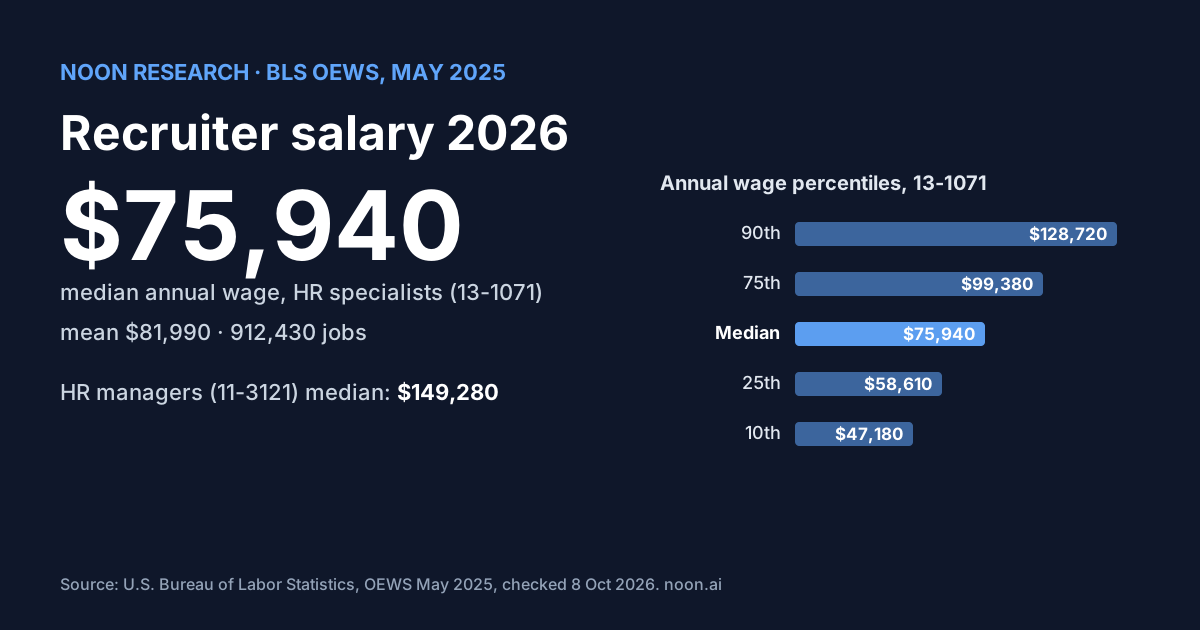
Key takeaway: The median recruiter salary in the US is $75,940 a year ($36.51 an hour), according to the Bureau of Labor Statistics' Occupational Employment and Wage Statistics (OEWS) for May 2025, the latest release. BLS counts recruiters in occupation 13-1071, Human Resources Specialists, which had 912,430 jobs and a mean wage of $81,990. The lowest-paid 10% earned under $47,180 and the highest-paid 10% over $128,720. Recruiting leaders sit in a separate code: Human Resources Managers (11-3121) had a $149,280 median, about twice the specialist figure.
There is no separate federal occupation called "recruiter". The BLS Occupational Outlook Handbook files recruiters under human resources specialists and says so directly: "Recruitment specialists, sometimes known as recruiters or 'talent acquisition specialists,' find, screen, and interview applicants for job openings in an organization" (BLS Occupational Outlook Handbook, Human Resources Specialists). The OEWS definition of 13-1071 starts with the same job: "Recruit, screen, interview, or place individuals within an organization" (BLS OEWS, 13-1071).
So the BLS figure is the closest thing to an official national recruiter salary, with one caveat that matters: the code also includes HR generalists, which is why we set out the full distribution, the industry and location splits, and the manager code alongside it.
This page uses the BLS pages we rendered on 8 October 2026 and the BLS public data API, which returned the same May 2025 values. If you hire recruiters in one city, our New York recruiter compensation benchmark goes deeper on that market.
How much do recruiters make in 2026?
$75,940 is the median annual wage for the occupation that includes recruiters, and $81,990 is the mean. These are the May 2025 OEWS estimates, the most recent BLS release available on 8 October 2026. The mean sits $6,050 above the median because a tail of high earners pulls the average up.
| Measure (13-1071, May 2025) | Annual | Hourly |
|---|---|---|
| 10th percentile | $47,180 | $22.69 |
| 25th percentile | $58,610 | $28.18 |
| Median | $75,940 | $36.51 |
| Mean | $81,990 | $39.42 |
| 75th percentile | $99,380 | $47.78 |
| 90th percentile | $128,720 | $61.89 |
| Employment | 912,430 jobs |
The 90th percentile is 2.73 times the 10th, so "recruiter salary" covers a wide band. The middle half of the occupation earned between $58,610 and $99,380. On a monthly basis the median works out to about $6,328 before tax; that is our division of the annual figure, not a BLS number.
Which industries pay recruiters the most?
Information and technology employers pay the highest averages; staffing firms employ the most recruiters but pay the lowest medians among the big employers. The highest mean wages for 13-1071 in May 2025 were in narrow, tech-heavy industries:
| Industry (highest mean wage, May 2025) | Mean annual wage |
|---|---|
| Web search portals, libraries, archives and other information services | $142,490 |
| Media streaming, social networks and other content providers | $122,990 |
| Tobacco manufacturing | $115,660 |
| Software publishers | $115,130 |
| Computer and peripheral equipment manufacturing | $114,290 |
Those are narrow industries. Among the five largest employers of HR specialists, the BLS handbook reports these medians for May 2025:
| Large employing industry | Median annual wage | Share of HR specialist jobs |
|---|---|---|
| Government, excluding state and local education and hospitals | $84,100 | 10% |
| Professional, scientific, and technical services | $82,800 | 13% |
| Manufacturing | $79,270 | 7% |
| Healthcare and social assistance | $64,130 | 11% |
| Employment services | $60,550 | 13% |
The gap between government ($84,100) and employment services ($60,550) is $23,550 at the median. Employment services is the single largest OEWS industry for the occupation, with 124,520 jobs or 13.6% of the total. The BLS notes that "some organizations contract recruitment and placement work to outside firms, such as those in the employment services industry." OEWS wages count commissions and production bonuses, so commission-heavy agency pay is captured, but non-production bonuses and profit-sharing are not; see the limitations below. For how recruiter pay feeds into total hiring cost, see our cost-per-hire benchmarks.
Where do recruiters earn the most?
The District of Columbia and Silicon Valley. Mean annual wages for 13-1071 in May 2025:
| Highest-paying states | Mean annual wage | Highest-paying metro areas | Mean annual wage |
|---|---|---|---|
| District of Columbia | $116,020 | San Jose-Sunnyvale-Santa Clara, CA | $122,290 |
| Massachusetts | $95,400 | San Francisco-Oakland-Fremont, CA | $113,530 |
| California | $95,180 | Washington-Arlington-Alexandria, DC-VA-MD-WV | $105,580 |
| New York | $95,040 | Lexington Park, MD | $104,240 |
| Washington | $94,000 | Boulder, CO | $99,420 |
The San Jose metro mean is 49.2% above the national mean of $81,990, and the District of Columbia's is 41.5% above it. The largest numbers of jobs are elsewhere: California (104,000), Texas (84,930), Florida (62,730), New York (54,610) and Pennsylvania (36,960) employ the most HR specialists, and the New York-Newark-Jersey City metro alone has 52,370.
How much do recruiting managers and heads of talent make?
$149,280 at the median, about 1.97 times the specialist median. BLS puts people who plan and direct the HR function, including many recruiting managers and talent acquisition leaders, in 11-3121 Human Resources Managers. May 2025 estimates:
| Measure (11-3121, May 2025) | Annual |
|---|---|
| 10th percentile | $88,200 |
| 25th percentile | $111,110 |
| Median | $149,280 |
| Mean | $164,230 |
| 75th percentile | $199,290 |
| 90th percentile | $267,810 |
| Employment | 220,660 jobs |
The highest-paying states for HR managers were New York ($197,390 mean), Massachusetts ($195,110) and California ($191,920); the highest-paying metro was San Jose at $257,750. Not every head of talent is coded here, and not everyone in 11-3121 runs recruiting, so treat this as the leadership band for the function rather than a title-level salary.
Are recruiter salaries going up?
The published numbers are higher than two years earlier, but BLS warns against reading OEWS as a trend. The May 2023 estimates for 13-1071 were a $67,650 median and a $76,060 mean; May 2025 shows $75,940 and $81,990. That is $8,290 (12.3%) more at the median and 7.8% more at the mean. For HR managers the median moved from $136,350 to $149,280, up 9.5%.
The BLS is explicit that this comparison is rough: "The Bureau of Labor Statistics does not encourage the use of OEWS data for time-series analysis," because classification, methodology and the three-year pooled sample change between releases (BLS OEWS FAQ). Read it as a direction, not a raise benchmark.
Demand for the role is expected to keep growing. BLS projects HR specialist employment to grow 6% from 2025 to 2035, "faster than the average for all occupations," with about 73,700 openings a year. For the hiring side of the labor market these recruiters work in, see our JOLTS job openings vs hires 2026 page and the quits rate by industry.
What does this mean for recruiting teams?
Recruiter time is a real cost, and most of it goes to sourcing and outreach. Three practical reads:
- Benchmark against the percentile, not the median. A senior technical recruiter in San Francisco and a staffing-agency recruiter in a low-cost metro are both in 13-1071. Use the 75th and 90th percentiles ($99,380 and $128,720) and the metro tables for senior or high-cost hires.
- Use the right code for leaders. A head of talent benchmarked against the specialist median will look overpaid by about half; 11-3121 is the closer comparison.
- Price the work, not just the person. At the $36.51 median hourly wage, every hour a recruiter spends hand-searching profiles is a measurable cost. Our time-to-hire benchmarks show how long that cycle runs, and our guide to salary negotiation for recruiters covers the other side of the pay conversation.
How does Noon fit into recruiter workload?
Noon is built to take the sourcing and first-touch outreach off a recruiter's plate so their paid hours go to candidates who are already interested. The AI Sourcer searches the whole web for candidates, not just LinkedIn, evaluates each one against the role's criteria and non-negotiables, and keeps working in the background. Outreach runs as personalized email and SMS sequences, and interested candidates move to scheduling.
Noon is sold as one plan with unlimited sourcing, unlimited email enrichment, unlimited contacts, unlimited agents and unlimited seats, so adding a recruiter to the workspace does not add a seat fee. The plan is quote-based; see Noon pricing for what is included.
Methodology and sources
Methodology. On 8 October 2026 we rendered the BLS OEWS occupation profiles for May 2025 (13-1071 Human Resources Specialists and 11-3121 Human Resources Managers, by employment and by annual mean wage), the Occupational Outlook Handbook pages for both occupations, the May 2023 OEWS occupation pages, and the OEWS FAQ in Chrome through Playwright, and stored the page text and table cells as rendered with their URLs and fetch times in this article's research record. The 13-1071 national figures were cross-checked against the BLS public data API (OEWS series for employment, mean and percentile wages), which returned identical values. Ratios, differences and percentage changes are our arithmetic on BLS figures, not BLS statistics. Demand check: DataForSEO measured 1,000 monthly US searches for "recruiter salary" and 1,600 for "how much do recruiters make" on the same date.
Sources. BLS OEWS profiles, May 2025; BLS Occupational Outlook Handbook, Human Resources Specialists; BLS Occupational Outlook Handbook, Human Resources Managers; BLS OEWS May 2023, 13-1071; BLS OEWS FAQ.
Limitations. 13-1071 is broader than "recruiter": it includes HR generalists and other HR specialists, so the recruiter-only median may differ. OEWS counts only workers paid a wage or salary and does not cover the self-employed, which helps explain why its 912,430 jobs is lower than the handbook's 939,700. OEWS wages include base rates, commissions and production bonuses, but exclude overtime, non-production bonuses, profit-sharing and stock bonuses, so total compensation for some recruiters, especially in tech, can be well above these figures. May 2025 is the reference period, not 2026; the next OEWS release is generally due in late March or early April. The two-year change compares separately published estimates that BLS does not recommend using as a time series. Noon sells recruiting software, and the section on Noon describes our own product, not an independent comparison.
FAQ
What is the average recruiter salary in the US?
The mean annual wage for human resources specialists, the BLS occupation that includes recruiters, was $81,990 in May 2025. The median, the middle earner, was $75,940, or $36.51 an hour.
How much do entry-level recruiters make?
BLS does not publish pay by experience level, but the 10th percentile for 13-1071 was $47,180 and the 25th percentile $58,610 in May 2025, which is where most early-career recruiters fall.
How much do senior or technical recruiters make?
There is no separate BLS code for technical recruiters. The 75th percentile for 13-1071 was $99,380 and the 90th $128,720, and the highest-paying industries were software and information services, with means from $114,290 to $142,490.
Which state pays recruiters the most?
The District of Columbia, with a mean of $116,020 for HR specialists in May 2025, followed by Massachusetts ($95,400), California ($95,180), New York ($95,040) and Washington ($94,000).
How much does a talent acquisition manager make?
Human resources managers (11-3121), the BLS code that covers most HR and recruiting leadership, had a median of $149,280 and a mean of $164,230 in May 2025. The top 10% earned more than $267,810.