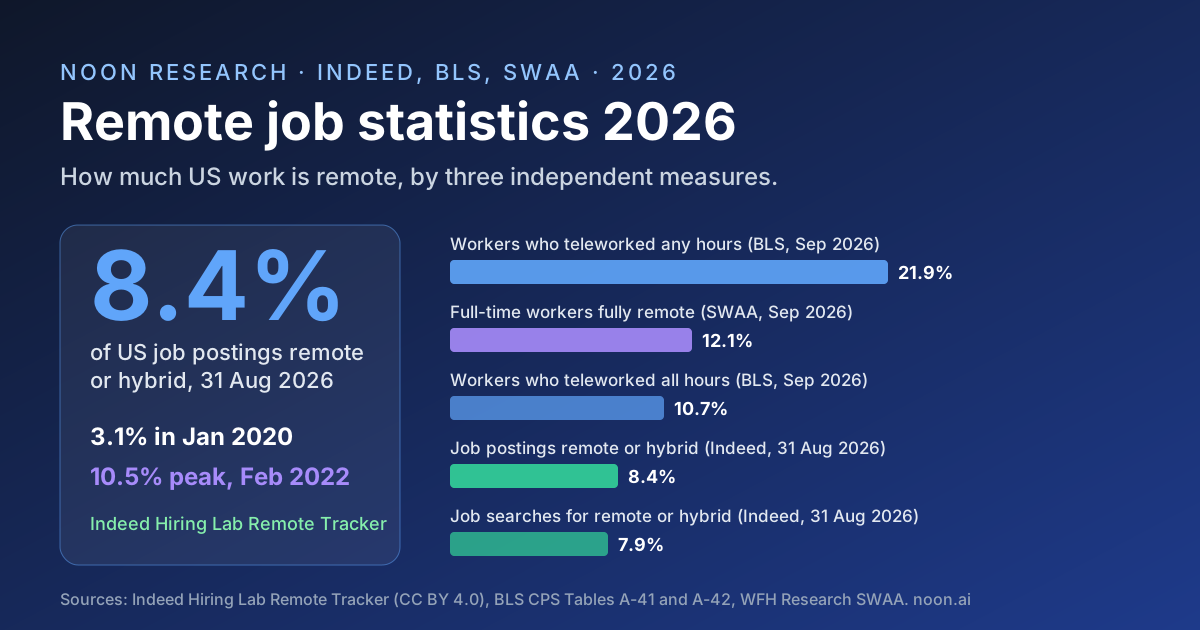
Key takeaway: 8.4% of US job postings on Indeed advertised remote or hybrid work on 31 August 2026, according to the Indeed Hiring Lab Remote Tracker. That is about 2.8 times the 3.1% share in January 2020, but 2.0 points below the 10.5% peak of February 2022, and almost flat on the 8.2% of a year earlier. Remote work is far more common among people already in jobs: the Bureau of Labor Statistics found 21.9% of US workers teleworked in September 2026, and 10.7% teleworked all of their hours.
"What percentage of jobs are remote" has three different answers depending on what you count: new job ads, workers, or workdays. A recruiter writing a job description cares about the first. A workforce planner cares about the second. This page sets out all three from the primary sources, using data we pulled on 9 October 2026, and shows where they disagree.
The three datasets are the Indeed Hiring Lab Remote Tracker (job postings and searches), the BLS Current Population Survey telework tables (workers), and the WFH Research Survey of Working Arrangements and Attitudes (workdays and arrangements). None of it is Noon data.
What percentage of jobs are remote in 2026?
8.4% of new US job postings mention remote, hybrid or flexible work, on a seven-day trailing average to 31 August 2026, the latest point in Indeed's dataset. Indeed counts a posting as remote when its title or description includes keywords tied to those arrangements, such as "remote work", "flexible work" or "hybrid role". So the 8.4% is a remote-or-hybrid share of ads, not a fully remote share.
| Indeed US remote or hybrid share of postings | Share |
|---|---|
| 31 January 2020 (pre-pandemic) | 3.1% |
| 31 January 2021 | 7.3% |
| 31 January 2022 | 10.2% |
| 26 February 2022 (series peak) | 10.5% |
| 31 January 2023 | 9.3% |
| 31 January 2024 | 8.8% |
| 31 January 2025 | 8.4% |
| 31 August 2025 | 8.2% |
| 31 January 2026 | 8.8% |
| 31 August 2026 (latest) | 8.4% |
The pattern is a jump, a peak and a plateau. The annual average share was 2.6% in 2019, 9.9% in 2022, 8.7% in 2023 and 8.2% in both 2024 and 2025. The January to August 2026 average is 8.7%. Remote and hybrid ads have held at roughly one in twelve US postings for three years.
Is remote work declining in 2026?
Not in job postings: the US remote or hybrid share rose 0.2 points year on year, from 8.2% on 31 August 2025 to 8.4% on 31 August 2026. It has drifted between those levels since 2024 rather than falling back toward pre-pandemic rates.
Job seekers' interest moved faster than employers' supply. The share of Indeed job searches for remote or hybrid work was 7.9% on 31 August 2026, up from 6.8% a year earlier, though below its 10.2% peak in January 2023.
The worker-side surveys tell a similar story of stability. BLS put the telework rate at 21.9% in September 2026 against 22.3% in September 2025, and every 2026 month so far has fallen between 21.6% and 23.0%. WFH Research measured 26.8% of full paid workdays done from home in September 2026, against 26.6% a year earlier and 7.2% in 2019.
Which jobs have the most remote postings?
Insurance, legal, mathematics and software development roles have the highest remote or hybrid shares, at 30% to 40% of postings. Hands-on and customer-facing work is close to zero. These are Indeed's occupational categories for US postings on 31 August 2026.
| Job category (Indeed, US) | Remote or hybrid share, 31 Aug 2026 | 31 Aug 2025 | Change (points) |
|---|---|---|---|
| Insurance | 39.7% | 36.1% | +3.6 |
| Legal | 32.9% | 32.8% | +0.1 |
| Mathematics | 32.4% | 30.5% | +1.9 |
| Software development | 30.8% | 33.7% | -2.9 |
| IT operations and helpdesk | 30.1% | 32.1% | -2.0 |
| Information design and documentation | 27.5% | 31.1% | -3.6 |
| Marketing | 25.2% | 26.1% | -1.0 |
| Banking and finance | 23.4% | 24.8% | -1.4 |
| Accounting | 21.5% | 21.6% | -0.1 |
| Human resources | 20.8% | 20.6% | +0.3 |
| Sales | 15.0% | 15.6% | -0.5 |
| Physicians and surgeons | 11.8% | 9.2% | +2.5 |
| Customer service | 6.2% | 6.4% | -0.2 |
| Construction | 3.9% | 3.6% | +0.4 |
| Retail | 1.9% | 3.6% | -1.6 |
| Driving | 1.2% | 1.3% | -0.1 |
Changes are computed from Indeed's unrounded values, so a few differ by 0.1 from the rounded columns.
Tech roles are the notable movers. Software development fell from 33.7% to 30.8% and information design and documentation from 31.1% to 27.5%, so the categories most associated with remote work are offering it less often. If you recruit engineers, our 2026 tech job market overview covers the wider hiring picture.
What percentage of workers work remotely?
21.9% of US workers teleworked at least some of their hours in September 2026, or 34.7 million of the 158.5 million people at work, according to BLS Table A-41. The group splits almost evenly: 10.7% of workers teleworked all of their hours and 11.2% teleworked some of them. Teleworkers worked 15.0% of all hours worked that month.
WFH Research's monthly survey adds the arrangement view for full-time wage and salary workers in September 2026:
| Arrangement, full-time workers (SWAA) | Sep 2026 | Sep 2025 |
|---|---|---|
| Fully on site | 57.9% | 60.1% |
| Hybrid | 30.0% | 27.9% |
| Fully remote | 12.1% | 12.0% |
Hybrid gained about two points over the year while fully remote held at 12%. The rise in hybrid is consistent with Indeed counting hybrid and flexible wording in its posting share.
Which occupations and industries telework most?
Computer and mathematical occupations had a 63.7% telework rate in September 2026, and food preparation had 1.4%. These figures come from BLS Table A-42 and describe workers, not job ads.
| Occupation or industry (BLS, Sep 2026) | Telework rate |
|---|---|
| Computer and mathematical occupations | 63.7% |
| Business and financial operations occupations | 53.8% |
| Legal occupations | 50.6% |
| Finance and insurance (industry) | 57.6% |
| Professional and technical services (industry) | 56.9% |
| Information (industry) | 53.5% |
| Manufacturing (industry) | 19.2% |
| Health care and social assistance (industry) | 17.4% |
| Retail trade (industry) | 10.4% |
| Accommodation and food services (industry) | 4.2% |
| Construction and extraction occupations | 2.2% |
| Food preparation and serving related occupations | 1.4% |
The ranking matches Indeed's: finance, insurance, legal and tech lead in both, and on-site trades trail in both. The levels differ because BLS counts anyone who worked from home for any hours, while Indeed counts ads that mention remote or hybrid terms.
Why is the share of remote jobs lower than the share of remote workers?
The BLS telework rate (21.9%) is about 2.6 times Indeed's remote or hybrid posting share (8.4%). Three things explain most of the gap:
- Stock versus flow. BLS measures everyone employed; Indeed measures new ads. Roles that went remote in 2020 and 2021 stay in the worker count without being re-advertised.
- Informal flexibility. A worker who sometimes works from home counts as teleworking for BLS, even if the job ad never mentioned it. Many employers agree flexibility after the offer rather than advertising it.
- Turnover mix. High-turnover sectors such as retail, food service and health care post many ads and have low remote shares, which pulls the posting average down.
For recruiters, the practical point is that remote or hybrid wording is still a minority feature of US ads, so it remains a differentiator in categories where it is rare. It also widens the applicant pool, which brings more screening work: see our guide to detecting fake job applicants in remote roles.
How does the US compare with other countries?
The US has the lowest remote or hybrid posting share of the seven countries Indeed tracks in this dataset.
| Country (Indeed) | Remote or hybrid share, 31 Aug 2026 | 31 Aug 2025 |
|---|---|---|
| Ireland | 17.6% | 16.7% |
| United Kingdom | 16.3% | 15.1% |
| Germany | 14.2% | 14.9% |
| Canada | 13.3% | 13.8% |
| Australia | 12.7% | 12.9% |
| France | 11.8% | 11.1% |
| United States | 8.4% | 8.2% |
Ireland and the UK rose over the year; Germany, Canada and Australia slipped. Cross-country comparisons depend on local wording and Indeed's market share in each country, so treat the gaps as directional.
What do remote job statistics mean for recruiters?
Use the posting share to calibrate job ads. In software development, insurance, legal or mathematics roles, roughly a third of competing ads mention remote or hybrid work, so omitting your arrangement is a visible gap. In sales, customer service and most on-site trades, a remote or hybrid option still sets an ad apart.
Remote and hybrid roles also stretch the reachable talent pool well past one commuting radius, which makes structured sourcing matter more. Passive sourcing helps shortlist candidates who are not scanning job boards, and the broader labor-market backdrop is in our analyses of job openings versus hires and quits rates by industry. If you are budgeting a recruiting team, our recruiter salary benchmark uses the same BLS methods.
Noon is an autonomous AI recruiting platform that sources, evaluates, ranks and contacts candidates by email and SMS, so a remote search across many locations runs as one workflow. Noon has a single plan with unlimited sourcing, enrichment, contacts, agents and seats; see pricing for details.
Methodology and sources
- Indeed Hiring Lab Remote Tracker. We cloned the public dataset from github.com/hiring-lab/remote-tracker on 9 October 2026 (CC BY 4.0). Indeed defines the series as "the share of remote/hybrid job postings and searches on Indeed, as a percentage of total (remote AND non-remote) job postings and searches, using a seven-day trailing average." Latest date: 31 August 2026. Annual averages are our means of the daily series.
- BLS Current Population Survey. Telework rates come from Table A-41 and Table A-42 for September 2026, rendered on 9 October 2026, and from the BLS public data API (series LNU0201B46B, LNU0201B8A1 and LNU0201BE23). BLS defines the telework rate as people who telework or work at home for pay as a percentage of those employed and at work in the survey week. Estimates are not seasonally adjusted.
- WFH Research SWAA. Monthly time series, release of September 2026, downloaded on 9 October 2026 from wfhresearch.com. The survey samples 2,500 to 10,000 US residents aged 20 to 64 each month; the work-from-home rate uses respondents who earned $10,000 or more in the prior year, reweighted to match the CPS.
Every figure on this page, with the exact source quote and fetch time, is recorded in our research file for this article, alongside the script that computes the derived numbers (year-on-year changes, annual averages, the 2.6 ratio and the 2.8 multiple).
Limitations
- Indeed's posting share is based on keyword matching, so it mixes fully remote, hybrid and flexible ads and can miss ads that offer remote work without using the keywords.
- Indeed postings are not all US job ads, and the sector names in our table are our labels for Indeed's category codes.
- The three sources cover different dates: Indeed to 31 August 2026, BLS and SWAA to September 2026.
- BLS monthly telework figures are not seasonally adjusted, so compare the same month across years.
- SWAA is an online panel survey; its arrangement shares cover full-time wage and salary workers only.
FAQ
What percentage of jobs are remote in 2026?
8.4% of US job postings on Indeed advertised remote or hybrid work on 31 August 2026. That compares with 3.1% in January 2020 and a 10.5% peak in February 2022.
What percentage of US workers work from home?
21.9% of US workers teleworked at least some hours in September 2026, per BLS, and 10.7% teleworked all of their hours. WFH Research found 12.1% of full-time workers were fully remote and 30.0% hybrid.
Are remote jobs going away?
The data does not show that. The remote or hybrid share of US postings was 8.4% on 31 August 2026, against 8.2% a year earlier, and the BLS telework rate has stayed between 21.6% and 23.0% in every month of 2026.
Which industries have the most remote jobs?
In Indeed postings, insurance (39.7%), legal (32.9%), mathematics (32.4%) and software development (30.8%) lead. Among workers, BLS reports the highest telework rates in computer and mathematical occupations (63.7%) and the finance and insurance industry (57.6%).
Why do remote job postings show a lower share than remote workers?
Postings measure new ads, while BLS measures everyone employed. Many existing employees telework informally or kept arrangements set in 2020 and 2021, and high-turnover on-site sectors post a large share of ads.