
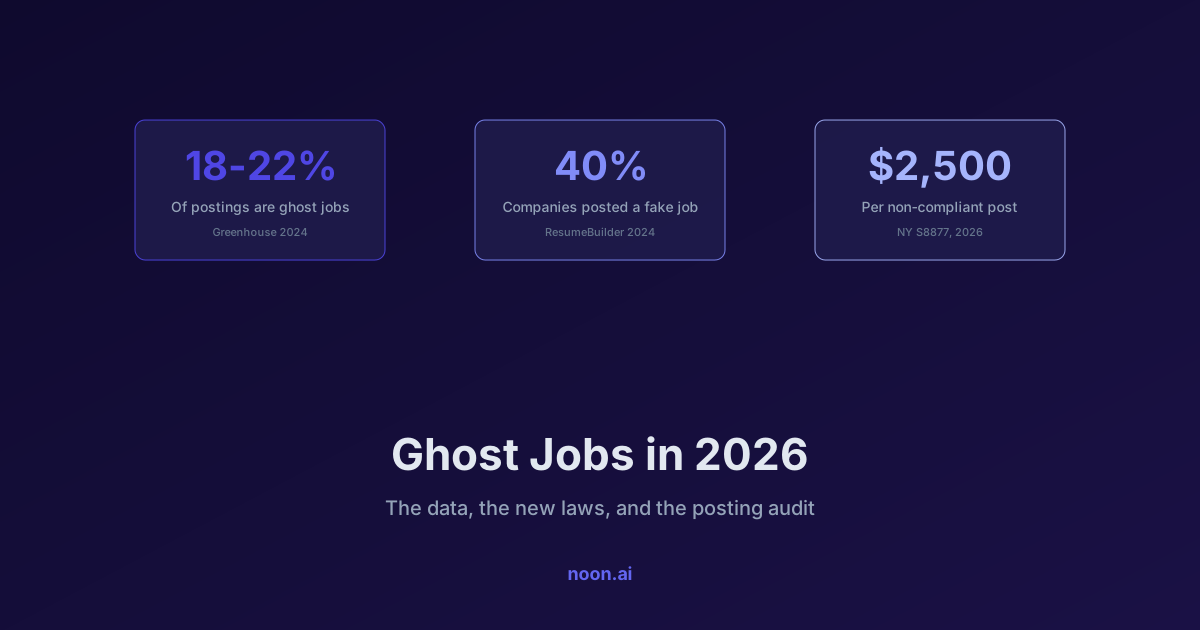
Key takeaway: A ghost job is a public posting for a role the employer is not actively filling. In any given quarter, 18–22% of jobs posted on the Greenhouse platform are classified as ghost jobs (Greenhouse, December 2024), and 40% of hiring managers say their company posted a fake listing in the past year (ResumeBuilder, June 2024). That practice is now becoming a compliance problem: on 2 June 2026 the New York legislature passed S8877, which would require timing disclosures on postings and fine employers $2,500 per non-compliant advertisement (HR Dive, 11 June 2026).
Ghost jobs stopped being a job-seeker complaint and became an employer risk sometime in 2026. The behaviour is measurable, legislatures have written the measurements into bill findings, and the first penalties are drafted.
Most coverage of the topic is written for candidates: how to spot a fake listing, how not to waste an application. This guide is written for the people who publish postings — what the data actually says, what the new statutes require, and the posting hygiene audit that keeps a talent team out of both the news and the fine schedule. It sits alongside our broader hiring best practices guide, which covers the fundamentals of building compliant, effective recruiting processes.
What is a ghost job?
A ghost job (also called a fake or phantom job posting) is a publicly advertised role that the employer is not actively working to fill. In practice it covers four distinct situations, and only one of them is deliberate deception:
- Never-real postings — advertised roles that were never budgeted or approved.
- Already-filled postings — real roles, filled weeks ago, never taken down.
- Evergreen pipeline postings — "always open" listings used to collect résumés for anticipated future demand.
- Frozen requisitions — real roles that were approved, then quietly paused by a hiring freeze while the ad stayed live.
Categories 2 and 4 are the ones most talent teams are guilty of, and they are the easiest to fix. Categories 1 and 3 are the ones legislators are targeting.
How common are ghost jobs?
Three independent measurements, each with a different methodology, converge on "a meaningful minority of listings":
| Finding | Figure | Source |
|---|---|---|
| Share of postings on the Greenhouse platform classified as ghost jobs, per quarter | 18–22% | Greenhouse 2024 State of Job Hunting report (Dec 2024) |
| Hiring managers whose company posted a fake listing in the past year | 40% | ResumeBuilder survey of 1,641 hiring managers (May 2024) |
| Companies with an active fake listing at time of survey | 3 in 10 | ResumeBuilder, May 2024 |
| Candidates who suspect they have encountered a ghost job | 3 in 5 | Greenhouse, Dec 2024 |
The rate is not uniform across industries. Greenhouse's analysis of Q2 2024 postings found construction highest at 38%, art at 34%, legal at 29%, and corporate services near 31% (reported by Fox 9, January 2025).
Three caveats worth stating plainly, because most articles on this topic skip them. First, "40% of companies posted a fake job" is not the same as "40% of listings are fake" — the ResumeBuilder respondents reported wildly different volumes, from one to three listings (26% of them) up to 75 or more (13%). Second, the Greenhouse figure is a platform-specific classification of postings that produced no hire, which sweeps in frozen and cancelled requisitions alongside deliberate fakes. Third — and this is the Congressional Research Service's own caution — most of the widely quoted surveys and analyses come from firms that sell hiring-related services (CRS, "Ghost" Job Postings, 25 April 2025). Treat every figure in the table above as directional.
Why do employers post ghost jobs?
The stated motivations in the ResumeBuilder survey are uncomfortable reading, and they explain why the practice persists despite the reputational cost:
- Signalling growth to investors, customers, and the market.
- Managing internal morale — showing overworked employees that relief is coming.
- Applying pressure — making current staff feel replaceable.
- Pipeline building — collecting résumés for roles expected later.
Seven in ten hiring managers in that survey said they consider the practice morally acceptable. That is the number to keep in mind when assessing whether your own organisation has a policy problem rather than an operational one.
Only the fourth motivation — pipeline building — reflects a real recruiting need, and it is the one with a legitimate alternative. Building a warm candidate pool does not require a public posting at all; outbound sourcing does the same job without advertising a vacancy that does not exist. That distinction is exactly what the new statutes are drawing.
Are ghost jobs illegal?
Not yet, in most of the United States — but the direction of travel is unambiguous, and New York is the furthest along.
New York S8877 was passed by state lawmakers on 2 June 2026 and awaits the governor's signature — it is not law yet. It would apply to employers with 100 or more employees and to third-party job posting platforms (HR Dive, 11 June 2026). Its requirements:
| Situation | Required disclosure (bold, capital letters) |
|---|---|
| Position to be filled within 90 days | Statement that it is a current vacancy, with the intended fill date |
| Position to be filled after 90 days | Statement that it will be filled "no sooner than" a specified date |
| No expectation the job will be filled | Statement that there is no current vacancy and the employer is collecting résumés for future openings |
The bill also requires postings to be removed within two weeks of the role being filled, and requires employers to notify third-party platforms that posted the role independently. Penalties start at $2,500 per non-compliant advertisement, rising to $5,000 if not corrected within 30 days and doubling for each subsequent 30-day period (HR Dive, 11 June 2026).
New Jersey is considering companion bills A1161 and S2136, reported out of committee with amendments in May 2026. The New Jersey version is stricter in one respect: an employer may only run an "anticipated vacancy" posting if it has listed the same position at least three times, or hired at least four people into similar roles, in the preceding 18 months — and such a posting expires after 120 days. Its penalties are far smaller than New York's: after a seven-business-day window to rectify, not more than $300 for a first offence and $600 for a subsequent one (New Jersey A1161, as amended).
At the federal level there is attention but no statute. The Congressional Research Service published a primer on the practice in April 2025, and in June 2026 Senator Ruben Gallego wrote to the Department of Labor and the Federal Trade Commission asking them to investigate how widespread ghost jobs are and what enforcement tools exist against deceptive job ads (Fortune, 18 June 2026).
One popular claim deserves correcting here, because recruiting commentary repeats it constantly: ghost jobs are not what is inflating the official job-openings numbers. The BLS JOLTS survey counts an opening only if a specific position exists, work is available, the job could start within 30 days, and the employer is actively recruiting — and JOLTS responses are confidential, which removes the signalling incentive entirely. CRS's conclusion is that if employers answer honestly, JOLTS openings are unlikely to be ghost jobs (CRS, April 2025). The distortion is in job-board listing counts, not in the federal statistics.
Practically: if you are a multi-state employer with 100+ headcount, assume disclosure-and-takedown obligations are coming to your largest markets within the next two legislative cycles, and that "we forgot to close the req" will not be a defence.
What do ghost jobs cost the employer that posts them?
The compliance exposure is new. The recruiting cost has always been there.
They poison your application data. A stale posting keeps collecting applicants, which inflates applications-per-req and buries live roles in the same queue. Recruiter workload at Greenhouse-platform companies rose 26% in a single quarter as AI-assisted mass applying took hold (Greenhouse, December 2024) — adding phantom volume to that is expensive.
They degrade candidate trust at exactly the wrong moment. Three in five candidates already suspect they have hit a ghost job, and 61% report being ghosted after an interview — nine percentage points worse than eight months earlier (Greenhouse, December 2024). The suspicion is well founded: among companies that admitted posting fake listings, 85% said applicants to those listings were actually interviewed (ResumeBuilder, May 2024). Candidates are not imagining the wasted afternoons. Once a candidate categorises your brand as a time-waster, your outbound messages to that person are dead too. Our guide to improving candidate experience covers the downstream effect on offer acceptance.
They hide the real bottleneck. Teams that fill roles slowly often keep postings live as a hedge. But median time-to-fill for nonexecutive roles is 39 calendar days in 2026, down from 44 in 2025 (SHRM 2026 recruiting benchmarking) — if your reqs stay open far longer than that, the answer is diagnosing the funnel, not leaving the ad up. Our time-to-hire benchmarks break down where the days actually go.
How should a recruiting team audit its postings?
A quarterly posting audit takes an afternoon and eliminates most accidental ghost jobs. Six checks:
- Reconcile live postings against approved requisitions. Anything advertised without an open, funded req comes down today.
- Check the fill date on every closed role. If the hire started and the ad is still up, you already fail the New York two-week rule.
- List every third-party platform your ATS syndicates to, and confirm that closures propagate. Job boards copy postings automatically, so a listing you removed at source can stay live elsewhere — a failure mode CRS explicitly identifies as an unintentional source of ghost jobs. Under S8877 you would be obliged to notify those platforms.
- Flag frozen requisitions explicitly. A hiring freeze should trigger either a takedown or a disclosure, never silence.
- Set a maximum posting age — 90 days is a defensible default, and matches the disclosure threshold in the New York bill.
- Kill "evergreen" reqs that have produced no hire in 12 months. If you need the pipeline, build it outbound instead of advertising a vacancy that does not exist.
Check five is the one that catches most organisations. Job boards do not expire postings on your schedule; our guide to job posting sites covers how the syndication chain works and which boards refresh from your ATS.
What replaces a pipeline-building ghost job?
The honest use case behind evergreen postings — "we want a warm pool of candidates for roles we expect in Q4" — is a sourcing problem, not an advertising problem. Outbound sourcing builds the same pool without publishing a vacancy that does not exist, and it produces better candidates, because you choose who enters the pool rather than waiting to see who applies.
At Noon, that is what the AI sourcer does continuously: it searches across the open web rather than a single job board, evaluates each profile against the role's criteria including non-negotiables it never relaxes, and keeps monitoring for people who enter the market after your first pass — so the pool stays current without a live posting collecting applications for a role that is not open. Outreach runs from the same system, which means the pool is warm rather than a spreadsheet of names. Teams auditing postings for ghost job risk can book a demo to see the evergreen posting alternative in action.
For teams making the shift from posting-led to outbound-led hiring, our comparison of outbound vs. inbound recruiting covers how the mix usually settles, and our recruiting outreach benchmarks give the reply rates to plan against — 16.6% of contacted candidates replied across 844,234 sequences in the last twelve months.
FAQ
What counts as a ghost job? A public posting for a role the employer is not actively filling. That includes never-approved roles, filled roles whose ads were never removed, frozen requisitions, and permanent "evergreen" listings used to collect résumés. Under New York's S8877, the third and fourth categories would remain legal but would require an explicit disclosure that there is no current vacancy.
What percentage of job postings are fake? Platform data from Greenhouse puts it at 18–22% of postings per quarter (December 2024), with construction highest at 38%. Survey data from ResumeBuilder measures a different thing — the share of companies, not postings — and found 40% of hiring managers said their company posted a fake listing in the past year (May 2024).
Is it illegal to post a job you don't intend to fill? Not currently in most jurisdictions, and New York's bill is passed but not yet signed. S8877, passed 2 June 2026 and awaiting the governor's signature, would require disclosure of hiring intent and timing for employers with 100+ employees, with penalties starting at $2,500 per non-compliant post. New Jersey is considering similar bills (A1161/S2136).
How long can a job posting stay up? There is no general limit today. New York's bill would require removal within two weeks of the position being filled, and New Jersey's version would expire anticipated-vacancy postings after 120 days. A 90-day internal maximum keeps you inside both.
Do ghost jobs distort the official job numbers? Probably not the federal ones. BLS counts a JOLTS opening only when a specific position exists, work is available, it could start within 30 days, and the employer is actively recruiting; responses are confidential, so the signalling motive disappears. CRS concludes that honestly answered JOLTS data is unlikely to contain ghost jobs (CRS, April 2025). Job-board listing counts are a different matter — and Senator Gallego asked DOL and the FTC to examine the question in June 2026 (Fortune).
How do we build a candidate pipeline without an evergreen posting? Source outbound. A continuously running sourcing agent maintains a pool of evaluated, contactable candidates for anticipated roles without advertising a vacancy — and unlike an inbound résumé pile, the pool is selected against your criteria rather than self-selected. See our guide to passive sourcing.