Key takeaway: The best AI recruiting tool is the one that removes your biggest bottleneck, and in 2026 that bottleneck is usually recruiter hours, not search quality. Top picks by category: Noon (autonomous agent for sourcing, outreach, and scheduling), Gem (CRM plus sequences), Ashby (AI-enhanced ATS), hireEZ and SeekOut (recruiter-operated search), Juicebox (natural-language search with add-on agents), and Paradox (conversational AI for high-volume hiring). Talent acquisition pros already using generative AI report saving about 20% of their workweek (LinkedIn Future of Recruiting, 2025); the tools below differ in how much of that week they take over.
The AI recruiting market has moved from "does it have AI" to "what does the AI actually do for me." Buyers now ask harder questions: does it reduce time-to-hire, does it improve candidate quality, and does it pay for itself within a quarter? For the wider picture of recruiting platforms, see our guide to recruiting tools.
The pressure behind those questions is workload. Gem's 2025 Recruiting Benchmarks, drawn from 140 million applications and 1.3 million hires, found the average recruiter now carries 14 open requisitions and 2,500+ applications, while average team size fell from 31 to 24 between 2022 and 2024 (Gem, 2025). LinkedIn's 2025 Future of Recruiting report found 37% of TA professionals were experimenting with or actively integrating generative AI into hiring. The teams getting the largest gains apply AI to whole workflows (sourcing, outreach, scheduling) rather than to single tasks like writing job descriptions.
How we categorized these tools
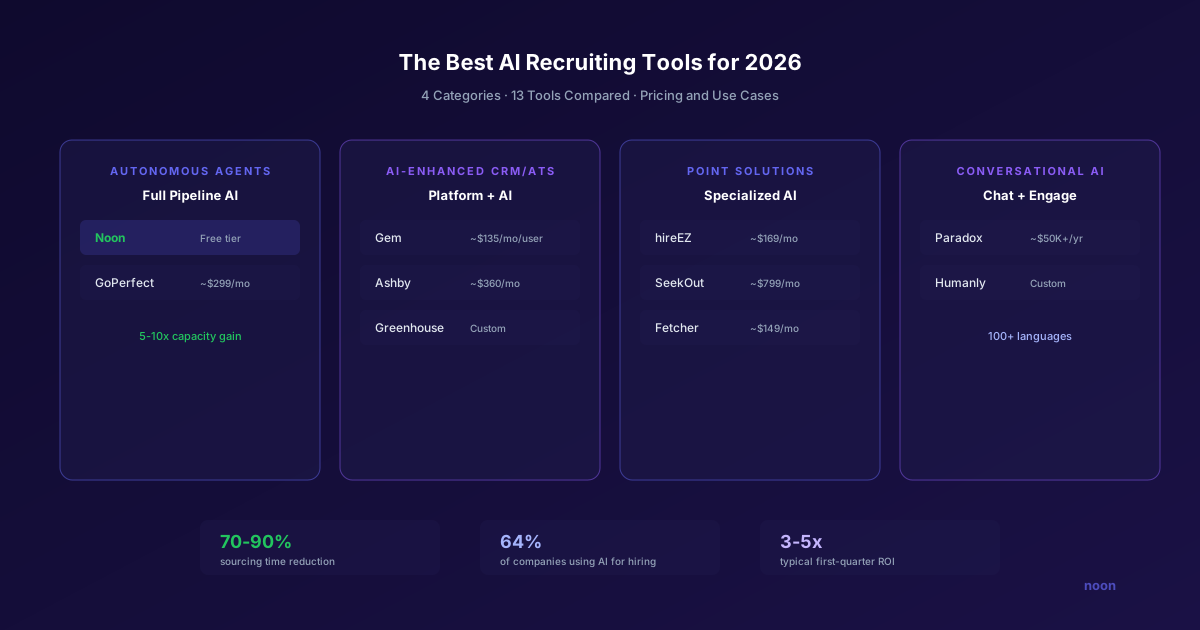
AI recruiting tools fall into four categories. Most vendors claim to do everything, but each has a center of gravity.
Category 1: Autonomous AI agents. Run the recruiting workflow from sourcing to scheduling with limited human intervention. The recruiter describes the role, reviews candidates, and handles conversations.
Category 2: AI-enhanced CRM/ATS platforms. Recruiting systems of record that have added AI features. The platform manages the workflow; AI accelerates specific steps.
Category 3: Point-solution AI tools. Specialized tools that apply AI to one function, most often search.
Category 4: Conversational AI. Chatbots and assistants that handle candidate engagement: answering questions, pre-screening, and scheduling.
Prices below were read from each vendor's public pricing page on 28 September 2026. Where a vendor does not publish a price, we say so rather than guess.
What are the best AI recruiting tools by category?
Autonomous AI agents
Noon: Full-pipeline recruiting agent. Noon's AI Sourcer searches across the open web (not just LinkedIn), evaluates candidates against role criteria with strict non-negotiables, and calibrates from thumbs-up/down feedback. It then runs personalized email and SMS sequences and books interviews through a Calendly-integrated AI Coordinator, synced to 20+ ATS platforms. The recruiter's role shifts from execution to review and conversations. Pricing: one quote-based plan with unlimited sourcing, contacts, email enrichment, agents, and seats; see how Noon pricing works. Best for: teams whose bottleneck is recruiter hours. You can book a demo to see the workflow run on one of your open roles.
GoPerfect: Autonomous sourcing, resume screening, and outreach sequences, packaged by company size (its Growth tier covers companies of 250-2,000 employees). Pricing: quote-based via demo. Best for: growing companies that want an agent sold as a tiered package.
AI-enhanced CRM/ATS platforms
Gem: CRM-first platform with AI sourcing agents, AI-personalized outreach, rediscovery, analytics, and scheduling, sold as Standard or AI-powered seats alongside your ATS or as an all-in-one. Pricing: the Gem Startup Program lists $130 a month billed yearly for companies with 1-10 employees; larger teams are quoted. Best for: mid-to-large teams that want CRM and sequencing in one place.
Ashby: Modern all-in-one ATS with native analytics, scheduling, and AI features such as candidate matching and automated stage transitions. Pricing: the Foundations plan (up to 100 employees) is priced by headcount band on Ashby's calculator, which showed $400 a month in the view we read, with 10% off annual commitments; Plus and Enterprise are quoted. Best for: teams that want best-in-class analytics in their ATS.
Lever: ATS and CRM hybrid with relationship management, nurture campaigns, and internal mobility. Pricing: quote-based. Best for: relationship-driven recruiting teams.
Greenhouse: Market-leading ATS for structured hiring: scorecards, interview kits, approvals, and compliance tooling, with AI-assisted sourcing and scheduling features. Pricing: quote-based. Best for: process-driven teams that prioritize structured hiring.
Point-solution AI tools
hireEZ: AI-powered search across a broad profile index with outreach automation and an AI Boolean builder. Pricing: solo recruiters start at $494 a month with a 7-day free trial; enterprise pricing is configured to the stack it replaces. Best for: high-volume sourcing by recruiters who run their own searches.
SeekOut: 1B+ profile search with power filters, inferred security clearance, advanced diversity filters on team tiers, and AI multi-step campaigns. Pricing: Recruit Core $149 a month billed annually or $179 monthly, 500 contact credits a month, 14-day free trial. Best for: technical, cleared, and diversity-focused sourcing. See our Noon vs SeekOut comparison.
Juicebox: Natural-language people search (formerly PeopleGPT) with email outreach and add-on agents that can auto-email or auto-shortlist. Pricing: Starter $99 and Growth $179 per seat a month billed yearly, plus $199 a month per agent. Best for: individual recruiters who want fast, flexible search. See Noon vs Juicebox.
Fetcher: Curated candidate batches with recruiter feedback loops, plus self-sourcing and, on its top tier, a dedicated sourcer. Pricing: Self-serve from $115 a month, Growth $379, Amplify $649, Enterprise quoted. Best for: teams that want sourced batches with a human-assisted option.
Findem: Attribute-based talent search and market analytics for sizing talent pools. Pricing: quote-based. Best for: enterprise teams needing granular targeting and market intelligence.
Eightfold AI: Enterprise talent intelligence covering external recruiting, internal mobility, and workforce planning. Pricing: quote-based, enterprise contracts. Best for: large enterprises wanting one talent intelligence layer.
Conversational AI
Paradox (Olivia): Conversational AI for high-volume hiring that handles screening, scheduling, FAQs, and application collection over text and web chat. Pricing: quote-based. Best for: retail, hospitality, healthcare, and other hourly hiring at scale.
Humanly: Conversational screening and engagement with automatic scheduling for candidates who pass. Pricing: quote-based. Best for: mid-market teams wanting chatbot screening.
How do the top AI recruiting tools compare side by side?
| Tool | Category | What the AI does | Published entry price | Best for |
|---|---|---|---|---|
| Noon | Autonomous agent | Sourcing, evaluation, email/SMS outreach, scheduling | Quote-based, unlimited plan | Recruiter capacity |
| GoPerfect | Autonomous agent | Sourcing, screening, outreach | Quote-based | Growing companies |
| Gem | AI-enhanced CRM | Sourcing agents, outreach, analytics | $130/mo yearly (1-10 FTE) | CRM-integrated workflow |
| Ashby | AI-enhanced ATS | Analytics, automation | $400/mo shown (Foundations, by headcount) | Data-driven teams |
| Lever | AI-enhanced CRM+ATS | Relationship management | Quote-based | Nurture-focused teams |
| Greenhouse | AI-enhanced ATS | Structured hiring | Quote-based | Compliance-first teams |
| hireEZ | Point solution | Search and outreach | $494/mo solo | High-volume sourcing |
| SeekOut | Point solution | Deep search, diversity filters | $149/mo yearly | Technical and D&I hiring |
| Juicebox | Point solution | Natural-language search, add-on agents | $99/seat/mo yearly | Individual recruiters |
| Fetcher | Point solution | Curated batches | From $115/mo | Feedback-loop sourcing |
| Findem | Point solution | Talent intelligence | Quote-based | Enterprise analytics |
| Eightfold | Point solution | Talent intelligence | Quote-based | Enterprise talent platform |
| Paradox | Conversational AI | High-volume engagement | Quote-based | Hourly hiring at scale |
| Humanly | Conversational AI | Screening, engagement | Quote-based | Mid-market engagement |
How to choose
If your biggest problem is sourcing capacity: autonomous AI agents (Noon, GoPerfect). They save the most time because they take over the steps that repeat on every search: finding, screening, contacting, and following up.
If you need a system of record with AI features: AI-enhanced platforms (Gem, Ashby, Greenhouse, Lever). These are CRM or ATS first, AI second. Choose based on the workflow stage that matters most.
If you need best-in-class search that recruiters drive: point solutions (hireEZ for breadth, SeekOut for technical and diversity filters, Juicebox for natural-language search, Fetcher for curated batches, Findem for analytics).
If you're hiring hourly workers at scale: conversational AI (Paradox for very high volume, Humanly for mid-volume with screening).
Pricing structure matters as much as price. Most tools in this list meter by seat, and several also meter contact credits or agents. That makes sourcing capacity cost more every time you add a recruiter or a role. Noon's single plan has no seat, agent, or contact limits, so compare total cost at your real headcount and role count, not the entry price.
What to ask in vendor demos
- "Show me a live search for one of our actual open roles." Not a pre-built demo. See how the AI handles your real requirements.
- "How does the AI improve over time?" Tools that learn from recruiter feedback get better with use; static ones don't.
- "Which steps still need a person every week?" Ask the vendor to walk through a week of one requisition and name every manual step.
- "Walk me through the compliance features." Bias auditing, scoring explanations, and data-privacy controls should be standard, not add-ons.
- "What is metered?" Seats, contact credits, exports, agents, mailboxes. Metering decides your real cost more than the headline price.
Related reading
- Best candidate sourcing platforms in 2026
- AI sourcing tools for recruiting
- Why manual sourcing takes all day
- 10 Best Tools That Integrate with BambooHR in 2026
FAQ
Do I need multiple AI tools or one platform? It depends on your hiring complexity. For most teams of 1-20 recruiters, one autonomous platform plus an ATS covers most needs. Enterprise teams with very different hiring types may add specialized tools for specific segments, such as conversational AI for hourly roles.
What ROI should I expect? Measure it in recruiter hours first. LinkedIn's 2025 Future of Recruiting report found TA professionals using generative AI saved about 20% of their workweek. Translate saved hours into roles covered per recruiter and days-to-fill, and ask vendors for the same metrics from customers with a similar hiring mix.
Does the AI send messages automatically, or is there manual input? It varies. Search tools such as SeekOut and Juicebox let recruiters launch AI-written campaigns, and some add agents that can auto-email. Autonomous agents like Noon run email and SMS outreach for the candidates they source, while recruiters set criteria, approve or reject candidates, and take over conversations.
How much time does it take to use an AI recruiting tool well? Expect to invest time up front on each new role: clear criteria and feedback on the first batches. After that, the tool should need less of your week, not more. If recruiters are still rewriting searches weekly, the tool is not learning.
How do I get buy-in from hiring managers? Run a side-by-side on one role: AI-sourced versus traditionally sourced. Share shortlist quality, response rates, and time to first interview with the hiring manager. The comparison makes the case better than a vendor deck.