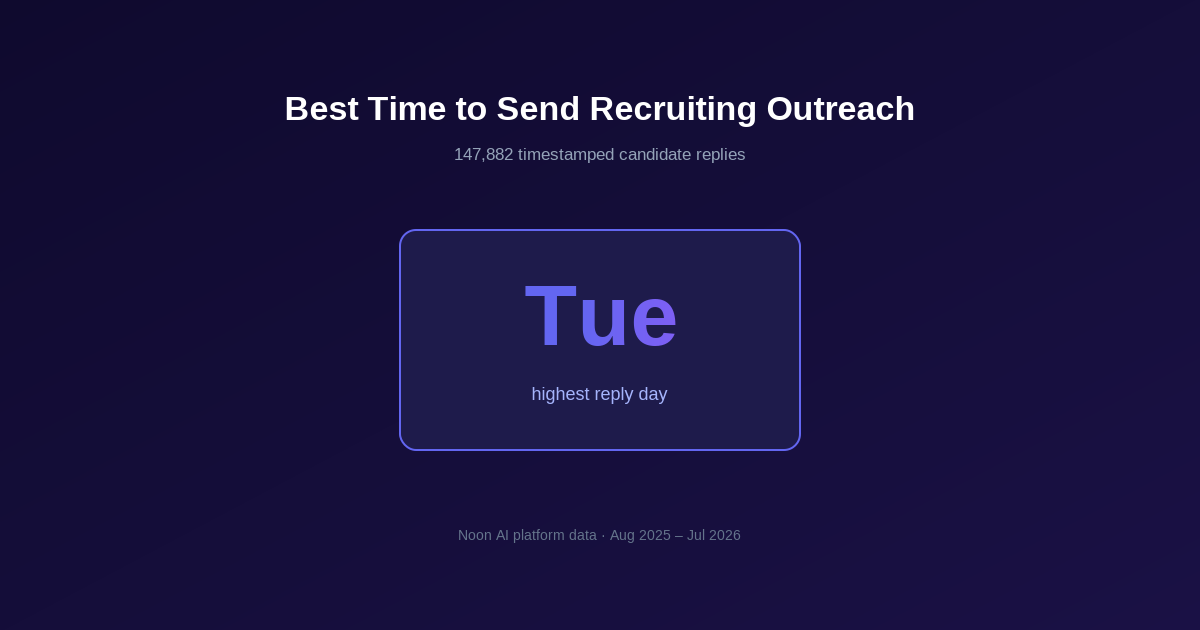
Key takeaway: Candidate replies to recruiting outreach peak on Tuesday, run strong Monday through Thursday, and collapse roughly 77% on weekends, based on 147,882 timestamped replies from the twelve months ending July 2026 (Noon AI platform data). Reply volume is highest in the 9am–2pm US window, 25% of replies arrive within 11 hours of contact, and the median reply takes 2.8 days.
Send timing is the cheapest optimization in outreach: it costs nothing to move a send from Saturday to Tuesday. The constraint on volume has tightened at the same time. Since April 2025, Microsoft has required domains that send more than 5,000 emails a day to Outlook.com addresses to pass SPF, DKIM, and DMARC, routing non-compliant mail to Junk first (Microsoft, April 2025), and Google asks senders to keep reported spam below 0.3% (Google Workspace sender guidelines). Fewer, better-timed sends are the way to stay under those lines.
Here is when candidates actually respond, measured rather than surveyed, plus how to apply it across time zones, follow-ups, and SMS.
What day of the week do candidates reply most?
| Day | Share of replies |
|---|---|
| Monday | 19.5% |
| Tuesday | 19.7% |
| Wednesday | 18.6% |
| Thursday | 17.7% |
| Friday | 16.1% |
| Saturday | 5.3% |
| Sunday | 3.1% |
Tuesday edges out Monday for the top spot, and the Monday–Thursday block accounts for over 75% of all replies. Weekend reply volume runs about 77% below the weekday average. Candidates treat recruiter messages as work items, and work items wait until Monday.
Practical rule: schedule opener messages for Monday–Wednesday so the follow-up cadence (2–4 business days apart) also lands inside the high-response block.
What time of day do candidates reply?
Reply volume climbs steeply from the early morning US time, peaks in the late-morning-to-early-afternoon window (roughly 9am–2pm Eastern), and stays elevated into the evening. The single busiest hour in our data corresponds to lunchtime on the US East Coast: candidates answer recruiters when they get a private moment, not during deep work hours.
Two implications:
- Send in the morning, candidate-local time. A message near the top of the inbox at 9–11am gets the full length of the peak window.
- Evening replies are real. A meaningful share of replies arrives after typical work hours, because candidates reply to recruiters privately. Instant follow-up on those replies matters; a reply that sits until the next morning cools fast.
How long until a candidate replies?
- 25% of replies arrive within 11 hours of the first message.
- The median is 2.8 days.
- 75% arrive within 7.1 days, 90% within 14.2 days.
So a sequence should not be judged, or stopped, early. A candidate who has been silent for a week is still inside the normal reply window, which is why sequences in our data keep following up for two weeks (and why 65% of replies come after message one).
How do you handle candidates in other time zones?
The 9am to 2pm window is measured in US Eastern time. The principle that carries over is local time: a message sent at 9am in New York lands at 6am in San Francisco and 2pm in London, which puts it under a morning's worth of email for the West Coast candidate and near the end of the working day in the UK. Three rules make this manageable:
- Schedule by the candidate's location, not the sender's. Use the city on the candidate's profile as the time-zone source and queue sends for 9 to 11am in that zone.
- Batch by region. Split a multi-region search into one send window per region (Americas, EMEA, APAC) instead of one global blast at the recruiter's start of day.
- Keep follow-ups on business days in the candidate's zone. A Monday follow-up sent from San Francisco on Sunday evening Pacific time arrives in Sydney on Monday afternoon, which is fine; the reverse can land on a Saturday.
Recruiters regularly ask us how to change the time zone for outreach messages, and the answer in most sequencing tools is a per-campaign or per-step send window. Set it once per region and leave it.
How should follow-ups be timed?
Timing compounds across a sequence. In the same dataset, 35.1% of replies come from the first message, 27.0% from the second, and 17.9% from the third, so the follow-ups collectively matter more than the opener (recruiting follow-up benchmarks). Space touches 2 to 4 business days apart, which keeps every message inside the Monday to Thursday block if the opener goes out on a Monday or Tuesday:
| Message | Send on | Why |
|---|---|---|
| 1 | Monday or Tuesday, 9 to 11am local | Highest reply days, full peak window ahead |
| 2 | Thursday or the next Monday | Message two captures 27.0% of replies |
| 3 | About day 7 to 8 | Median reply lands at 2.8 days, so most early repliers are already in |
| 4 | About day 12 to 14 | 90% of replies arrive within 14.2 days |
For the full sequence design, including stop conditions after a reply, see how to automate recruiting outreach.
When should SMS outreach go out?
Text messages follow different rules from email. The US Telephone Consumer Protection Act regulations bar telephone solicitations to residential subscribers before 8am or after 9pm in the recipient's local time (47 CFR 64.1200(c)(1)). Whether a given recruiting text counts as a solicitation is a question for your counsel, but the 8am to 9pm local window is the conservative default most teams adopt for every candidate text. Inside it, use SMS as a follow-up to an unanswered email rather than as the opener, and keep it to one short message with a clear way to opt out.
Does seasonality matter?
Yes. Monthly reply rates in the same dataset ranged from 13.3% in December to 19.7% in March, with January–May the strongest stretch. Plan bigger outbound pushes for late January through May and expect slower replies in the second half of December. Full monthly numbers are in the candidate reply rate benchmarks.
At Noon, the outreach agent runs personalized email and SMS sequences and responds to candidate replies the moment they arrive, and the AI Scheduler books the interview once a candidate says yes. If your bottleneck is the list rather than the send time, start with candidate sourcing strategies.
FAQ
What is the best day to send recruiting emails? Monday through Wednesday. Tuesday sees the highest reply volume (19.7% of all replies), and Monday–Thursday together account for over 75% (Noon AI platform data, 2026).
Should recruiters send outreach on weekends? No. Weekend reply volume runs roughly 77% below weekdays. Queue weekend sends for Monday morning instead.
How quickly do candidates respond to recruiters? A quarter reply within 11 hours, half within 2.8 days, and 90% within two weeks. Keep sequences alive at least 14 days before marking a candidate unresponsive.
What time should recruiters send outreach to candidates in another time zone? Send for 9 to 11am in the candidate's local time, not the recruiter's. Split multi-region searches into one send window per region so Americas, EMEA, and APAC candidates each receive the message at the start of their working day.
How many days apart should recruiting follow-ups be? Two to four business days. The median reply arrives 2.8 days after first contact and 90% arrive within 14.2 days, so a four-message sequence over about two weeks covers almost the whole reply window (Noon AI platform data, 2026).
What hours can recruiters send text messages? Treat 8am to 9pm in the candidate's local time as the outer limit. US TCPA rules bar telephone solicitations outside that window (47 CFR 64.1200(c)(1)); confirm with counsel how they apply to your recruiting texts.
Sources
- Noon AI platform data: 147,882 timestamped candidate replies, twelve months ending July 2026.
- Microsoft Defender for Office 365 blog, Outlook's new requirements for high-volume senders (2 April 2025): https://techcommunity.microsoft.com/blog/microsoftdefenderforoffice365blog/strengthening-email-ecosystem-outlook%E2%80%99s-new-requirements-for-high%E2%80%90volume-senders/4399730
- Google Workspace Admin Help, Email sender guidelines: https://support.google.com/a/answer/81126
- Legal Information Institute, 47 CFR 64.1200, Delivery restrictions: https://www.law.cornell.edu/cfr/text/47/64.1200