
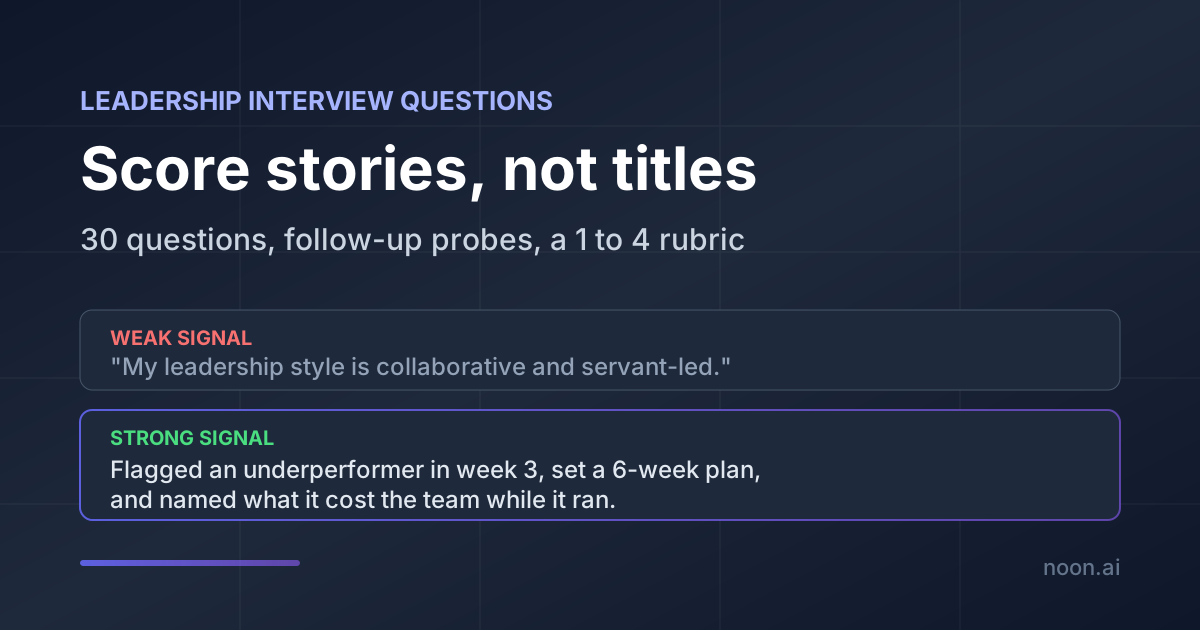
Key takeaway: Good leadership interview questions ask for a specific past situation ("Tell me about a time you...") or a realistic scenario, then probe for what the candidate personally did and what happened next. Pick four to six leadership competencies for the role, ask the same questions of every finalist, and score each answer against written anchors. Structured interviews were the top-ranked selection method in the largest recent re-analysis of hiring research (Sackett, Zhang, Berry and Lievens, Journal of Applied Psychology, 2022).
Leadership hires are the most expensive ones to get wrong, and the most often gotten wrong. Gallup estimates that managers account for at least 70% of the variance in employee engagement scores across business units, and that companies fail to choose the candidate with the right talent for a manager role 82% of the time (Gallup, Why Great Managers Are So Rare, updated February 2026).
The same Gallup analysis found that only about 18% of people currently in management roles show a high level of talent for managing others. A polished interviewee who has held a manager title is therefore weak evidence on its own. The interview has to separate people who have led from people who have sat near leadership.
This guide gives you 30 questions grouped by competency and by level, what a strong and a weak answer look like, the follow-up probes that expose rehearsed stories, and a scoring rubric you can paste into a scorecard. If you are the candidate, the last sections cover how to prepare.
What should leadership interview questions measure?
"Leadership" is too broad to score. Break it into competencies you can observe in a story, then choose the four to six that matter most for the specific role. A first-time team lead and a VP need different mixes.
| Competency | What you are testing | Most important for |
|---|---|---|
| Setting direction | Turns ambiguity into priorities and a plan people can follow | Directors, executives |
| Decision-making | Makes timely calls with incomplete information and owns the outcome | All levels |
| Developing people | Coaches, gives hard feedback, grows others' scope | Managers, managers of managers |
| Handling performance | Addresses underperformance early and fairly | First-time and mid-level managers |
| Influence without authority | Moves peers and stakeholders who do not report to them | Senior ICs, cross-functional leads |
| Leading change | Explains why, brings people along, sustains the change | Directors, transformation roles |
| Building trust | Candor, follow-through, admits mistakes | All levels |
| Hiring and team building | Raises the bar, builds a team that can run without them | Managers of managers, executives |
Write the competencies into the job requisition before the first interview, not after. If the hiring team cannot agree on the list, it will not agree on the candidate either.
30 leadership interview questions by competency
Behavioral questions ask about the past and are the backbone of the list. Situational questions ("What would you do if...") are useful for first-time managers who have few stories yet. Both formats are explained in our guide to interview questions to ask candidates.
Setting direction and strategy
- Tell me about a time you inherited a team or function with no clear plan. What did you do in the first 90 days?
- Describe a goal you set for your team that turned out to be wrong. How did you find out and what did you change?
- How do you decide what your team will not work on this quarter? Give a recent example.
- Walk me through how you translated a company-level goal into work your team could own.
Decision-making and judgment
- Tell me about the hardest call you made as a leader in the last two years. What made it hard?
- Describe a decision you had to make without the data you wanted. How did you decide when you had enough?
- Tell me about a time you reversed one of your own decisions. How did you communicate it?
- Give an example of a decision you escalated instead of making yourself. Why?
Developing people
- Tell me about someone on your team who grew significantly while working for you. What did you do specifically?
- Describe the hardest piece of feedback you have given. How did the person respond, and what happened over the next month?
- How do you decide what to delegate and to whom? Give an example where delegation went badly.
- Tell me about a time you helped someone get promoted, or moved them out of your team for a better fit.
Handling performance and conflict
- Tell me about a time you managed an underperforming team member. What was the timeline from first concern to resolution?
- Describe a conflict between two people on your team. What did you do, and what did you deliberately not do?
- Tell me about a time you had to let someone go. What would you do differently?
- Describe a time a high performer was hurting the team. How did you handle it?
Influence without authority
- Tell me about a time you changed the mind of a peer or senior stakeholder who disagreed with you.
- Describe a project that depended on a team you had no authority over. How did you get what you needed?
- Tell me about an initiative you started without being asked. How did you get others to join?
Leading change
- Describe a significant change you led that people resisted. How did you handle the resistance?
- Tell me about a time you had to communicate a decision you disagreed with. What did you say to your team?
- Walk me through a reorganization, process change or tool rollout you led. How did you measure whether it worked?
Building trust and accountability
- Tell me about a leadership mistake that affected your team. How did you own it?
- What is something your team would say you need to improve? How do you know?
- Describe a time you had to tell your manager something they did not want to hear.
Hiring and team building
- Tell me about the best hire you have made and how you identified them.
- Describe a hire that did not work out. What did you miss in the process?
- How did you build a team that could run without you for two weeks? What broke when you tested it?
Situational questions for first-time managers
- You are promoted to lead the team you used to be a peer on. One former peer wanted the role and is now disengaged. What do you do in your first two weeks?
- Two of your reports bring you conflicting priorities from different stakeholders, both marked urgent. Walk me through how you decide.
You do not need all 30. Pick one or two questions per competency you chose, which gives eight to twelve questions for a 60-minute leadership interview, and leave time for follow-ups. Use a few in the screening call and save the rest for the onsite.
How should you adjust questions by leadership level?
The same question means different things at different levels. "Tell me about a decision you made" should produce a story about a sprint plan from a new team lead and a story about a market or budget bet from a VP. Adjust the scope you expect, not only the wording.
| Level | What a strong story involves | Questions to weight |
|---|---|---|
| First-time manager or team lead | Their own team of 3 to 8, day-to-day prioritization, first hard feedback conversation | 10, 13, 14, 29, 30 |
| Manager of managers | Developing other managers, hiring leaders, cross-team trade-offs | 9, 12, 26, 27, 28 |
| Director or executive | Strategy, organization design, budgets, leading through change, board or exec stakeholders | 1, 2, 3, 20, 22 |
| Senior IC or tech lead | Influence without authority, technical direction, mentoring | 4, 11, 17, 18, 19 |
For internal candidates, ask the same questions you ask external ones. Internal candidates are often scored on reputation instead of evidence, which is unfair to them and to the external slate.
What does a strong answer sound like?
Strong leadership answers share four traits. Weak answers usually fail on the first two.
- A real, specific situation. A named project, a time frame, a team size. "I always..." or "My approach is generally..." describes a philosophy, not evidence.
- "I", not only "we". The candidate should be able to say exactly what they did. Some "we" is healthy; a story with no "I" in it hides the candidate's role.
- A cost or trade-off. Real leadership decisions give something up. If the story has no downside, ask what it cost.
- A result and a lesson. What happened, how they know, and what they would do differently. Leaders who cannot name a mistake in their own story are a risk.
Red flags worth probing: every conflict was someone else's fault, underperformance was tolerated for many months before action, the candidate takes credit for team results but blames the team for failures, and answers that sound identical to a popular interview-prep script.
Follow-up probes that expose rehearsed answers
Most candidates for leadership roles have prepared stories. The first answer tells you whether they prepared; the follow-ups tell you whether the story is theirs. Use two or three of these per question:
- "What did you personally do, as opposed to the team?"
- "What was the alternative you rejected, and why?"
- "Who disagreed with you, and what did they say?"
- "How long did that take, start to finish?"
- "What happened six months later?"
- "If I called that person today, how would they describe what you did?"
- "What would you do differently now?"
Specific, consistent detail across follow-ups is the strongest signal you can get in an interview. Vague answers that get vaguer under probing are the weakest. This is the core skill that separates a good interviewer from a bad interviewer.
How do you score leadership interview answers?
Score every answer on the same 1 to 4 scale with written anchors, independently, before the debrief. A 4-point scale removes the safe middle score that 5-point scales invite.
| Score | Anchor |
|---|---|
| 4 | Specific situation at the scope the role needs; clear personal actions; trade-off named; measurable result; credible lesson. Holds up under every probe. |
| 3 | Specific situation and clear actions; result or lesson is thinner, or the scope is one level below the role. |
| 2 | Situation is general or the candidate's role is unclear; leans on "we"; little evidence of the competency. |
| 1 | No relevant example, a hypothetical in place of a real story, or an example that shows the opposite of the competency. |
Assign each interviewer two or three competencies so the loop covers all of them without repeating questions. The U.S. Office of Personnel Management recommends that structured interviews be scored by a panel where each member rates responses individually and then discusses significant discrepancies (OPM, Structured Interviews). Our explainer on the interview panel covers how to set one up, and structured interview validity has the research behind the approach.
Take notes on what the candidate said, not your impression of it. "Gave written warning after 3 weeks, PIP after 6" can be scored in the debrief; "seemed decisive" cannot. Our guide to interview notetaking covers formats that work.
Which questions should you avoid?
Three kinds of question produce little signal or create risk:
- Abstract self-descriptions. "What is your leadership style?" invites a rehearsed label. If you ask it, follow with "Tell me about a time that style did not work."
- Brainteasers and trick questions. They measure composure under an odd format, not leadership.
- Questions that touch protected characteristics. Asking about family plans, age, religion or similar topics is a legal risk in the US and elsewhere. SHRM's checklist on interview and employment application questions lists the common traps.
How to answer leadership interview questions as a candidate
If you are preparing for a leadership interview, the scoring rubric above is what good interviewers use. Prepare for it directly:
- Build five to seven stories that cover direction, a hard decision, developing someone, a performance problem, conflict, change and a mistake. Most questions can be answered with one of them.
- Use STAR (Situation, Task, Action, Result) but spend most of the time on Action. Interviewers score what you did.
- Size the story to the role. Interviewing for director? Lead with stories about leading managers and cross-team decisions, not your first team.
- Name the trade-off and the lesson before you are asked.
- Prepare for the follow-ups listed above. If a story falls apart at "What happened six months later?", pick a different one.
- Ask leadership questions back: how the team is measured, why the role is open, and what the last person in it struggled with.
Where Noon fits
Leadership loops are, rightly, run by people. Teams tell us in evaluation calls that interviewing is the stage where they most want human judgment, and that is where interviewer time should go. Noon handles the work before it: sourcing candidates across the web beyond LinkedIn, running personalized email and SMS outreach, and booking interviews automatically. Its AI Interviewer can run a first-round voice screen with the questions your team defines, and its AI Notetaker records and transcribes live interviews and tracks coverage of the questions you set in advance, with reminders for missed ones, which makes the scoring step above easier to enforce.
Everything runs on one plan with unlimited sourcing, contacts, agents and seats. See how Noon is priced, browse the Noon product suite, or book a demo to see it on a live leadership requisition.
Frequently asked questions
What are the best leadership interview questions? The most useful ones ask for a specific past situation: "Tell me about a time you managed an underperforming team member," "Describe the hardest call you made as a leader," and "Tell me about a leadership mistake and how you owned it." They work because they can be scored and probed.
How many leadership questions should an interview include? Eight to twelve in a 60-minute interview, one or two per competency, with time for two or three follow-ups each. Fewer questions with deeper probing beats a long list answered on the surface.
What is the difference between leadership and management interview questions? Management questions focus on running a team: delegation, performance, prioritization. Leadership questions also cover direction, influence without authority and leading change. Most manager roles need both, so mix them according to level.
How do you interview someone for a leadership role with no management experience? Use situational questions (29 and 30 above) and behavioral questions about influence without authority, mentoring and leading projects (17 to 19). Many strong first-time managers have led through influence long before they had reports.
How do you answer "What is your leadership style?" Give a one-line description, then a short story that shows it in action, and a second story where you adapted it. Interviewers are listening for flexibility and self-awareness, not a label.
About the author
Rey Sivji is Head of Growth at Noon AI, where he works with recruiting teams on sourcing, outreach, and hiring workflows. Email rey@noon.ai.