
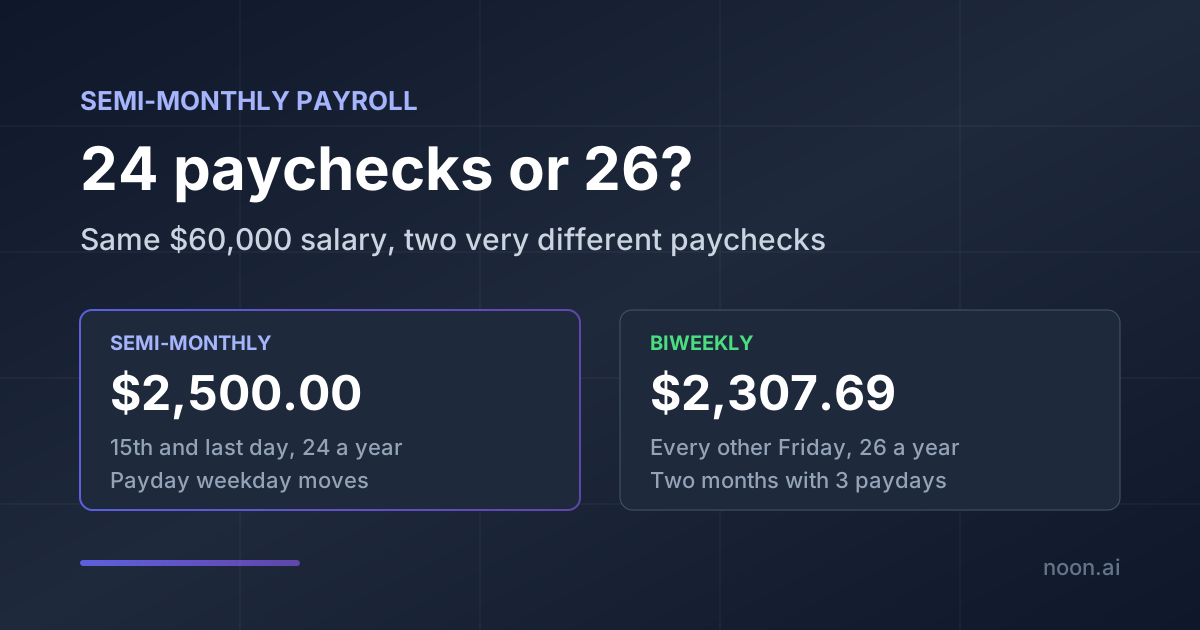
Key takeaway: Semi-monthly payroll pays employees twice a month on fixed dates, usually the 15th and the last day, for 24 paychecks a year. Biweekly payroll pays every other week on the same weekday, for 26 paychecks (27 in some years). Biweekly is the most common US schedule, used by 43.0% of private establishments in February 2023, against 19.8% for semi-monthly (BLS, Length of pay periods in the CES survey). Semi-monthly suits salaried teams and monthly bills. Biweekly suits hourly teams, because every pay period lines up with whole workweeks.
The two schedules sound interchangeable and differ by only two paychecks a year, which is why "semi-monthly" and "biweekly" get confused in offer letters, job ads and even payroll setups. The differences show up in three places: how overtime is calculated, how benefit deductions divide, and what a new hire sees on the first paycheck.
Usage depends heavily on company size. In the Bureau of Labor Statistics' February 2023 Current Employment Statistics data, 22.5% of establishments with 1 to 9 employees paid semi-monthly, while only 5.6% of establishments with 1,000 or more employees did; at that size 66.6% paid biweekly (BLS). Industry matters too: semi-monthly was used by 37.5% of information establishments and 30.2% in financial activities, but 6.5% in construction, where 65.4% paid weekly.
State law can take the choice away entirely. Massachusetts requires hourly employees to be paid weekly or biweekly, and New Hampshire requires weekly or biweekly pay unless the state labor department gives written permission for semi-monthly (U.S. Department of Labor, State Payday Requirements). This guide covers how each schedule works, the math that differs, the state rules to check, and how to explain pay frequency to candidates.
What is semi-monthly payroll?
Semi-monthly payroll (also written semimonthly) pays employees on two fixed dates each month. The most common pairs are the 15th and the last day of the month, or the 1st and the 15th. That gives 24 paychecks a year, every year.
Because the dates are fixed, the weekday moves. When a payday falls on a weekend or holiday, the employer has to pay on the business day before or after, so pick one and write it into the pay policy before the first run. Each pay period also varies in length: a period ending February 15 covers 15 days, while one ending August 31 covers 16.
For salaried employees that variation does not matter, because each check is the same: annual salary divided by 24. For hourly employees it does, because the hours in each period change with the calendar.
What is biweekly payroll?
Biweekly payroll pays employees every two weeks on the same weekday, usually Friday. Each pay period covers exactly two workweeks (14 days), which keeps hourly pay and overtime simple. A year normally has 26 biweekly paydays, so two months each year have three paydays instead of two.
Some years have 27. In 2027, January 1 and December 31 both fall on a Friday, so an employer whose biweekly Friday payday lands on January 1, 2027 will run 27 paydays that year. For salaried employees that creates a decision: pay 27 checks at the usual amount (annual salary divided by 26), which overpays the year, or divide the salary by 27 for that year, which shrinks every check. Hourly employees are unaffected, because they are paid for the hours worked in each period.
Semi-monthly vs biweekly: side-by-side comparison
| Factor | Semi-monthly | Biweekly |
|---|---|---|
| Paychecks per year | 24 | 26 (27 in some years) |
| Payday | Fixed dates, e.g. 15th and last day | Same weekday every other week |
| Pay period length | 13 to 16 days, varies by month | Always 14 days |
| Salaried check on $60,000 | $2,500.00 | $2,307.69 |
| Overtime tracking | Workweeks split across periods | Each period holds two full workweeks |
| Monthly benefit deductions | Split evenly, 2 per month | Uneven: 26 checks against 12 premiums |
| Share of US private establishments (BLS, Feb 2023) | 19.8% | 43.0% |
| Best fit | Salaried, exempt teams | Hourly or mixed teams |
The IRS treats them as different payroll periods: Publication 15-T (2026) uses 24 periods for semi-monthly and 26 for biweekly in its percentage-method withholding worksheet, so a payroll system set to the wrong frequency withholds the wrong amount of federal income tax (IRS Publication 15-T, 2026).
How does overtime work with semi-monthly pay?
Overtime under the Fair Labor Standards Act is calculated per workweek, not per pay period. The rule is explicit: the Act "takes a single workweek as its standard and does not permit averaging of hours over 2 or more weeks" (29 CFR 778.104). A semi-monthly period almost never contains whole workweeks, so a week that starts on the 13th and ends on the 19th straddles two pay periods.
In practice, that means:
- Track hours by workweek, not by pay period. Your time system needs a fixed workweek (for example, Sunday to Saturday) independent of the pay calendar.
- Pay overtime on the payday for the period in which the workweek ends. If the amount cannot be computed in time, it must be paid as soon as practicable and no later than the next payday after it can be computed (29 CFR 778.106). Overtime for a straddling week can land one check after the first hours of that week were paid.
- Convert salaries to a weekly rate for non-exempt salaried staff. Federal regulations say a semi-monthly salary is translated to its weekly equivalent "by multiplying by 24 and dividing by 52" (29 CFR 778.113). A $2,500 semi-monthly salary is $1,153.85 a week, or $28.85 an hour for a 40-hour week, and time and a half is calculated from that rate.
Biweekly avoids most of this: every period is two complete workweeks, so overtime for week one and week two is calculated and paid on the same check. That is one practical reason hourly-heavy industries such as construction lean weekly or biweekly in the BLS data.
How do benefit deductions differ?
Most benefit premiums are monthly, so the schedule decides how cleanly they divide. Take an employee share of $300 a month for health insurance:
- Semi-monthly: $150 from each of the 24 checks. Every month nets the same $300.
- Biweekly, spread over all checks: $3,600 a year divided by 26 is $138.46 per check. Months with three paydays deduct more.
- Biweekly, 24 deductions: $150 from two checks a month, with no deduction on the two "third" paychecks. Employees like the larger third checks, but payroll has to flag them every year.
- Biweekly in a 27-pay year: $3,600 divided by 27 is $133.33 per check, if deductions are spread across every check.
The same issue applies to 401(k) contributions set as a flat dollar amount, garnishments and any monthly employer reimbursement. Semi-monthly keeps all of them aligned with the calendar; biweekly needs a rule for the extra checks.
Which states restrict semi-monthly pay?
Federal law does not set a pay frequency, but most states do. The Department of Labor's state payday table lists the required frequencies and exceptions (DOL Wage and Hour Division, revised January 1, 2023). Examples worth checking before you pick a schedule:
| State | Rule (DOL summary) | Effect on semi-monthly |
|---|---|---|
| Massachusetts | Hourly employees paid weekly or biweekly; salaried may be semi-monthly | Not allowed for hourly staff |
| New Hampshire | Weekly or biweekly required | Only with written NHDOL permission |
| New York | Weekly payday for manual workers | Semi-monthly only upon approval for manual workers |
| Rhode Island | Most employers must pay weekly | Less frequent pay only by petition, at least twice a month |
| Texas | Non-exempt employees paid at least twice a month | Allowed; periods must have as nearly equal days as possible |
| California | Most wages paid at least twice each calendar month | Allowed for most workers |
| Arizona | Two or more paydays a month, not more than 16 days apart | Allowed |
| Vermont | Biweekly and semi-monthly paydays need written notice | Allowed with written notice |
If you hire across several states, the strictest state you hire in often decides the schedule for the whole hourly workforce. A payroll provider can run more than one frequency, so another common answer is semi-monthly for salaried staff and biweekly or weekly for hourly staff. The BLS survey even has a category for these "multiple-pay-period reporters".
Which pay schedule should you choose?
Use the BLS mix and the rules above as a starting point, then decide on four questions:
- Who is on the payroll? Mostly salaried, exempt employees fit semi-monthly. Mostly hourly or overtime-eligible employees fit biweekly (or weekly, which some states require).
- Where do you hire? Check the payday rule in every state where you have employees. Massachusetts, New Hampshire, New York and Rhode Island are the common blockers.
- How are benefits billed? Monthly premiums and contributions fit semi-monthly with no extra-check rules.
- What does payroll cost per run? Some providers charge per run, others per month. Our breakdowns of Paycom pricing and OnPay pricing show one provider whose billing follows pay frequency and one whose per-worker fee does not, and the payroll software comparison covers which platforms handle multiple schedules.
If you are changing schedules, give employees written notice well before the switch (Vermont, for example, requires written notice for biweekly and semi-monthly paydays), show the first two paychecks under the new schedule with exact dates and amounts, and explain how benefit deductions will change. A transition often creates one short or long pay period; say which, and whether you will advance pay to cover a longer gap.
How should recruiters explain pay frequency to candidates?
Pay frequency is a small detail that causes real confusion at the offer stage. The same $60,000 salary is $2,500 a check semi-monthly and $2,307.69 biweekly, and candidates comparing two offers by take-home pay can conclude the biweekly offer is worse. A few habits prevent that:
- Lead with annual pay in the offer letter, then state the pay frequency and the per-check gross. South Carolina, for example, requires employers with five or more employees to tell new hires in writing the agreed wages and the time and place of payment (DOL).
- Give the first payday date. Depending on when the start date falls in the cycle, the first check can arrive after a full pay period plus processing time. Put the date in the offer or in onboarding materials so it is not a surprise.
- Quote salary the same way everywhere. Recruiting emails, job ads and the offer letter should all use the annual figure. Our research on salary in recruiter emails shows how rarely pay is shared up front, and consistency matters more once it is.
- Treat pay timing as part of the close. Small, avoidable surprises between verbal offer and signed offer feed into offer acceptance rates.
Where Noon fits
Pay schedules are an HR and payroll decision, but the recruiting team is usually the one explaining them to candidates. Noon is an AI recruiting platform that sources candidates across the web (not only LinkedIn), evaluates them against each role's criteria, runs personalized email and SMS outreach, and books interviews, so recruiters have time to handle the offer-stage details that decide whether a candidate signs. Noon runs one plan with unlimited sourcing, contacts, agents and seats. See Noon pricing or book a demo to discuss pricing for your team.
Frequently asked questions
What does semi-monthly payroll mean? It means employees are paid twice a month on fixed dates, such as the 15th and the last day of the month. There are always 24 paydays a year, and the weekday of each payday changes from month to month.
Is semi-monthly the same as biweekly? No. Semi-monthly is twice a month on set dates (24 paychecks a year). Biweekly is every two weeks on the same weekday (26 paychecks, or 27 in some years). On the same salary, each semi-monthly check is larger.
Which is better for employees, biweekly or semi-monthly? Annual pay is the same either way. Biweekly gives two months a year with a third paycheck and predictable Friday paydays. Semi-monthly gives larger, calendar-aligned checks that match monthly bills like rent.
How do you calculate semi-monthly pay from an hourly rate? Multiply the hourly rate by the hours actually worked in that pay period, then add any overtime from workweeks that ended in the period. For a salaried employee, divide annual salary by 24.
Can a company use both semi-monthly and biweekly payroll? Yes. Many employers pay salaried staff semi-monthly and hourly staff biweekly or weekly, subject to state payday rules. The BLS survey tracks establishments that use more than one pay period length as their own reporter category.
Which pay schedule is most common in the US? Biweekly. In BLS data for February 2023, 43.0% of private establishments paid biweekly, 27.0% weekly, 19.8% semi-monthly and 10.3% monthly.
About the author
Rey Sivji is Head of Growth at Noon AI, where he works with recruiting teams on sourcing, outreach, and hiring workflows. Email rey@noon.ai.