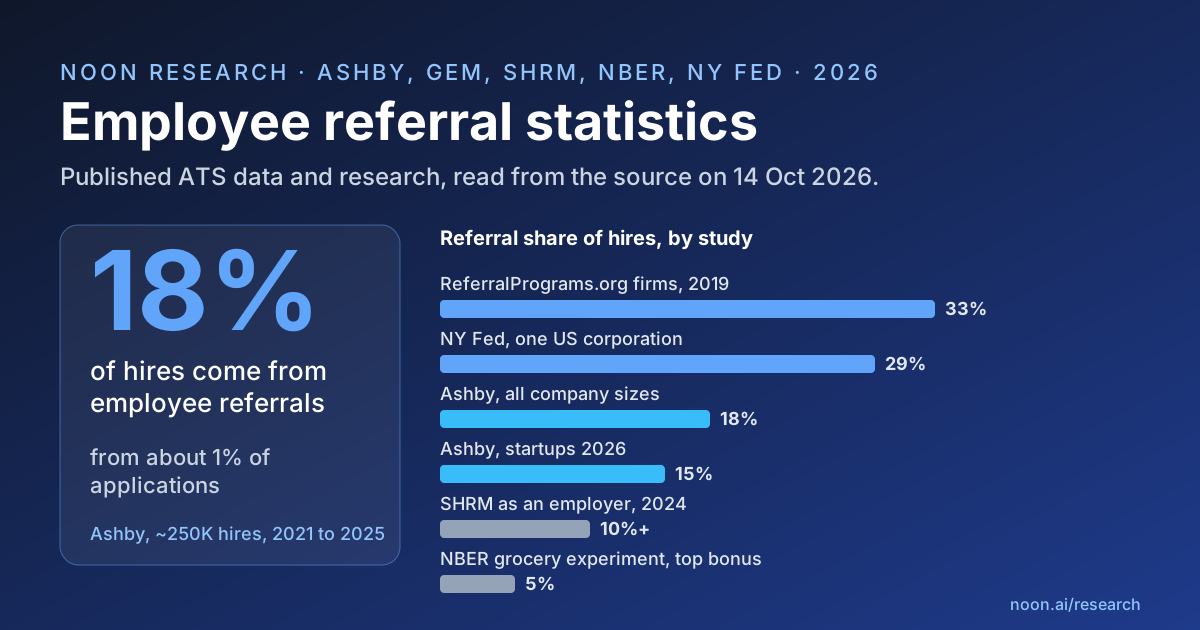
Key takeaway: About 18% of hires come from employee referrals. Ashby's analysis of nearly 250K hires from January 2021 to June 2025 puts referrals at roughly 18% of hires, while referrals make up about 1% of applications on the same platform. Referred candidates are among the most efficient sources a team has: 40% reach an interview and 16% of those interviewed reach an offer, and Gem finds referrals convert at 11x the rate of inbound applicants. Startups get a smaller share (15%), and in enterprise referral programs about 1 in 10 referrals ends in a hire.
Referral share is one of the most repeated numbers in recruiting and one of the least sourced. Many statistics lists quote it without a dataset, a date or a definition behind it. This page uses only figures we read at the primary source on 14 October 2026: applicant tracking system (ATS) datasets from Ashby and Gem, ERIN's 2024 referral platform data as reported by SHRM, an iCIMS retention study, and three economics research papers.
All figures below are third-party data attributed to each publisher. None of them are Noon data.
What percentage of hires come from employee referrals?
About 18% in the largest current ATS dataset. Ashby's report on inbound hiring, built on nearly 250K hires, found that "Hires from sourced (16%) and referral (18%) held steady" while inbound applications accounted for between 43% and 52% of hires. Ashby also found that referrals "stay consistent at ~17% of hires regardless of inbound volume", so a role flooded with applications does not crowd out referral hires.
The share moves a lot with the employer and the job. Every figure in this table is a referral share of hires, but the populations are very different:
| Source | Population | Referral share of hires |
|---|---|---|
| ReferralPrograms.org firms, August 2019 (cited in NBER w25920) | Firms listed on the site, mainly US tech | 33% mean |
| New York Fed Staff Report 568 | One large US corporation | 29% |
| Ashby inbound report (2025) | Nearly 250K hires, all company sizes | ~18% |
| Ashby State of Startup Hiring 2026 | Venture-backed startups | 15% |
| ReferralPrograms.org, four European firms (NBER w25920) | European firms listed on the site | 12% |
| SHRM as an employer, 2024 | Roughly 500 employees | Slightly more than 10% |
| NBER w25920 field experiment, largest bonus | Grocery chain, low-skilled jobs | 5% |
Two patterns stand out. Tech employers with formal programs report far higher shares than hourly or low-skilled employers, and the 18% ATS figure sits near the middle of the range. If your team is well below 10% outside hourly hiring, the program is likely under-used; if it is above 30%, you are close to the top of anything published.
For the wider set of hiring benchmarks, see our recruitment statistics roundup.
Why do referrals make up so few applications but so many hires?
Because almost everything else is inbound. Ashby's referral report, covering over 38M applications across 93K jobs from January 2021 to December 2024, counts 93.8% of applications from inbound, 4.8% from sourced and 1% from referral. The referral share of applications fell "from 2% in Q1 2021 to less than 1% three years later (Q1 2024)" as inbound volume rose.
Gem's 2026 Recruiting Benchmarks takeaways, based on over 165 million applicants and 1.2 million hires from June 2021 to May 2025, show the same shape. Job boards and company marketing channels generate roughly 90% of all applications but account for only about half of hires. Direct sourcing delivers 11% of hires from just 2.6% of applications, and "Referrals convert at 11x the rate of inbound applicants, and internal mobility at 32x."
The clearest single-firm view comes from the New York Fed study of one US corporation's hiring data. Job board applicants were 60% of applicants. Referred applicants were "only 6 percent of the applicant sample, but 21 percent of interviewees, 27 percent of offer recipients, and 29 percent of hires." Their share of hires was about 4.8 times their share of applicants. Our applicants per job benchmarks show how large the inbound side of that funnel has become.
What is the referral conversion rate at each hiring stage?
Ashby reports stage conversion by source of application. Multiplying the two published rates gives an application-to-offer rate for each source:
| Source | Application to interview | Interview to offer | Application to offer (calculated) |
|---|---|---|---|
| Internal | 42% | 32% | 13.4% |
| Referred | 40% | 16% | 6.4% |
| Agency | 42% | 8% | 3.4% |
Inbound sits far below all three. Ashby found inbound offer rates fell about 70%, "7 in 1000 to 2 in 1000", over the period, which it ties to inbound volume tripling. A referred applicant was roughly as likely to reach an interview as an internal candidate, but half as likely to turn that interview into an offer.
Ashby's 2026 recruiting operations benchmarks, on over 54M applications through March 2026, add the first gate: 52% of referred candidates pass initial screens, compared to 35% overall. To compare those stage rates with every other source, see our recruiting funnel benchmarks and interview-to-offer ratio benchmarks.
How many employee referrals turn into hires?
About 1 in 10 at enterprise scale. ERIN, a referral software vendor, analyzed its 2024 user data (over 1.1 million referrals from 744,580 unique users), and SHRM reported the funnel: "out of 10 candidates who receive a referral notice, eight respond to the referral, six apply for the job, four are interviewed, and one is hired."
Read stage by stage, that is one hire for every six referred applicants (about 16.7%) and one for every four referred candidates interviewed (25%). Smaller employers can run much tighter programs. At SHRM itself, with roughly 500 employees, about 50% of referrals become hires.
Which referral channels produce the most hires?
In ERIN's data, 55% of referrals were sent by email, 30% were shared over social media and only 10% were sent by SMS or text. Social sharing underperformed: "While 30% of all referrals were shared via social media, only 14% of hires came from this channel." That is less than half the hires its referral volume would suggest. A direct, personal message to a specific person beats a broadcast post.
Who refers matters too. Ashby found that "Referrals are more likely to result in interviews when the referrer works in the same job function as the role being filled." An engineer referring an engineer is a stronger signal than a salesperson referring one.
Do referred hires perform better?
On the evidence published, modestly. Ashby's Quality of Hire report, built on over 35,000 hiring manager scorecards across nearly 15,000 hires, found referred hires score 4.0 on its quality scale, against 3.8 for inbound and 3.9 for sourced hires. At the top of the scale the gap widens: 36% of referred hires were rated "Greatly Exceeds Expectations", compared to 28% for inbound and 32% for sourced.
Referred candidates also say yes more often. Ashby reports that referred candidates "have higher offer acceptance rates than both inbound and sourced candidates across both business and technical roles". Our offer acceptance rate benchmarks cover the overall rates. They are not cheaper on salary, though: the New York Fed study found an employee referral is associated with a starting salary premium of 2.1 percent.
Do referred employees stay longer?
Yes, and this is the most consistent finding in the research:
- NBER Working Paper 25920 (Friebel, Heinz, Hoffman and Zubanov), a field experiment at a grocery chain: referrals have 45% lower attrition than observably similar non-referrals, and having a referral program in a store leads to a roughly 15% reduction in worker turnover.
- New York Fed Staff Report 568: referred workers are only about 85 percent as likely to leave the corporation as non-referred workers.
- IZA Discussion Paper 7382 (Burks, Cowgill, Hoffman and Housman), using data from nine large firms in call-centers, trucking and high-tech: referred workers are 10% to 30% less likely to quit.
- iCIMS (2018), across over 50 companies and 91,000 employees: half of referral hires stayed at least 38 months, compared to 22 months for non-referral hires, which iCIMS describes as a 70% improvement.
Lower turnover is where much of a referral's value shows up, because each early leaver means paying for the same hire twice. See our cost-per-hire benchmarks for what each replacement costs.
Are referral hires growing or shrinking as a share of hiring?
Shrinking slowly on the largest dataset. Ashby's 2026 recruiter productivity report, on over 109M applications and 247K jobs, found that by Q1 2026 inbound accounts for 52% of all hires, up from 38% in early 2021, and "Sourced and referral hires have both declined as a share of total hires over the same period." Ashby's EMEA report adds that referral hires make up a slightly smaller share of hiring in EMEA than in AMER.
Bigger bonuses are not a reliable fix. In the NBER grocery experiment, higher bonuses produced more referrals, but "Even under the largest bonus, only 5% of hires are referrals", and encouraging referrals without a bonus produced none.
What should recruiting teams do with these numbers?
- Measure referrals by stage, not just by hire count. Track screen pass rate, interview-to-offer and offer acceptance for referred candidates against the 52%, 16% and 6.4% benchmarks above.
- Ask by function. Request referrals from people in the same job family as the open role, where Ashby finds interview rates are higher.
- Push direct asks over social posts. In ERIN's data social shares were 30% of referrals but 14% of hires.
- Do not expect bonus size to scale volume. The NBER experiment found bonuses move referral counts only modestly.
- Plan for the other four in five hires. Even a strong program covers a minority of hiring, so most roles still need sourcing. Our guide to sourcing channels for tech recruiting compares the options.
How Noon helps teams hire beyond the referral network
Referrals work because someone already vetted the candidate, but a team's network is finite, and the data above shows most hires still come from somewhere else. Noon's AI recruiting platform applies the same targeted approach to everyone else: it sources across the whole web, not just LinkedIn, and evaluates every candidate against the role's criteria before anyone is contacted, so the shortlist looks more like a referral list than an inbound pile. Outreach goes out by email and SMS, and hiring-manager feedback calibrates the search as it runs. Noon has a single plan with unlimited sourcing, enrichment, contacts, agents and seats; see Noon pricing for details.
Methodology and sources
- Ashby Talent Trends Reports. Inbound (October 17, 2025; nearly 250K hires, January 2021 to June 2025), Referrals (May 16, 2025; 38M applications, 93K jobs), State of Startup Hiring 2026 (February 23, 2026), Recruiting Operations Benchmarks (May 7, 2026), Recruiter Productivity (April 28, 2026), EMEA Recruiter Productivity (September 9, 2026) and Quality of Hire (September 9, 2026).
- Gem, Key takeaways from the 2026 Recruiting Benchmarks Report. Data from June 2021 to May 2025.
- SHRM, Majority of Employee Referrals Made During Work Hours (February 25, 2025), reporting ERIN's 2024 platform data and SHRM's own 2024 referral share.
- iCIMS, How Employee Referrals Impact Retention (October 19, 2018).
- Friebel, Heinz, Hoffman and Zubanov, What Do Employee Referral Programs Do? NBER Working Paper 25920 (June 2019, revised August 2022).
- Brown, Setren and Topa, Do Informal Referrals Lead to Better Matches? Federal Reserve Bank of New York Staff Report 568 (August 2012, revised June 2013).
- Burks, Cowgill, Hoffman and Housman, The Value of Hiring through Referrals IZA Discussion Paper 7382 (May 2013).
Every source was fetched on 14 October 2026, with Ashby, Gem, SHRM and iCIMS pages read rendered in a browser. Each figure's exact quote and fetch time is recorded in our research file for this article, and a script checks every quote against the saved source text. Calculated figures are labeled: application-to-offer rates multiply Ashby's application-to-interview and interview-to-offer rates for each source, the 4.8x figure divides the New York Fed's 29% hire share by its 6% applicant share, and the ERIN stage rates divide one hire by six applicants and by four interviews.
Limitations
- Ashby's 18% hire share and 1% application share come from two reports with different windows (to June 2025 and to December 2024), so they describe the same platform but not an identical sample.
- Ashby's reports differ on trend. The inbound report says referral hires held steady at about 18%; the 2026 productivity report says referral hires declined as a share through Q1 2026. The level is consistent; the direction depends on the window.
- Calculated application-to-offer rates assume the two published stage rates apply to the same candidates; Ashby publishes them separately, rounded to whole percentages.
- Each vendor reports on its own customers, so none is a random sample of all employers. ERIN's funnel describes enterprise-level organizations running a formal referral program.
- The economics papers are older (2012 to 2022) and each studies specific settings: one corporation, a grocery chain, and nine firms in three industries. Their retention results are consistent with each other, but they are not 2026 benchmarks.
- The iCIMS retention study is from 2018 and is shown as a dated comparison.
FAQ
What percentage of hires come from employee referrals?
About 18% in Ashby's ATS data covering nearly 250K hires from January 2021 to June 2025, and 15% at startups. Published figures range from 5% in a grocery chain field experiment to a 33% mean among firms listed on ReferralPrograms.org in 2019.
What is a good referral to hire conversion rate?
ERIN's 2024 enterprise data shows about 1 in 10 referrals resulting in a hire, or 1 in 6 referred applicants. In Ashby's data, 40% of referred applicants reach an interview and 16% of those interviewed reach an offer, about 6.4% from application to offer.
Are referral hires better than other hires?
Slightly, on the published evidence. Ashby's hiring manager scorecards rate referred hires 4.0 against 3.8 for inbound and 3.9 for sourced hires, and 36% of referred hires get the top rating against 28% of inbound hires.
Do employee referrals reduce turnover?
Yes. An NBER field experiment found referrals had 45% lower attrition than similar non-referrals, the New York Fed found referred workers about 85% as likely to leave, and an IZA study of nine large firms found them 10% to 30% less likely to quit.
How much more likely are referrals to be hired than inbound applicants?
Gem's 2026 benchmarks found referrals convert at 11x the rate of inbound applicants. In one corporation studied by the New York Fed, referred candidates were 6% of applicants but 29% of hires.