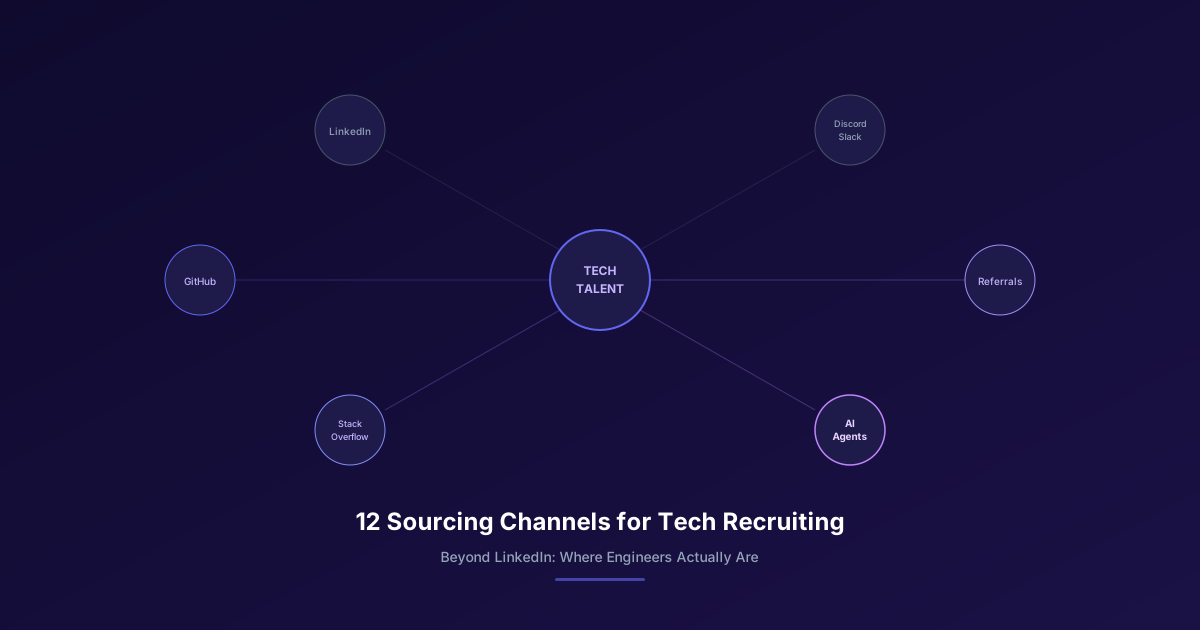
Key takeaway: The most effective sourcing channels for tech recruiting in 2026 are: LinkedIn (still #1 for volume), GitHub and Stack Overflow (for code quality signals), AI sourcing platforms (for cross-channel aggregation), niche communities (Discord, Hacker News), and employee referrals (45% higher retention at 2 years and candidates hired 55% faster). The best teams use 4-5 channels simultaneously, not one channel exclusively.
Most tech recruiters source from LinkedIn. It's the default, 1 billion members, familiar interface, built-in messaging. The problem is that everyone else is sourcing from LinkedIn too.
Senior engineers receive 10-30 InMails per week. They've muted recruiter messages. They've turned off open-to-work signals because the outreach quality is so poor. And according to Stack Overflow's 2025 Developer Survey, 45.6% of developers aren't actively looking for work, and another 28.8% are only "somewhat open." Nearly three-quarters of the engineering talent market sits outside LinkedIn's active candidate pool.
Meanwhile, the demand keeps climbing. The Bureau of Labor Statistics projects 129,200 software developer openings annually through 2034, with employment growing 15%, roughly four times the average occupation. And the market is frozen rather than loose: Indeed Hiring Lab's September 2026 snapshot reports a JOLTS hires rate of 3.2%, a level otherwise seen only in April 2020 and the 2009-2011 recovery, with tech postings still "depressed despite improving from last year's lows" (Indeed Hiring Lab, September 24, 2026). Employed engineers are not moving, so the channels that reach them where they already are matter more than the ones that wait for them to apply.
This guide covers 12 sourcing channels for tech recruiting, organized by type: professional networks, developer community platforms, AI-powered tools, and alternative channels. For each, we cover what makes it effective, when to use it, and how it fits into a multi-channel sourcing strategy. Tool pricing was re-checked on September 25, 2026.
How do the 12 channels compare?
| # | Channel | Signal quality for engineers | Cost | Recruiter effort | Best for |
|---|---|---|---|---|---|
| 1 | LinkedIn Recruiter | Medium | High (per-seat license) | High | Management and non-engineering roles |
| 2 | GitHub | High | Free | High | Backend, infra, ML engineers who ship public code |
| 3 | Stack Overflow | Very high for specific technologies | Free | High | Deep specialists |
| 4 | Hacker News | High | Free | Medium | Startup-oriented engineers |
| 5 | Discord and Slack communities | Medium to high | Free | Very high (relationship building) | Niche stacks, DevRel |
| 6 | Conferences and meetups | High for senior roles | Medium to high | Very high | Senior and specialized hires |
| 7 | AI sourcing agents (Noon) | High (cross-source, contextual) | One flat plan | Low | Any role; continuous coverage |
| 8 | SeekOut / hireEZ | Medium to high | $149 to $494 per seat per month self-serve; team tiers custom | High (recruiter runs searches) | Enterprise search teams |
| 9 | Employee referrals | Very high | Referral bonus only | Low to medium | Every role |
| 10 | University and bootcamp partnerships | Medium | Low to medium | Medium | Junior and new-grad roles |
| 11 | Technical blogs and publications | High | Free | Medium | Passive senior candidates |
| 12 | Open-source communities | Very high | Free | Medium | Infrastructure and platform roles |
Category 1: Professional networks
1. LinkedIn Recruiter
What it is: The largest professional network, with AI-assisted search, InMail messaging, and the LinkedIn Hiring Assistant.
Best for: Broad professional searches where candidates have polished profiles, product managers, engineering managers, DevOps, and roles where network and career trajectory matter as much as technical skills.
Strengths:
- 1B+ member profiles: the largest professional database
- LinkedIn Hiring Assistant provides AI-assisted sourcing suggestions
- InMail gets higher open rates than cold email for many professional roles
- Rich profile data (endorsements, recommendations, career history, education)
Limitations:
- Expensive: $8,999+/year per Recruiter seat
- Crowded: Senior engineers are overwhelmed with InMails, response rates declining
- Surface-level signals: You see job titles and company names, not code quality or technical depth
- Walled garden: Only searches LinkedIn's database
Signal quality for engineers: Medium. LinkedIn tells you where someone worked and what their title was. It doesn't tell you if they can write good code.
2. GitHub
What it is: The world's largest software development platform with 180M+ developer accounts. Public repositories, contributions, and activity provide direct evidence of technical capability.
Best for: Sourcing developers where code quality and open-source contribution matter, backend engineers, ML engineers, infrastructure specialists, and anyone who ships public code.
How to use it for recruiting:
- Search for contributors to relevant repositories (e.g., contributors to PyTorch or Kubernetes)
- Filter by language, location, and activity recency
- Review contribution quality: not just volume. A developer with 5 meaningful pull requests to a major project is a stronger signal than someone with 500 trivial commits
- Check their profile for contact information (many developers list their email)
Strengths:
- Direct evidence of technical skill: you can see their actual code
- Less recruiter noise than LinkedIn: engineers aren't bombarded here
- Open-source contribution signals collaboration, code review ability, and community engagement
- Free to search
Limitations:
- Not all developers have active GitHub profiles: especially those in enterprise environments where code is proprietary
- No built-in messaging system: you need to find contact information elsewhere
- Activity doesn't correlate perfectly with job-seeking interest
- Limited professional context (company, title, salary expectations)
Signal quality for engineers: High. Code doesn't lie.
3. Stack Overflow
What it is: The largest developer Q&A platform. Reputation scores and answers provide evidence of technical knowledge and communication ability.
Best for: Identifying developers with deep expertise in specific technologies. A developer with a top-1% reputation in PostgreSQL has demonstrated expertise in a way no resume can.
How to use it for recruiting:
- Search for top-ranked contributors by technology tag
- Review answer quality: well-explained, well-received answers signal both technical depth and communication ability
- Stack Overflow Talent (paid) provides candidate profiles and messaging
- Cross-reference with GitHub and LinkedIn for a complete picture
Strengths:
- Deep technical expertise signals that are impossible to fake
- Communication quality is visible: how well someone explains technical concepts
- Technology-specific filtering is precise
- Reputation scores provide objective ranking
Limitations:
- Skews toward problem-solving and knowledge-sharing: not all great engineers participate in Q&A communities
- Declining posting activity (some shifted to AI tools for answers)
- Smaller talent pool than LinkedIn or GitHub for sourcing purposes
- Stack Overflow Talent features have been restructured multiple times
Signal quality for engineers: Very high for specific technology expertise.
Category 2: Developer communities
4. Hacker News / Y Combinator community
What it is: The tech startup community hub. Monthly "Who's Hiring?" and "Who Wants to be Hired?" threads are high-signal sourcing channels.
Best for: Startup-oriented engineers, founders-turned-engineers, and candidates who value startup culture and technical depth.
How to use it for recruiting:
- Post in the monthly "Who's Hiring?" thread (free, community-regulated)
- Review the "Who Wants to be Hired?" thread for candidates actively seeking opportunities
- Monitor discussions for technical leaders sharing insights: these are passive sourcing targets
- The audience skews toward experienced engineers who read and contribute to technical discussions
Signal quality: High. The HN audience self-selects for technical curiosity and startup orientation.
5. Discord and Slack communities
What it is: Technology-specific communities where developers gather around shared interests, Reactiflux (React), Python Discord, MLOps Community, and hundreds of others.
Best for: Niche technical roles where community involvement signals deep interest and expertise. DevRel, open-source engineers, and roles requiring specific technology stack experience.
How to use it for recruiting:
- Join communities relevant to your hiring needs (many are open)
- Participate genuinely before recruiting: provide value, answer questions, share knowledge
- Post in designated job channels (most communities have them)
- Identify active contributors who demonstrate expertise through their participation
Limitations: Many communities have strict anti-recruiting rules. Spamming job posts will get you banned and damage your employer brand. Community-based recruiting requires authentic, long-term engagement.
6. Tech conferences and meetups
What it is: Speaking at or attending conferences (virtual and in-person) provides access to engaged, passionate professionals.
Best for: Senior and specialized roles where personal relationships and technical credibility matter.
How to use it for recruiting:
- Sponsor relevant conferences for visibility and booth access
- Have engineers (not just recruiters) represent the company
- Follow up with speakers and attendees whose work aligns with your needs
- Virtual conferences have made this more accessible: you can attend niche events without travel
Signal quality: High for senior roles. Conference speakers have demonstrated both expertise and communication ability.
Category 3: AI-powered sourcing tools
7. AI sourcing agents (Noon)
What it is: Autonomous AI that searches a candidate's public professional footprint across the whole web (professional profiles, code repositories, publications, patents, company pages) to find, evaluate, and contact qualified candidates by email and SMS without recruiter intervention.
Best for: Any tech role where you want comprehensive coverage without manual searching. Particularly effective for roles where qualified candidates are scattered across platforms.
Why it's different from a search tool: Traditional sourcing tools are search engines that a recruiter operates. Noon operates autonomously: describe the role, give thumbs-up or thumbs-down feedback on initial candidates, and the system handles sourcing, evaluation, and email and SMS outreach while calibrating to your preferences. Non-negotiables you set are never relaxed, and because candidates are evaluated from their full public career history rather than a self-submitted resume, the sourced pipeline is far less exposed to the fabricated profiles that inbound remote postings attract (see our guide to detecting fake job applicants). If you're evaluating AI sourcing for your tech recruiting workflow, you can book a demo to see how cross-channel aggregation works in practice.
Strengths:
- Searches across multiple sources simultaneously (not just LinkedIn)
- AI screening evaluates candidates against your specific criteria using LLM-based analysis
- Personalized email and SMS outreach generated for each candidate, with contact details enriched and verified before sending
- System improves with feedback and learns what "good" means for your specific search
- Runs continuously without recruiter effort and hands interested candidates to the AI Scheduler for booking
Signal quality: High. Aggregates signals from multiple platforms and evaluates contextually, not just by keywords.
8. SeekOut / hireEZ
What it is: AI-powered sourcing platforms that aggregate candidate data from multiple sources (LinkedIn, GitHub, publications, patents) and provide assisted search.
Best for: Enterprise teams that want enhanced search capabilities with diversity sourcing features and compliance tools.
Strengths:
- Large aggregated databases (SeekOut: 1B+ profiles; hireEZ: 800M+)
- Diversity sourcing dashboards
- Boolean and AI-assisted search
- Strong ATS integrations
Pricing (September 2026): Both vendors now publish an entry price. SeekOut's self-serve Recruit Core seat is $149 per user per month billed annually ($179 monthly) with 500 contact credits and 1,000 exports a month; hireEZ lists a solo recruiter seat at $494 per month with a 7-day trial. Team and enterprise tiers at both are custom. See our SeekOut pricing and hireEZ pricing breakdowns for the details.
Limitations:
- Recruiter still does the work; these are search tools, not agents
- Contacts and exports are metered per seat, so outreach volume costs extra on top of the license
- Outreach features are lighter than dedicated engagement tools, so many teams still pair them with a CRM
Category 4: Alternative channels
9. Employee referrals
What it is: Your existing engineers referring candidates from their networks.
Best for: Every role. Referrals consistently rank as the highest-quality source of hire across all studies.
The data: Employee referrals produce 45% higher retention rates at 2 years compared to job board hires (SHRM 2025). Referred candidates are hired 55% faster on average.
How to improve your referral program:
- Make referral bonuses meaningful ($3,000-10,000 for technical roles)
- Make the process frictionless: one-click submission, not a 15-minute form
- Share specific hiring needs regularly: engineers can't refer if they don't know what's open
- Close the loop: tell referrers what happened with their referral within a week
10. University and bootcamp partnerships
What it is: Relationships with CS programs, coding bootcamps, and technical universities for early-career hiring.
Best for: Junior and new-grad technical roles. Also effective for emerging specialties where bootcamps are producing talent faster than traditional programs (AI/ML, cloud infrastructure, data engineering).
11. Technical blogs and publications
What it is: Engineers who write technical blog posts demonstrate expertise, communication ability, and intellectual curiosity, three signals that predict success in senior roles.
How to use it for recruiting: Monitor platforms like Medium, dev.to, personal blogs, and company engineering blogs. Authors of high-quality technical content are strong passive sourcing targets.
12. Open-source project communities
What it is: Maintainers and significant contributors to open-source projects relevant to your technology stack.
Best for: Infrastructure, DevTools, and platform engineering roles where open-source experience directly translates to job performance.
How to source: Identify the open-source projects your team uses. Find the top contributors. These people have demonstrated both technical ability and collaborative skills in a public, verifiable way.
How do you build a multi-channel tech sourcing strategy?
The most effective tech recruiting teams don't rely on any single channel. They build a systematic multi-channel approach:
Tier 1 (always on):
- AI sourcing agent (Noon) running continuously across all sources
- Employee referral program actively promoted
- GitHub and Stack Overflow monitoring for target technology areas
Tier 2 (role-specific activation):
- LinkedIn Recruiter for management and senior leadership roles
- Hacker News and Discord communities for startup-oriented engineers
- Conference attendance for specialized senior roles
Tier 3 (supplemental):
- University partnerships for junior hiring
- Technical blog monitoring for passive senior candidates
- Open-source community engagement for infrastructure roles
The key insight: AI sourcing agents like Noon aggregate signals from multiple channels automatically. Instead of manually checking LinkedIn, then GitHub, then Stack Overflow, the AI searches across all sources simultaneously, evaluates candidates holistically, and generates personalized email and SMS outreach, turning a 12-channel strategy from a full-time job into a configured workflow. For the manual version of the same discipline, our guide to passive sourcing walks through building shortlists channel by channel, and our comparison of AI sourcing versus manual sourcing covers when each approach wins.
FAQ
What are the best sourcing channels for tech recruiting? The most effective channels vary by role seniority and specialization. LinkedIn remains important for professional context, but GitHub and Stack Overflow provide stronger technical signals. AI sourcing agents like Noon aggregate across all channels simultaneously. Employee referrals consistently rank as the highest-quality source of hire. The best approach is multi-channel.
Why is LinkedIn not enough for tech recruiting? LinkedIn reaches less than half the engineering talent market. 45.6% of developers aren't actively looking (Stack Overflow 2025). Senior engineers are overwhelmed with InMails. And LinkedIn profiles show job titles, not code quality. Supplementing with GitHub, Stack Overflow, and AI sourcing tools provides stronger technical signals and access to passive candidates.
How do I source developers on GitHub? Search for contributors to repositories relevant to your technology stack. Review contribution quality, meaningful PRs to major projects indicate both technical skill and collaboration ability. Check profiles for contact information. Cross-reference with LinkedIn for professional context. AI tools like Noon automate this by searching GitHub alongside other sources.
What is multi-channel sourcing? A systematic approach to sourcing candidates across multiple platforms simultaneously, LinkedIn, GitHub, Stack Overflow, communities, referrals, and AI tools, rather than relying on a single source. Multi-channel approaches find stronger candidates because different platforms reveal different signals (LinkedIn: career trajectory; GitHub: code quality; Stack Overflow: technical depth).
How do AI sourcing tools fit into tech recruiting? AI sourcing agents like Noon automate the multi-channel sourcing process: searching across professional profiles, code repositories, publications, and other public sources simultaneously, evaluating candidates against your criteria, and generating personalized email and SMS outreach. They make a 12-channel strategy feasible for teams that don't have the bandwidth to manually search each platform.
How much do sourcing tools cost in 2026? The developer-community channels (GitHub, Stack Overflow, Hacker News, Discord, open source, technical blogs) are free apart from recruiter time. LinkedIn Recruiter is a per-seat enterprise license. SeekOut and hireEZ now publish self-serve seats at $149 and $494 per month respectively, with custom team pricing above that. Noon runs on one plan with unlimited sourcing, contacts, and seats; see the pricing page.
Which sourcing channels are most exposed to fake candidates? Inbound channels for remote roles. Job-board and careers-page applications for remote engineering positions are where the FBI's impersonation alerts and most recruiting teams' complaints are concentrated, because a self-submitted resume is cheap to fabricate. Channels that evaluate a candidate's existing public footprint (GitHub history, Stack Overflow reputation, conference talks, open-source contributions, or an AI agent that reads all of them) are structurally harder to game, which is one more reason to source outbound for those roles.