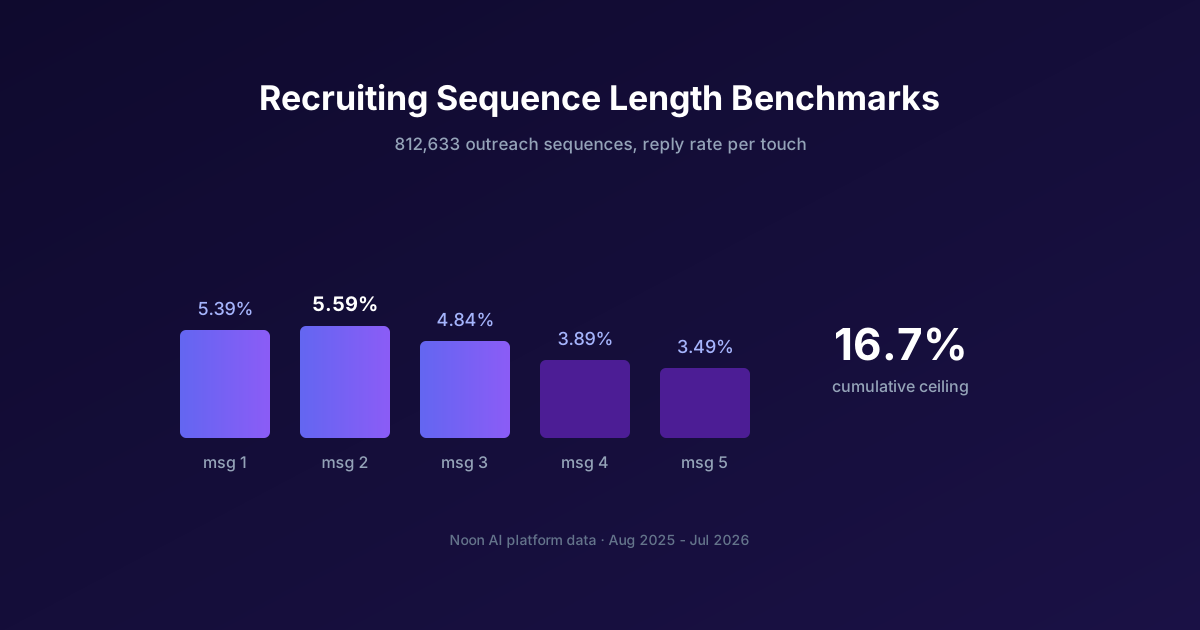
Key takeaway: Five touches capture 95% of the replies a recruiting sequence will ever produce, and touch two is the single highest-yield message in the sequence. Measured across 812,633 outreach sequences on the Noon platform from August 2025 to July 2026: each candidate who receives message one replies to it 5.39% of the time, message two converts 5.59% of the candidates who receive it, message three 4.84%, message four 3.89%, and message five 3.49%. Cumulatively that is a 5.4% reply rate after one touch, 12.9% after three, 15.9% after five, and a 16.7% ceiling that later messages barely move. Stopping at one message costs roughly two thirds of the pipeline; going past six buys almost nothing.
Sequence length is the most-argued and least-measured setting in outbound recruiting. The published advice is candidate-side and cautious: Juicebox's guide tells applicants to use a "Rule of Three", meaning "your initial application and a maximum of two well-timed follow-ups" (Juicebox, follow-up email guide, 6 November 2025), and Coursera advises that "sending a brief email every two weeks shows respect for their time" (Coursera, how to follow up with a recruiter, 8 July 2026). Neither is a benchmark for a recruiter running outbound sourcing at volume, and neither is derived from reply data.
Here is what the reply data says.
How much does each additional message actually add?
The honest way to measure this is per-touch conversion: of the candidates who received message k, what share replied to it before the next message went out. That avoids the trap explained further down.
| Message | Candidates who received it | First replies to it | Reply rate for this message | Cumulative reply rate |
|---|---|---|---|---|
| 1 | 812,633 | 43,782 | 5.39% | 5.39% |
| 2 | 642,663 | 35,955 | 5.59% | 9.81% |
| 3 | 524,060 | 25,340 | 4.84% | 12.93% |
| 4 | 396,415 | 15,407 | 3.89% | 14.83% |
| 5 | 245,342 | 8,565 | 3.49% | 15.88% |
| 6 | 86,658 | 3,861 | 4.46% | 16.36% |
| 7 | 23,273 | 1,540 | 6.62% | 16.54% |
| 8 | 14,940 | 927 | 6.20% | 16.66% |
| 9 to 12 | 7,646 | 502 | 4.56% at msg 9, 0.94% by msg 12 | 16.72% |
Three findings worth acting on:
Message two out-converts message one. 5.59% against 5.39%, on 642,663 candidates. The second message is not a salvage attempt on a failed first message; it is the best-performing message in the sequence. That is consistent with what recruiters see anecdotally, since the second message arrives when the candidate is no longer triaging a cold inbox for the first time.
The decay only starts at message four. Touches one through three sit in a narrow 4.8% to 5.6% band. The drop to 3.89% and 3.49% at touches four and five is the first real decline.
The rise at touches seven and eight is a selection effect, not a reward for persistence. Only 23,273 candidates ever received a seventh message, roughly 3% of the dataset, and those are concentrated in searches where a recruiter deliberately kept pushing on a short, high-value list. Read those two rows as "what happens on hand-picked lists", not as an argument for eight-step sequences.
Cumulatively, the shape is clear: three touches get you 77% of the achievable reply rate, five get you 95%, and six get you 98%. Everything beyond touch six adds 0.36 percentage points in total.
Which message do replies actually come from?
The same data expressed as a share of all replies received:
| Message | Share of all replies | Cumulative |
|---|---|---|
| 1 | 32.2% | 32.2% |
| 2 | 26.5% | 58.7% |
| 3 | 18.7% | 77.4% |
| 4 | 11.3% | 88.7% |
| 5 | 6.3% | 95.0% |
| 6 | 2.8% | 97.8% |
| 7+ | 2.2% | 100% |
67.8% of replies arrive after the first message. A single-touch cold campaign reaches under a third of the candidates who were willing to talk. (Our earlier follow-up benchmarks put this figure at 64.9% using a message-index definition of the reply step; the 67.8% here counts sent touches that preceded the reply and excludes out-of-office and bounce events, so the two are the same finding measured two ways.)
Why do raw "reply rate by sequence length" numbers say the opposite?
Because a reply ends the sequence, so sequence length is contaminated by the outcome. Grouping sequences by how many messages they ended up containing produces this:
| Total messages sent | Sequences | Reply rate |
|---|---|---|
| 1 | 169,970 | 18.4% |
| 2 | 118,603 | 25.7% |
| 3 | 127,645 | 21.0% |
| 4 | 151,073 | 12.9% |
| 5 | 158,684 | 7.9% |
Read naively, that table says long sequences perform terribly and recruiters should send two messages. It says nothing of the kind. A sequence stops when a candidate replies, so short sequences are enriched with repliers, and long sequences are, almost by construction, the ones nobody replied to. The same bias produces an even more misleading cut: among email-first sequences, those with no follow-up show a 24.8% reply rate against 13.9% for those with follow-ups. Nobody should conclude that follow-ups suppress replies. They ran because no reply had arrived.
Per-touch conversion, in the first table, is immune to this: it conditions on having received the message, then asks what happened next. Any sequence-length benchmark that does not condition on delivery of that touch is reporting survivorship, not performance.
How long should the gaps between touches be?
Observed cadence across the same dataset, measured as the median gap between consecutive sent messages:
| Gap | Sequences | Median interval |
|---|---|---|
| Message 1 to 2 | 642,663 | 47.9 hours (2.0 days) |
| Message 2 to 3 | 524,060 | 94.8 hours (4.0 days) |
| Message 3 to 4 | 396,415 | 111.6 hours (4.7 days) |
| Message 4 to 5 | 245,342 | 120.0 hours (5.0 days) |
| Message 5 to 6 | 86,658 | 94.9 hours (4.0 days) |
Set against reply latency, this cadence is slightly too slow after touch two. About 90% of the replies a given message produces arrive within 64 to 76 hours of it being sent, which is the finding in our candidate response time benchmarks. A 4 to 5 day interval therefore leaves one to two days in which the previous message has stopped working and the next one has not been sent. A three-day interval, held for the first five touches, fits the measured reply window without stacking messages on top of each other.
That also matches the platform mechanics on LinkedIn, where a recruiter cannot send another InMail "until they respond to the first message you sent" and LinkedIn itself sends "an automatic reminder within three days" (LinkedIn Recruiter Help). On LinkedIn, the three-day mark is when the platform has already made your follow-up for you, so the recruiter's next real touch belongs on another channel. Multi-channel sequencing is not a sophistication, it is the only way to keep a cadence on LinkedIn at all, and the documented ceilings are in our LinkedIn limits guide.
What does an evidence-based sequence look like?
- Five touches, then stop. Five captures 95.0% of achievable replies. A sixth adds 2.8 points of reply share; a seventh and eighth together add 2.2 on hand-picked lists only.
- Three-day intervals. Roughly 90% of a message's replies land inside 64 to 76 hours, so day three is when the previous message is spent.
- Put your best writing in message two, not message one. It converts at the highest rate of any touch in the sequence, on the second-largest audience.
- Change channel rather than repeating one. InMail-first sequences reply at 20.0% against 15.0% for email-first, and LinkedIn blocks a second InMail before a response, so the natural touch two is email and the natural touch three is a connection request. Acceptance-rate benchmarks for that step are in the LinkedIn connection acceptance benchmarks.
- Do not judge sequence performance on completed-sequence reply rates. Track per-touch conversion, or you will conclude your best campaigns are your worst.
- Keep candidates open for 30 days after the last touch. Replies keep arriving well past the final send, and the funnel effects of premature closure show up in recruiting funnel benchmarks.
Running a five-touch, three-day, multi-channel cadence by hand across hundreds of candidates is an operations problem rather than a recruiting one, which is exactly the part worth automating. Noon's AI outreach sequences email, LinkedIn, and SMS with per-candidate personalization and keeps the intervals honest, and replies route straight into the AI scheduler instead of an inbox queue. For the message content itself, our cold recruiting outreach templates and the outreach benchmarks hub cover what goes inside each touch.
FAQ
How many follow-up emails should a recruiter send? Four, for a five-message sequence. Measured across 812,633 sequences, cumulative reply rate reaches 15.88% at five touches against a 16.72% ceiling, so five messages capture 95% of achievable replies (Noon AI platform data, August 2025 to July 2026).
Is one message ever enough? No. A single touch converts 5.39% of candidates and yields 32.2% of the replies a full sequence would produce. Two thirds of candidates who eventually reply do so to a follow-up.
Which message in a sequence performs best? Message two, at a 5.59% reply rate among the 642,663 candidates who received it, marginally ahead of message one at 5.39% and clearly ahead of message four at 3.89%.
Do long sequences annoy candidates and hurt reply rates? Our data cannot measure annoyance, and the apparent collapse in reply rate for longer sequences is survivorship bias rather than fatigue: sequences run long precisely because no reply arrived. What the per-touch numbers do show is that touches beyond six add 0.36 percentage points of reply rate in total, so they are usually not worth the send.
How many days should there be between recruiting follow-ups? Three. About 90% of the replies to a given message arrive within 64 to 76 hours of it. Recruiters in this dataset wait 47.9 hours before touch two, then stretch to 4 to 5 days for later touches, which is slower than the reply window justifies.
How many touches do recruiting sequences actually contain? 89.3% of sequences in this dataset sent 5 messages or fewer, and only 2.9% ever reached a seventh touch. Sequence lengths of 1 to 5 touches are all common, and volume falls sharply after 6.
Methodology
- Dataset: 812,633 anonymized candidate outreach sequences initiated on the Noon platform between 2025-08-01 and 2026-07-31, containing 3,379,700 sent messages across email, LinkedIn InMail, and LinkedIn connection requests.
- Per-touch reply rate for message k = sequences whose first qualifying reply arrived after message k and before message k+1, divided by all sequences that received message k. This conditions on delivery of the touch, which removes the survivorship bias described above.
- Cumulative reply rate = all first replies up to and including touch k, divided by the 812,633 sequences that received a first touch.
- Qualifying reply = first inbound candidate message, excluding out-of-office autoresponders and bounce events. 135,968 sequences (16.7%) received one.
- Cadence intervals are median differences between consecutive sent timestamps within a sequence.
- Sequence composition is chosen by recruiters, not randomized, so per-touch rates describe what happens at each step of real campaigns rather than a controlled test of sequence length.
- All figures are aggregate. No candidate, customer, or company-identifiable data appears in any statistic above.