
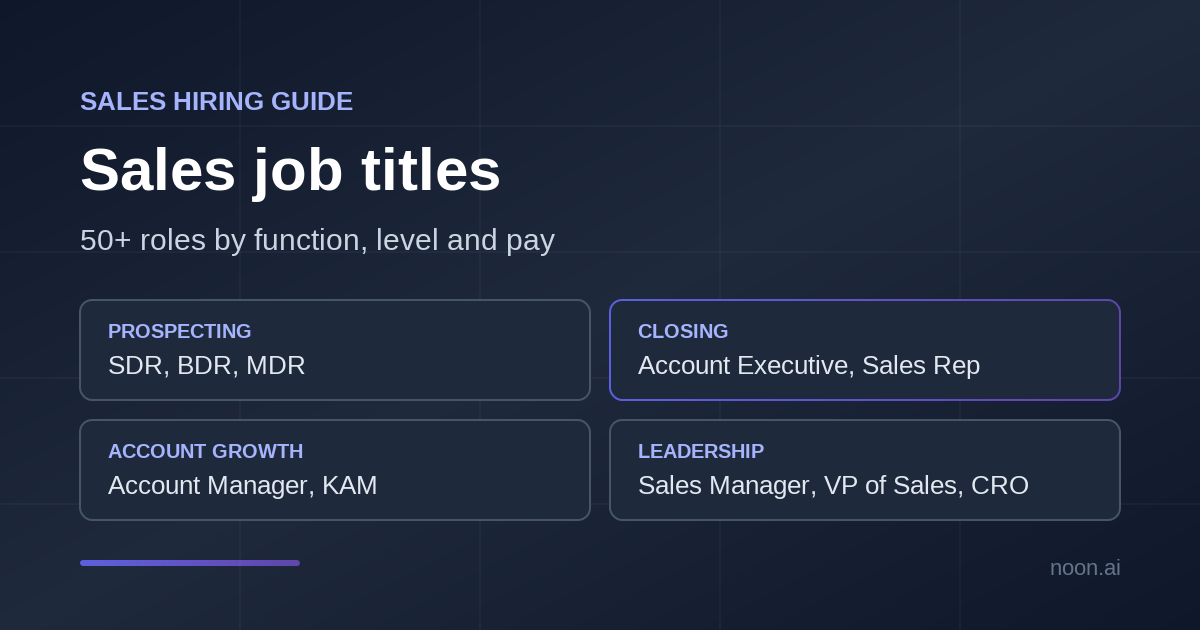
Key takeaway: Most sales job titles fall into six functions: prospecting (SDR, BDR), closing (Account Executive, Sales Representative), account growth (Account Manager, Key Account Manager), technical sales (Sales Engineer, Solutions Consultant), sales operations and enablement, and leadership (Sales Manager up to CRO). The title alone rarely tells you the job. Read it together with the customer segment, whether the person carries a quota, and whether they manage people.
Sales is one of the largest job families in the U.S. economy, which is why its titles are so inconsistent. In the Bureau of Labor Statistics' May 2025 Occupational Employment and Wage Statistics, retail salespersons alone held 3,897,860 jobs, and sales representatives of services held another 1,256,010 (BLS OEWS, May 2025).
Pay varies as much as the titles. The same BLS release puts the median annual wage at $72,080 for wholesale and manufacturing sales representatives, $124,900 for sales engineers and $148,270 for sales managers. A title that sounds senior at one company can sit in a lower pay band at another, so hiring teams need a shared map before they write a job post or a search string.
This guide gives that map: titles grouped by function and level, the segment and industry variants that hide good candidates, the titles that mislead, and how to use all of it when you hire.
What are the main types of sales job titles?
Group titles by the work, not the wording. Every sales org splits the revenue process into roughly the same six jobs, whatever each company calls them.
| Function | What the person owns | Common titles |
|---|---|---|
| Prospecting | Booking first meetings | SDR, BDR, MDR, Lead Generation Specialist |
| Closing | Signing new business against a quota | Account Executive, Sales Representative, Inside Sales Rep, Territory Manager |
| Account growth | Renewals, upsell and cross-sell | Account Manager, Key Account Manager, Strategic Account Manager |
| Technical sales | Demos, discovery and proofs of concept | Sales Engineer, Solutions Consultant, Pre-Sales Consultant |
| Operations and enablement | Process, data, tooling and training | Sales Operations Manager, Revenue Operations Analyst, Sales Enablement Manager |
| Leadership | Team results, hiring and forecasting | Sales Manager, Sales Director, VP of Sales, CRO |
The fastest way to read an unfamiliar title is to ask which of these six rows it belongs to. If you cannot tell from the title, the job description or the person's profile almost always answers it within two lines.
Sales job titles by seniority
Within each function, titles step up in a fairly predictable ladder. The exact rungs vary, but most B2B companies use some version of this.
Entry level (0 to 2 years)
- Sales Development Representative (SDR)
- Business Development Representative (BDR)
- Market Development Representative (MDR)
- Inside Sales Representative
- Sales Associate
- Sales Coordinator
- Lead Generation Specialist
- Associate Account Executive
Individual contributor, mid level (2 to 6 years)
- Account Executive (AE)
- Mid-Market Account Executive
- Outside Sales Representative
- Field Sales Representative
- Territory Manager
- Account Manager
- Sales Engineer
- Solutions Consultant
- Sales Operations Analyst
- Channel Sales Manager
- Partner Manager
Senior individual contributor
- Senior Account Executive
- Enterprise Account Executive
- Strategic Account Executive
- Key Account Manager
- Strategic Account Manager
- Global Account Manager
- Principal Sales Engineer
- Senior Solutions Architect
First-line management
- SDR Manager or Sales Development Manager
- Sales Manager
- Inside Sales Manager
- Regional Sales Manager
- Account Management Lead
- Sales Engineering Manager
- Sales Operations Manager
- Sales Enablement Manager
Senior leadership
- Director of Sales
- Director of Sales Development
- Area Vice President (AVP)
- Regional Vice President (RVP)
- Head of Sales
- VP of Sales
- Senior Vice President of Sales
- Chief Sales Officer (CSO)
- Chief Revenue Officer (CRO)
Smaller companies compress the top of this ladder: at a small business the director of sales is usually the most senior salesperson, and only larger companies add a VP of Sales or Chief Sales Officer above that role (U.S. Chamber of Commerce CO, 5 Common Sales Job Titles and What They Mean). Two notes on the ladder. "Senior" and "Enterprise" often mean the same step, and a company with no enterprise segment will use "Senior" instead. And first-line managers are not always promoted closers; many SDR managers come up through the SDR team and have never closed a deal themselves, which matters if you are hiring them into a closing org.
How does the customer segment change the title?
The single biggest source of title confusion is the segment the rep sells into. The same "Account Executive" title covers very different jobs depending on deal size.
| Segment | Typical title | What changes |
|---|---|---|
| SMB | Account Executive, Inside Sales Rep | Short cycles, high deal volume, mostly phone and video |
| Mid-market | Mid-Market Account Executive | Several stakeholders, longer cycles, some travel |
| Enterprise | Enterprise Account Executive | Few large deals a year, procurement and security reviews |
| Strategic or named accounts | Strategic Account Executive, Global Account Manager | A handful of named logos, multi-year relationships |
When you hire, match the segment before you match the title. An SMB rep with a strong record is usually a better enterprise candidate after a year in mid-market than straight from SMB, because the deal mechanics differ so much. The job analysis behind the role should state the segment, the average deal size and the cycle length, so the title on the post matches the work.
Sales titles that vary by industry and region
Some of the strongest candidates never had "sales" in their title. These are the variants recruiters most often miss.
- Medical devices and life sciences: Territory Manager, Clinical Specialist, Medical Science Liaison (a scientific education role, not a quota-carrying sales position).
- Pharmaceuticals: Pharmaceutical Sales Representative, Key Account Director.
- Industrial and manufacturing: Technical Sales Representative, Applications Engineer, Distributor Manager.
- Financial services: Relationship Manager, Financial Advisor, Wholesaler (in asset management, a wholesaler sells funds to advisors).
- Insurance: Producer, Insurance Agent, Account Executive (at a brokerage, often a service role).
- Real estate: Real Estate Agent, Broker, Leasing Consultant.
- Retail: Sales Associate, Sales Floor Associate, Store Manager.
- UK and Ireland: Business Development Manager often means a closer, not a prospector.
- Netherlands and Belgium: Commercial Manager is a common closing title.
BLS tracks several of these as separate occupations. Its May 2025 estimates count 193,370 real estate sales agents with a median wage of $52,830, and 284,800 sales representatives for technical and scientific products with a median of $104,920 (BLS OEWS, May 2025).
Which sales titles mislead recruiters?
Every synonym you add to a search widens it, and some widen it in the wrong direction. These five cause the most wasted screens.
- Account Executive at an agency. In advertising, PR and marketing agencies, an Account Executive runs client delivery and often has never sold new business.
- Account Manager vs. Customer Success Manager. An Account Manager usually carries a revenue target. A Customer Success Manager is typically measured on adoption and retention. Include CSMs only when the role is about renewals and expansion.
- Sales Manager as an individual contributor. In SMB, field sales and much of Europe, "Sales Manager" can mean a rep with a territory and no direct reports. Check the profile for team size.
- Business Development in partnerships. "Business Development Manager" at a tech company is often a partnerships or corporate development job, not a sales seat.
- SDR vs. BDR. Many companies use SDR for inbound and BDR for outbound, but plenty use them the other way around or interchangeably. Ask about the lead source in the first call.
The fix for all five is the same: screen on the work (quota, segment, lead source, team size) rather than the label.
How should you use sales titles when hiring?
Titles matter at two points in a sales hire: when you write the post and when you search for people.
Writing the job post. Use the plain, most-searched version of the title ("Account Executive", "Sales Development Representative") and put the segment or specialty after it: "Account Executive, Mid-Market". Internal labels like "Revenue Hunter" or "Growth Champion" lower the number of people who find the post. State the quota, the on-target earnings structure and the segment in the first screen of the description. If you are building a team from zero, the order of hires matters more than the titles; the tools for hiring sales reps guide covers how to set up the loop.
Searching for candidates. Search the title family, then filter by the work. A starting Boolean string for a mid-market closer:
("Account Executive" OR "Sales Executive" OR "Territory Manager" OR "Inside Sales" OR "Business Development Manager" OR "Commercial Manager") AND (SaaS OR software) NOT ("Customer Success" OR advertising OR "public relations" OR recruiter)
For an SDR or BDR search, stem on the phrase instead of the acronym, because bare acronyms pull in unrelated profiles:
("Sales Development" OR "Business Development Representative" OR "Market Development" OR "Lead Generation") NOT (manager OR director)
The same title-family approach works for other roles. Our list of alternative job titles for recruiters applies it to talent acquisition.
Interviewing. Titles do not predict performance, so the interview has to test the work. Leadership candidates need the questions in our leadership interview questions guide, and early-career SDR hiring often turns on coachability and drive, which we cover in hiring for personality. If you would rather hand the search to a specialist firm, see the best sales and marketing recruiting firms.
How much do sales roles pay?
BLS does not publish pay by job title, but its occupation codes line up with the main title groups. These are national medians from the May 2025 release (BLS OEWS, May 2025).
| BLS occupation | Closest titles | U.S. employment | Median annual wage |
|---|---|---|---|
| Retail salespersons | Sales Associate, Sales Floor Associate | 3,897,860 | $35,410 |
| Sales representatives of services | Account Executive, Inside Sales Rep (services) | 1,256,010 | $69,990 |
| Wholesale and manufacturing sales reps, except technical | Sales Representative, Territory Manager | 1,238,190 | $72,080 |
| Wholesale and manufacturing sales reps, technical and scientific | Technical Sales Rep, Medical Device Rep | 284,800 | $104,920 |
| First-line supervisors of non-retail sales workers | Sales Team Lead, Inside Sales Manager | 214,390 | $87,520 |
| Sales engineers | Sales Engineer, Solutions Consultant | 51,790 | $124,900 |
| Sales managers | Sales Manager, Director of Sales, VP of Sales | 637,080 | $148,270 |
Treat these as floors for a benchmark, not offers. Software and enterprise roles usually pay above the national median for their code, and quota-carrying roles split pay between base and variable, so compare on-target earnings, not base alone.
Where Noon fits
Title search breaks down for sales roles because the same work hides under dozens of labels. A common thing we hear in evaluation calls is that teams want candidates from more sources than LinkedIn alone. Noon's AI sourcer searches the whole web on what a person has done (segment, quota, industry, deal size) rather than on the title they happen to hold, then runs personalized email and SMS outreach and books interviews with the people who reply. Sourcing, contacts and agents are unlimited on one quote-based plan; see pricing or book a demo.
Frequently asked questions
What are the most common sales job titles? Sales Representative, Account Executive, Sales Development Representative, Business Development Representative, Account Manager, Sales Manager and Sales Associate. In retail, Sales Associate is by far the most common; in B2B software, Account Executive and SDR are.
What is the hierarchy of job titles in sales? A typical B2B ladder runs SDR or BDR, Account Executive, Senior or Enterprise Account Executive, Sales Manager, Director of Sales, VP of Sales and then Chief Revenue Officer or Chief Sales Officer. Specialist tracks such as sales engineering and account management have their own senior individual contributor and manager levels.
What is the difference between an SDR and an Account Executive? An SDR books qualified meetings and hands them over. An Account Executive runs the sales process from the first meeting to a signed contract and carries a new-business quota.
What is a good title for a salesperson on a job post? Use the standard title candidates search for, such as "Account Executive" or "Sales Representative", and add the segment or product after a comma. Avoid creative titles: they reduce how often the post appears in job searches.
Is Account Manager a sales job? Usually, yes. Most Account Managers carry a revenue target for renewals and expansion in existing accounts. At advertising and marketing agencies, though, the title often describes a client service role without a sales target.
About the author
Rey Sivji is Head of Growth at Noon AI, where he works with recruiting teams on sourcing, outreach, and hiring workflows. Email rey@noon.ai.