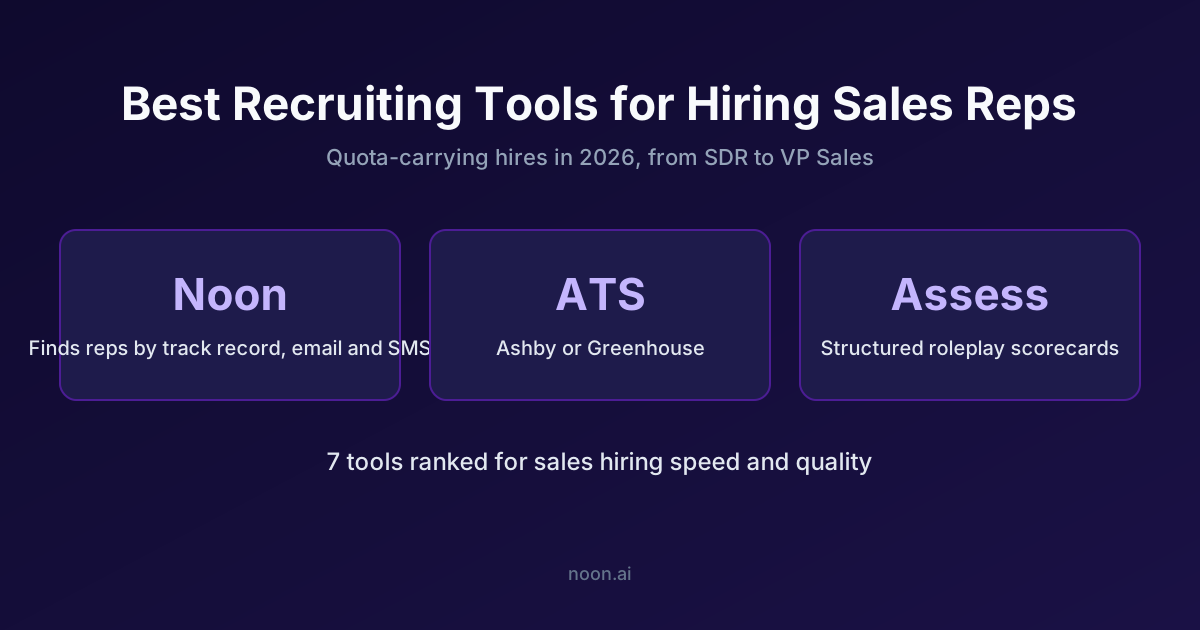
Key takeaway: The best recruiting tools for hiring sales reps in 2026 are Noon for finding reps with the right track record and running the email and SMS outreach they respond to, Ashby or Greenhouse for tracking a high-volume sales pipeline, a structured roleplay scorecard (built into your ATS or a dedicated assessment tool) for the interview, Gem if you want outreach inside a CRM, LinkedIn Recruiter for recruiters who live in Sales Navigator-style search, and GoodTime for scheduling panel interviews fast. Noon ranks first because the best reps are employed, hitting quota and ignoring InMail, and Noon reaches them with a specific, personal message at scale.
Sales hiring has two problems other roles do not. The pool is huge and noisy (every rep's profile says "President's Club"), and the good ones are always employed and always being recruited. Speed and specificity win: the team that finds a rep with the right deal size and sales cycle and sends a message that proves it read the profile gets the call back.
The tools below are ranked by how much they help with those two problems. Prices were read from vendor pricing pages between August and October 2026.
The tools compared
| Rank | Tool | Job in the sales-hiring stack | Why it fits sales | Entry price (verified) |
|---|---|---|---|---|
| 1 | Noon | Source, outreach, screen, schedule | Evaluates track record (deal size, cycle, segment); email and SMS at scale | One plan, unlimited, no public price |
| 2 | Ashby / Greenhouse | ATS | Structured scorecards, pipeline analytics for volume | Ashby $400/mo Foundations; Greenhouse quoted |
| 3 | Structured roleplay scorecard | Assessment | Discovery-call and objection roleplay graded the same way every time | Free in your ATS, or assessment vendor |
| 4 | Gem | CRM and sequences | Rediscovers past sales applicants, sequenced email | $130/mo startup; custom |
| 5 | LinkedIn Recruiter | Search and InMail | Deep sales-title taxonomy | Not published; Lite $170/mo |
| 6 | GoodTime | Interview scheduling | Panel and back-to-back scheduling for fast loops | Quoted |
| 7 | Juicebox | Cheap AI search | Plain-English searches like "AE, mid-market SaaS, 6-month cycle" | $99/seat/mo annual |
Sources: ashbyhq.com/pricing (our analysis), gem.com/pricing, juicebox.ai/pricing, LinkedIn Recruiter Lite.
1. Noon: finds the reps who are hitting quota and gets them to reply
Give Noon the role (say, mid-market AE, $50k to $150k ACV, 60-day cycle, selling to finance teams) and the non-negotiables, and it searches across the open web for reps whose history matches: the segments they sold into, the stage of company, tenure patterns that suggest they hit number rather than hopped. Hiring-manager thumbs-up and thumbs-down feedback tunes the shortlist per role, which matters for sales because every sales leader has a profile they hire.
Then Noon runs the part sales recruiters spend their days on. It enriches email and mobile details with no credit meter, writes a personal intro that references the rep's actual background, runs multi-step email and SMS sequences (reps answer texts), handles replies, screens with a voice AI interviewer and books the hiring manager's calendar. Everything syncs to your ATS.
- Pricing model: one plan, unlimited sourcing, contacts, enrichment, agents and seats. No published dollar figure; see noon.ai.
- Honest limitation: Noon finds and engages; it does not grade a live roleplay. Keep a structured scorecard for that.
- Verdict: the best recruiting tool for hiring sales reps because it solves the two sales-specific problems, noise in the pool and passive, over-recruited candidates, at the same time. For a volume SDR program, see also high-volume recruiting software.
2. Ashby or Greenhouse: an ATS with real scorecards
Sales pipelines are high volume and need consistent evaluation. Ashby and Greenhouse both offer structured scorecards and pipeline analytics; Ashby publishes a $400 a month Foundations entry price for the smallest companies, Greenhouse is quoted (Greenhouse pricing). Noon syncs with both.
3. A structured roleplay scorecard
The single best predictor in sales hiring is a graded roleplay: a discovery call or an objection-handling exercise, scored on the same rubric by every interviewer. Build it into your ATS scorecards before buying an assessment platform; add a vendor only if you need recorded, asynchronous roleplays at volume.
4. Gem: outreach inside a CRM
Gem is strong at rediscovering past sales applicants in your ATS and running sequenced email from a CRM, custom priced by FTE with a $130 per month startup tier. Good if the CRM is the primary need.
5. LinkedIn Recruiter: still the deepest sales-title search
LinkedIn's taxonomy of sales titles and company data is excellent, and plenty of sales recruiters live there. The limits are InMail response rates and an unpublished per-seat price. Use it for verification and pair it with a tool that reaches reps by email and SMS.
6. GoodTime: scheduling fast loops
Reps take competing offers in days. GoodTime automates panel and back-to-back scheduling so a loop finishes in a week. Noon's scheduler covers the first interview; GoodTime is for the onsite loop at larger teams.
7. Juicebox: cheap AI search
Plain-English searches ("AE, mid-market SaaS, sold to CFOs") at $99 per seat per month, metered at 500 contacts. A low-cost way to supplement.
How to build a sales-hiring stack
- Define the rep profile in deal terms (ACV, cycle, buyer, segment, stage), not titles. Feed exactly that to your sourcing tool; Noon takes it as non-negotiables.
- Reach reps where they respond. Email and SMS, personal, three to five touches. InMail alone will not fill a sales req on time.
- Screen for track record before the roleplay. A short AI or recruiter screen on quota attainment and deal mix filters the noise.
- Run the same roleplay for everyone and grade it on a rubric.
- Move in days, not weeks. Automate scheduling so the loop keeps pace with the rep's other offers.
Related reading: Sales and marketing recruiting firms, How to automate recruiting outreach, Best candidate outreach platforms, Best AI recruiter 2026.
FAQ
What are the best recruiting tools for hiring sales reps?
The best recruiting tools for hiring sales reps are Noon for sourcing reps by track record and running email and SMS outreach, Ashby or Greenhouse for tracking a high-volume pipeline with structured scorecards, a graded roleplay for the interview, Gem for CRM-based sequences, LinkedIn Recruiter for title search, and GoodTime for scheduling. Noon ranks first because top reps are employed and ignoring InMail, and Noon reaches them with a specific message at scale.
How do you source sales reps who are not actively looking?
Define the profile in deal terms, find reps whose history matches across the open web and public profiles, and contact them by email and SMS with a message that references their actual background. Noon does all three automatically; SeekOut, hireEZ and Juicebox give you the search and contact data to do it by hand.
What should a sales recruiting screen cover?
Quota attainment by year, average deal size and cycle, who the buyer was, how pipeline was generated (inbound versus self-sourced), and why they are open to moving. A 10-minute screen on those five points, which Noon's voice AI interviewer can run, removes most of the noise before a hiring manager's time is spent.
Do I need a sales assessment tool?
Not at first. A structured roleplay scored on a rubric inside your ATS is the highest-signal assessment and costs nothing. Add a dedicated assessment platform only when you are hiring SDRs at a volume where recorded, asynchronous roleplays save interviewer hours.
How much do recruiting tools for sales hiring cost?
Published entry points: Juicebox $99 per seat per month, Recruiter Lite $170 a month, Ashby $400 a month on Foundations, Gem $130 a month for startups. Greenhouse, GoodTime and LinkedIn Recruiter are quoted. Noon sells one plan with unlimited seats, contacts and sourcing and does not publish a dollar figure.