
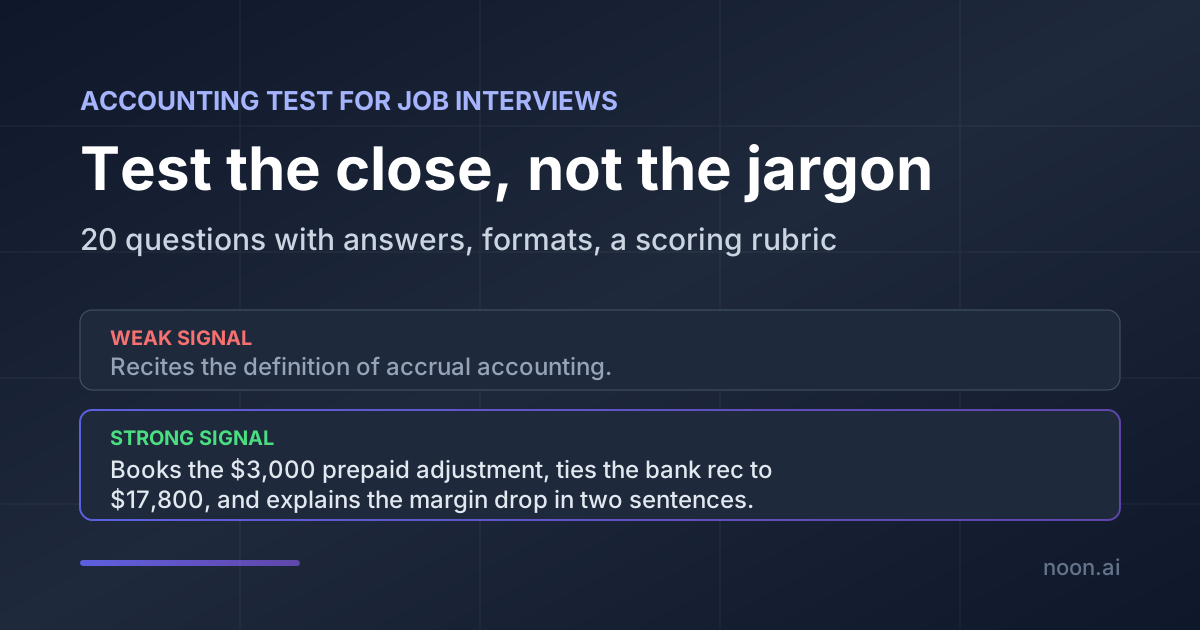
Key takeaway: An accounting test for a job interview should mirror the month-end close: journal and adjusting entries, statement impacts, reconciliations, cutoff and a short piece of analysis, plus an Excel task for most roles. Keep it to 30 to 60 minutes depending on level, give every candidate the same questions and time limit, score against a written answer key, and use the result alongside a structured interview rather than as a pass-or-fail gate on its own.
Accounting is a large, well-paid hiring market, which is why a cheap screen before the interview loop pays for itself. O*NET, using U.S. Bureau of Labor Statistics data, puts the 2025 median wage for accountants and auditors at $83,680 a year across 1,595,200 jobs, with about 115,300 projected openings a year over its 2025 to 2035 outlook (O*NET OnLine, Accountants and Auditors 13-2011.00).
A resume shows where someone closed the books. It does not show whether they can post a clean accrual or spot a reconciliation that ties for the wrong reason. Job-specific evidence is also what predicts performance: the largest recent re-analysis of selection research cut mean validity estimates by .10 to .20 points, yet most methods that ranked high before still ranked high, and structured interviews came out on top (Sackett, Zhang, Berry and Lievens, Journal of Applied Psychology, 2022).
This guide gives hiring managers a ready-to-use test: what to cover, which format to pick, 20 questions with worked answers, a scoring rubric and how to keep the test fair. If you are the candidate, the questions double as a practice set, and the last sections cover how to prepare.
What does an accounting interview test cover?
Test the tasks the person will do in their first close. O*NET's task list for accountants leads with examining financial records for accuracy, reconciling account discrepancies, preparing adjusting journal entries and reporting to management, so those belong at the core of any test.
| Domain | What you are testing | Bookkeeper / AP / AR | Staff accountant | Senior accountant |
|---|---|---|---|---|
| Fundamentals | Debits and credits, normal balances, accrual vs. cash | Yes | Yes | Quick check |
| Journal and adjusting entries | Prepaids, accruals, deferrals, depreciation, corrections | Basic | Yes | Complex cases |
| Statement linkages | How one entry moves the income statement, balance sheet and cash flow | Light | Yes | Yes |
| Reconciliations and error detection | Bank recs, out-of-balance trial balances, subledger tie-outs | Yes | Yes | Yes, with judgment |
| Working capital and cutoff | AR allowance, AP accruals, shipping terms | AP/AR focus | Yes | Yes |
| Inventory and COGS | FIFO and weighted average, write-downs | If relevant | Yes | Yes |
| Analysis | Ratios, variance explanations in plain language | No | Light | Yes |
| Excel | SUMIFS, lookups, pivot tables, cleaning an export | Yes | Yes | Yes |
Write the chosen domains into the role's scorecard before you test anyone. Testing domains the job does not use makes the test longer, less fair and harder to defend.
Which accounting test format should you use?
Most teams combine two formats: a short timed knowledge test to screen, then a practical exercise for finalists. Pick by role and by how much candidate time you can reasonably ask for.
| Format | Typical length | Best for | Watch-outs |
|---|---|---|---|
| Timed multiple-choice knowledge test | 15 to 30 min | Screening a large applicant pool for bookkeeper, AP/AR and staff roles | Rewards memorization; cannot show judgment |
| Short-answer technical test (like the 20 questions below) | 30 to 45 min | Staff and senior accountants | Needs a written answer key so scoring is consistent |
| Excel exercise on a sample export | 20 to 40 min | Any role that lives in spreadsheets | Provide the file and the software version you expect |
| Close case (reconcile, adjust, explain) | 45 to 90 min | Senior accountants, close leads, controllers | Too long for an early screen; pay or limit take-home time |
| Live technical interview questions | 15 to 20 min of a loop | Probing how a candidate reasons out loud | Score with anchors or it drifts into gut feel |
Off-the-shelf libraries from skills assessment tools cover the multiple-choice layer well. The practical exercise is where your own chart of accounts, close calendar and systems make the test specific to the job, and it is the part generic libraries miss.
Place the test after the screening call and before the onsite or panel. Testing before any human contact loses good candidates who will not do homework for a company that has not spoken to them.
20 accounting test questions with answers
Use these as a short-answer test or pick a subset for a timed screen. Each answer lists what a correct response contains, so any reviewer scores it the same way.
Fundamentals
1. During the year, a company's total assets rose by $10,000 and its total liabilities rose by $4,000. What happened to equity? Equity rose by $6,000. Assets equal liabilities plus equity, so the change in equity is the change in assets minus the change in liabilities.
2. Which of these normally carries a credit balance: accounts receivable, accumulated depreciation, prepaid insurance or dividends? Accumulated depreciation. It is a contra-asset account that offsets the related fixed asset. The other three normally carry debit balances.
3. A company performs $5,000 of services in December, invoices in January and is paid in February. When is the revenue recognized under accrual accounting? December, when the service is performed. Strong candidates add that the company records a receivable in December, and some will note an unbilled receivable or contract asset until the invoice goes out.
Journal and adjusting entries
4. On October 1 the company paid $12,000 for a 12-month insurance policy and debited prepaid insurance. What is the December 31 adjusting entry? Debit insurance expense $3,000, credit prepaid insurance $3,000. Three months have passed at $1,000 a month; the remaining prepaid balance is $9,000.
5. Employees earned $8,000 of wages in the last week of December that will be paid on January 5. What entry is needed at December 31? Debit wages expense $8,000, credit wages payable (accrued wages) $8,000. On January 5 the payment debits wages payable and credits cash.
6. On November 1 a customer prepaid $24,000 for a 12-month subscription. How much revenue is recognized by December 31, and what is the deferred revenue balance? Revenue of $4,000 (two months at $2,000) and a deferred revenue liability of $20,000.
7. Equipment costs $50,000, has a $5,000 salvage value and a five-year useful life. What is annual straight-line depreciation? $9,000 a year: ($50,000 minus $5,000) divided by five. The entry debits depreciation expense and credits accumulated depreciation.
8. A $1,200 utilities bill was posted to office supplies expense. What is the correcting entry, and what is the effect on net income? Debit utilities expense $1,200, credit office supplies expense $1,200. Net income does not change because both are expense accounts; the correction fixes classification only.
Financial statement impacts
9. The year-end accrual for $3,000 of interest expense was missed. What is the effect on the financial statements? Expenses are understated and net income is overstated by $3,000. Liabilities (interest payable) are understated by $3,000 and equity is overstated by $3,000. Ignore tax unless the candidate raises it, which is a good sign.
10. Classify each in the statement of cash flows under U.S. GAAP: buying equipment, paying interest, paying dividends. Buying equipment is investing. Interest paid is operating under U.S. GAAP. Dividends paid are financing. Candidates who mention that IFRS allows interest paid in operating or financing show useful range.
11. Beginning retained earnings are $200,000, net income is $60,000 and dividends declared are $15,000. What are ending retained earnings? $245,000: $200,000 plus $60,000 minus $15,000.
Reconciliations and the close
12. The bank statement shows $18,400. Outstanding checks total $2,100 and a $1,500 deposit is in transit. The book balance is $17,850, and a $50 bank fee has not been recorded. Does it reconcile? Yes. Adjusted bank balance: $18,400 minus $2,100 plus $1,500 equals $17,800. Adjusted book balance: $17,850 minus $50 equals $17,800. Only the $50 fee needs a journal entry (debit bank fees expense, credit cash).
13. The trial balance is out of balance by $540. Where do you look first? A difference divisible by 9 (540 / 9 = 60) points to a transposition or slide error, such as 1,060 entered as 1,600. Also check for a $270 item posted to the wrong side, since posting a debit as a credit creates a difference of twice the amount. Then check one-sided entries and accounts omitted from the trial balance.
14. Accounts receivable is $400,000. The aging analysis estimates 3% will be uncollectible. The allowance for doubtful accounts has a $4,000 credit balance before adjusting. What is bad debt expense? $8,000. The target allowance is $12,000 (3% of $400,000), so the entry tops up the existing $4,000: debit bad debt expense $8,000, credit allowance $8,000.
15. Goods were shipped FOB shipping point on December 30 and arrive on January 3. Whose inventory are they on December 31, and what should the buyer record? The buyer's, because title passes at shipment. The buyer records the purchase (inventory) and the payable in December. Under FOB destination they would stay in the seller's inventory until delivery.
Inventory and analysis
16. Beginning inventory is 100 units at $10. The company buys 100 more at $12 and sells 150. What are cost of goods sold and ending inventory under FIFO and weighted average? FIFO: COGS is $1,600 (100 at $10 plus 50 at $12) and ending inventory is $600 (50 at $12). Weighted average: average cost is $11, so COGS is $1,650 and ending inventory is $550. With rising costs, FIFO shows lower COGS and higher profit.
17. Current assets are $300,000 and current liabilities are $200,000. What is the current ratio, and what does it tell you? 1.5. The company has $1.50 of current assets for each $1.00 of current obligations. Good answers add that the mix matters: a ratio propped up by slow inventory is weaker than one backed by cash.
18. Accounts receivable is $90,000 and annual credit sales are $730,000. What is days sales outstanding (DSO)? 45 days: $90,000 divided by $730,000, times 365. Compare it with the payment terms; 45 days against net 30 terms means customers pay late.
19. Revenue grew 10% but gross margin fell from 42% to 38%. What would you check? There is no single right answer. Look for product or customer mix shifts, discounting or price changes, higher input or freight costs, inventory write-downs, and misclassified or mistimed entries (cutoff errors, costs booked to COGS that belong elsewhere). A strong answer prioritizes the checks and says what data each one needs.
Excel
20. Column A holds vendor names, column B holds status and column C holds invoice amounts. Write a formula for the total of open invoices from the vendor "Acme".
=SUMIFS(C:C, A:A, "Acme", B:B, "Open"). Follow up by asking how they would pull each vendor's payment terms from another sheet (XLOOKUP or INDEX/MATCH) and how they would build the open AP total by vendor in a pivot table.
How do you score an accounting test?
Score each question 0, 1 or 2, then compare domain scores across the candidate pool instead of looking only at the total. A candidate who aces fundamentals but misses every reconciliation question is a different hire from one who misses two definitions.
| Score | What it means |
|---|---|
| 2 | Correct answer with the right reasoning (correct accounts, amounts and direction) |
| 1 | Right idea with a calculation slip, a missing side of the entry, or an incomplete explanation |
| 0 | Wrong accounts or direction, or no answer |
Starting cut scores for the 20-question set (40 points), to adjust once you have scored your first few candidates:
- Bookkeeper, AP or AR specialist: 22 or more, with at least half the points on questions 1 to 5, 12 and 20.
- Staff accountant: 28 or more, with no zero on questions 4 to 8 or 12.
- Senior accountant: 32 or more, plus a strong written answer to question 19.
Red flags that matter more than the total:
- Entries with debits and credits reversed on more than one question.
- A bank reconciliation that "balances" by forcing a plug.
- Correct numbers with no reasoning, which on a take-home can mean the answers came from somewhere else.
- Variance answers that list every possible cause without prioritizing any.
Treat the test as one input. Combine it with a structured interview where every finalist answers the same questions, scored against written anchors.
How long should the test be for each role?
| Role | Length | What to include |
|---|---|---|
| Bookkeeper, AP or AR specialist | 25 to 35 min | Fundamentals, AP/AR entries, a bank reconciliation, one Excel task |
| Staff or general ledger accountant | 40 to 45 min | All 20 questions above, or 15 plus an Excel exercise |
| Senior accountant | 45 to 60 min | Harder adjusting entries, error chains, a variance write-up |
| Accounting manager or controller | 60 to 90 min case | A close case: reconcile, propose adjustments, write a short memo to the CFO |
For take-home cases longer than an hour, give a firm time box and say what tools are allowed, including whether AI assistants or accounting software may be used. Then spend ten minutes of the next interview asking the candidate to walk through two of their answers. That one step does more against copied answers than any proctoring tool.
How do you keep an accounting test fair and legal?
U.S. employers using tests to select candidates fall under the federal Uniform Guidelines on Employee Selection Procedures. Two parts matter most for an accounting test:
- Job relatedness. Content validity evidence means "the content of the selection procedure is representative of important aspects of performance on the job" (29 CFR 1607.5(B), eCFR). A test built from the role's real close tasks meets that standard far more easily than a generic brain teaser.
- Adverse impact monitoring. A selection rate for any race, sex or ethnic group below four-fifths (80%) of the rate for the highest group is generally regarded by federal agencies as evidence of adverse impact (29 CFR 1607.4(D), eCFR). Track pass rates once you have enough candidates.
In practice: give every candidate the same questions, time limit and instructions; offer reasonable accommodations on request; keep the answer key and scores with the hiring record; and do not test skills the job does not use. This is general information, not legal advice.
How can candidates prepare for an accounting test?
- Rebuild the basics from memory. Write out the entries for prepaids, accruals, deferred revenue and depreciation until they are automatic.
- Practice a bank reconciliation and a trial balance error hunt with real numbers, not just the definitions.
- Know how one entry flows through all three statements. Questions 9 and 10 above are the kind interviewers use to separate staff from senior candidates.
- Brush up on Excel: SUMIFS, XLOOKUP, pivot tables and cleaning a messy export.
- Ask what the test covers and how long it is. It is a fair question, and the answer tells you what the team values.
- Show your work. Partial credit usually goes to visible reasoning, and a reviewer cannot give credit for steps it cannot see.
Hiring managers looking for more question ideas beyond accounting can use our guide to interview questions to ask candidates.
Where Noon fits
Noon is not a testing platform, and an accounting test should stay with the people who know the close. A hesitation we hear often in evaluation calls is that teams want people, not software, making the final hiring call. Noon is built around that: it takes on the work before the test, sourcing accountants across the web beyond LinkedIn, running personalized email and SMS outreach, and booking interviews automatically.
The Noon AI Interviewer can run a first-round voice screen with role-specific questions your team defines, such as a few of the technical questions above, and returns a transcript, structured analysis and a next-round recommendation, so only qualified candidates reach the written test. Teams that prefer to hand the search to an agency can compare options in our list of finance and accounting recruiting firms.
Everything runs on one plan with unlimited sourcing, contacts and agents. See how Noon is priced or book a demo to see it on a live accounting requisition.
Frequently asked questions
What is an accounting test for a job interview? It is a short skills assessment, usually 30 to 60 minutes, that checks whether a candidate can do core accounting work: journal and adjusting entries, statement impacts, reconciliations and basic analysis, often with an Excel task. Employers use it between the screening call and the final interviews.
What questions are on an accounting interview test? Typical questions ask for an adjusting entry (prepaid insurance, accrued wages, deferred revenue), a depreciation calculation, a bank reconciliation, the statement impact of a missed accrual, inventory costing under FIFO or weighted average, and a ratio such as DSO or the current ratio. The 20 questions above cover each type.
How long is an accounting test for a job interview? Most are 25 to 45 minutes for bookkeeper, AP/AR and staff accountant roles and 45 to 60 minutes for senior roles. Manager and controller candidates often get a 60 to 90 minute close case instead.
Is an accounting test pass or fail? It should not be on its own. Set a cut score for the role, look at domain scores rather than just the total, and combine the result with a structured interview and reference checks.
Can employers use an Excel test for accounting jobs? Yes, and most should, since accountants spend much of their day in spreadsheets. Give candidates the file, state the software version, and test tasks the job uses, such as SUMIFS, lookups and pivot tables.
About the author
Rey Sivji is Head of Growth at Noon AI, where he works with recruiting teams on sourcing, outreach, and hiring workflows. Email rey@noon.ai.