
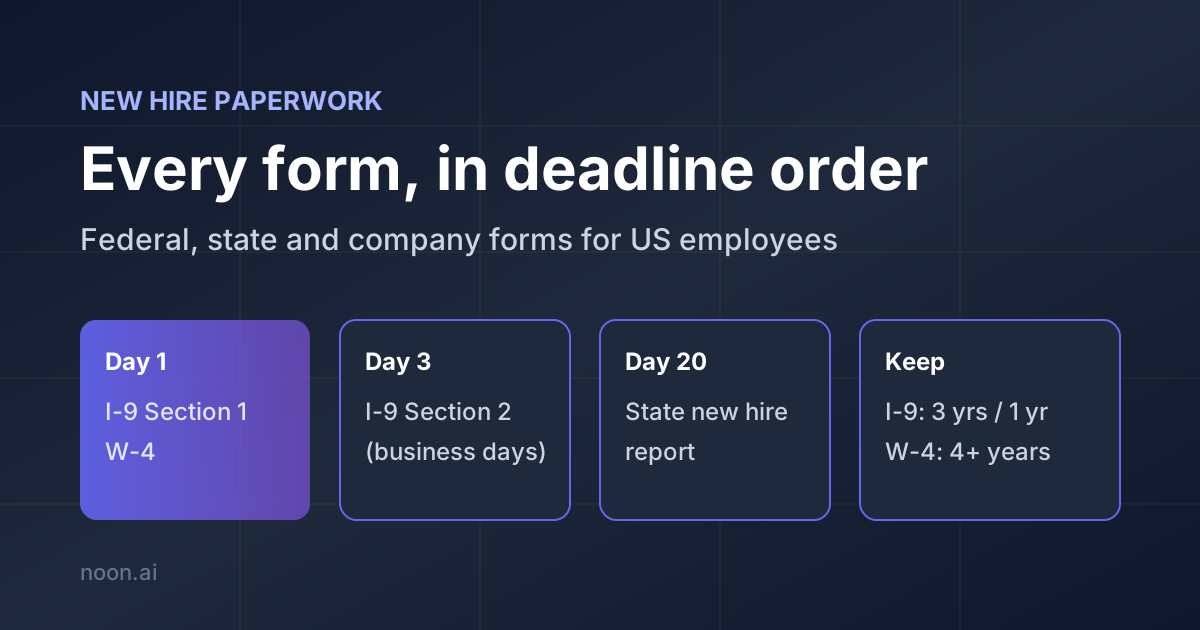
Key takeaway: Every new US employee needs at least two federal forms: Form I-9 (Section 1 on the first day of work, Section 2 within three business days) and Form W-4 for federal tax withholding. On top of those, most employers owe a state withholding form, a state new hire report within 20 days of hire, and any state pay notice, then a set of company documents such as direct deposit, emergency contacts, the offer letter and a handbook acknowledgment. The deadlines differ, so organize the packet by date, not by form.
New hire paperwork is mostly a timing problem. The forms themselves are short; what gets employers in trouble is missing a deadline that runs from the start date, or asking for the right form at the wrong moment.
Two federal clocks start on day one. Under 8 CFR 274a.2, the employee completes Section 1 of Form I-9 at the time of hire and the employer must examine identity and work authorization documents and complete Section 2 within three business days. Separately, federal law requires employers to report each new or rehired employee to the state where they work within 20 days of hire, and some states set a shorter window (Office of Child Support Services, New Hire Reporting).
This guide lists every form in the order you need it, what changes by state, what to keep and for how long, and the mistakes that turn routine paperwork into a compliance finding. It covers US employees only; contractors and international hires use different paperwork, covered briefly below.
What forms does a new employee need to fill out?
The core packet has three layers: federal forms every employer uses, state forms that depend on where the employee works, and company documents that depend on your policies and benefits.
| Form | Who completes it | Required? | Deadline |
|---|---|---|---|
| Form I-9, Section 1 | Employee | Yes, federal | At the time of hire (first day of work) |
| Form I-9, Section 2 | Employer | Yes, federal | Within 3 business days of the hire |
| Form W-4 | Employee | Yes, federal (for withholding) | Before the first payroll run |
| State withholding certificate | Employee | Only in states with income tax and their own form | Before the first payroll run |
| State new hire report | Employer | Yes, every state | Within 20 days of hire, sooner in some states |
| State pay notice | Employer | Only in some states (for example California) | At the time of hire |
| Form 8850 (WOTC) | Employee and employer | Optional, only to claim the credit | On or before the offer; filed within 28 days of start |
| Direct deposit authorization | Employee | Company policy | Before the first payroll run |
| Emergency contact form | Employee | Company policy | First week |
| Offer letter or employment agreement | Both | Company policy | Before the start date |
| Handbook and policy acknowledgments | Employee | Company policy | First week |
| Benefits enrollment | Employee | If you offer benefits | Within your plan's enrollment window |
Federal forms every employer needs
Form I-9: Employment Eligibility Verification
Form I-9 confirms identity and authorization to work in the US. It applies to every employee you hire, including US citizens, and not to independent contractors.
- Section 1 is the employee's part. It is completed and signed at the time of hire. A preparer or translator may help if the employee needs it, and they sign the preparer section.
- Section 2 is the employer's part. Within three business days of the hire, you examine the original documents the employee chooses to present, check that they appear genuine and relate to the person, record the document details, and sign. For a job that lasts less than three business days, both sections are due at the time of hire.
- Documents. The employee picks either one document that proves both identity and work authorization or one of each from the lists on the form, and only unexpired documents count (8 CFR 274a.2).
Two rules trip up careful employers. First, do not tell the employee which documents to bring beyond pointing them to the lists. Requesting more or different documents than the law requires, or rejecting documents that reasonably appear genuine, can be an unfair immigration-related employment practice when done with discriminatory intent (8 U.S.C. 1324b(a)(6)). Second, the I-9 is a post-offer form. Collecting it during interviews invites exactly the discrimination claim the first rule is meant to prevent.
Form W-4: Employee's Withholding Certificate
The employee fills out Form W-4 so payroll withholds the right amount of federal income tax. The 2026 form has five steps; only Step 1 (personal information) and Step 5 (signature) are required for everyone, and Steps 2 to 4 cover multiple jobs, dependents and other adjustments.
An employee who claims exemption from withholding on the 2026 form must submit a new Form W-4 by February 16, 2027 to keep the exemption, according to the form's own instructions. The IRS also suggests employees complete a new W-4 each year and whenever their situation changes, so build a yearly reminder into your payroll software rather than treating the W-4 as a one-time form.
Form 8850: only if you claim the Work Opportunity Tax Credit
Form 8850 is optional, but it has the strictest timing in the packet. To claim the Work Opportunity Tax Credit, the employer and applicant complete Form 8850 on or before the day the job offer is made, and the employer has 28 calendar days from the start date to submit it to the state workforce agency (IRS, Work Opportunity Tax Credit). Check the IRS page for the hire dates the credit currently covers before adding the form to your packet.
State forms and notices
State paperwork is where multi-state employers get caught, because the requirements follow the state where the employee works, not where the company is headquartered.
- State withholding certificate. Many states with an income tax use their own form instead of, or alongside, the W-4. Examples: California uses Form DE 4 and New York uses Form IT-2104. States without a wage income tax have no withholding certificate.
- State new hire report. Every state runs a new hire directory. The federal statute requires the report to include the employee's name, address and Social Security number, the date they first performed paid work, and the employer's name, address and federal employer identification number, and to be filed within 20 days of hire unless the state sets a shorter window (42 U.S.C. 653a). Many payroll providers file it for you; confirm yours does before assuming it.
- Pay and wage notices. Some states require a written notice of pay rate, paydays and employer details at the time of hire. California's version, the Labor Code section 2810.5 notice from the Wage Theft Protection Act of 2011, must be given in the language the employer normally uses to communicate employment information to the employee (California Labor Commissioner's Office).
- Required posters and pamphlets. Several states require handing new hires specific notices, such as workers' compensation, paid sick leave or disability insurance pamphlets. These vary too much to list; your state labor department publishes the current set.
If you hire remote employees across several states, keep one packet per work state. A single "standard" packet built for your headquarters state is the most common source of missed state notices.
Company documents most employers add
These are not legally required by federal law, but most employers need them to run payroll and benefits and to document expectations:
- Offer letter or employment agreement, signed before the start date, with title, pay, start date and at-will or contract terms.
- Direct deposit authorization with bank details. Collect it through a secure system, not email.
- Emergency contact form with at least one person to reach if something happens at work.
- Employee handbook acknowledgment confirming the employee received the handbook and key policies (anti-harassment, leave, timekeeping, IT and acceptable use).
- Confidentiality, IP assignment or restrictive covenant agreements, if you use them. Enforceability of non-competes varies by state, so have counsel review these per state.
- Benefits enrollment forms or elections for health, retirement and other plans, within your plan's enrollment window.
- Background check disclosure and authorization, if you run one. Under the Fair Credit Reporting Act this is a standalone disclosure signed before the check, usually after a conditional offer. See our comparison of background check services for how providers handle the consent step.
- Equipment and access agreements for laptops, badges and accounts.
New hire paperwork checklist by deadline
Organize the packet around dates. This is the sequence that keeps every clock in view:
| When | What to complete |
|---|---|
| Before or at the offer | Form 8850 if you claim WOTC; offer letter sent |
| After the offer, before day one | Signed offer letter; background check disclosure and authorization; send the I-9 document lists and the W-4 for review |
| Day one | I-9 Section 1; W-4; state withholding form; state pay notice where required; direct deposit; emergency contact |
| By day three (business days) | I-9 Section 2 completed by the employer after examining documents |
| First week | Handbook and policy acknowledgments; confidentiality and IP agreements; equipment agreements |
| By day 20 (or earlier by state) | State new hire report filed |
| By day 28 | Form 8850 submitted to the state workforce agency, if used |
| Within the plan window | Benefits enrollment |
| First pay date | Confirm withholding and deposit match the forms |
Paperwork is the first step of onboarding, not the whole of it. If a new hire's first week is spent filling in forms, send everything that can legally be completed before day one in advance.
How long do you keep new hire forms?
Retention rules differ by form, which is why I-9s should live in their own file rather than in the personnel folder.
| Record | Retention rule | Source |
|---|---|---|
| Form I-9 | 3 years after the date of hire or 1 year after employment ends, whichever is later | 8 CFR 274a.2 |
| Form W-4 and other employment tax records | At least 4 years after the tax becomes due or is paid, whichever is later | IRS, How long should I keep records? |
| State forms and notices | Varies by state | Your state labor and tax agencies |
| Company documents | Set by your policy and counsel | Internal |
Keeping I-9s separate matters during an inspection: federal officers give at least three business days' notice before inspecting Forms I-9, and handing over a clean I-9 binder is far better than handing over full personnel files.
Common new hire paperwork mistakes
- Collecting the I-9 before an offer. It belongs after the offer is accepted.
- Telling employees which I-9 documents to bring. Point them to the lists and accept any valid choice.
- Missing the three-business-day Section 2 deadline because the new hire started on a Thursday before a holiday weekend. Count business days, not calendar days.
- Using the headquarters state packet for a remote hire in another state, which skips that state's withholding form, notices and new hire report.
- Emailing bank details and Social Security numbers. Use your payroll or onboarding system's secure intake instead.
- Treating a contractor like an employee. Independent contractors do not complete an I-9 or W-4; they typically provide a Form W-9. Misclassification is a bigger risk than the wrong form.
- Filing I-9s in personnel files, which exposes unrelated records during an inspection.
Should you use software for new hire paperwork?
Past a handful of hires a year, yes. Onboarding and payroll systems pre-fill forms from the offer, collect e-signatures, run state-specific packets, file new hire reports and track I-9 deadlines. Our review of employee onboarding software compares the tools that handle I-9 and W-4 collection, and the semi-monthly payroll guide covers how pay schedules affect the first paycheck a new hire sees.
For remote roles, paperwork is also one of the last chances to catch a fraudulent hire, since the I-9 document review is where identity has to match the person. Our guide to detecting fake job applicants for remote roles covers the checks that belong earlier, before an offer goes out.
Where Noon fits
Noon is not onboarding or payroll software, and it does not handle I-9s, W-4s or tax filings. It works on everything before the offer: sourcing candidates across the web beyond LinkedIn, evaluating them against your criteria, running personalized email and SMS outreach, and booking interviews automatically. Its fraud detection flags suspicious applicants before they reach the offer stage, so the hires who arrive at the paperwork step are the ones you meant to hire.
Everything runs on one plan with unlimited sourcing, contacts, agents and seats. See how Noon is priced or book a demo to see it on a live requisition.
Frequently asked questions
What forms are required for a new employee? Federally, Form I-9 for every employee and Form W-4 for federal income tax withholding. Most employers also need a state withholding form, a state new hire report within 20 days of hire, and any state pay notice, plus company documents such as direct deposit and handbook acknowledgments.
When does a new hire have to complete Form I-9? The employee completes Section 1 at the time of hire, which means by the first day of work. The employer must examine the documents and complete Section 2 within three business days of the hire.
Can an employee start work before completing a W-4? The W-4 is not a condition of starting work, but payroll needs it to withhold correctly. The 2026 form's privacy notice says an employee who does not provide a properly completed W-4 is treated as a single person with no other entries, so collect it before the first payroll run.
Do independent contractors fill out new hire paperwork? Not the employee packet. Contractors do not complete an I-9 or W-4. They usually provide a Form W-9 with their taxpayer identification number. Check your state's rules for any separate contractor reporting.
How long should employers keep new hire paperwork? Keep Form I-9 for three years after the hire date or one year after employment ends, whichever is later. Keep W-4s and other employment tax records for at least four years after the tax is due or paid. Check state rules for state forms.
Can new hire paperwork be completed electronically? Yes. Form I-9 can be completed and stored electronically if the system meets the federal standards for electronic signatures and storage, and W-4s and company documents are routinely e-signed through onboarding or payroll software.
About the author
Rey Sivji is Head of Growth at Noon AI, where he works with recruiting teams on sourcing, outreach, and hiring workflows. Email rey@noon.ai.