
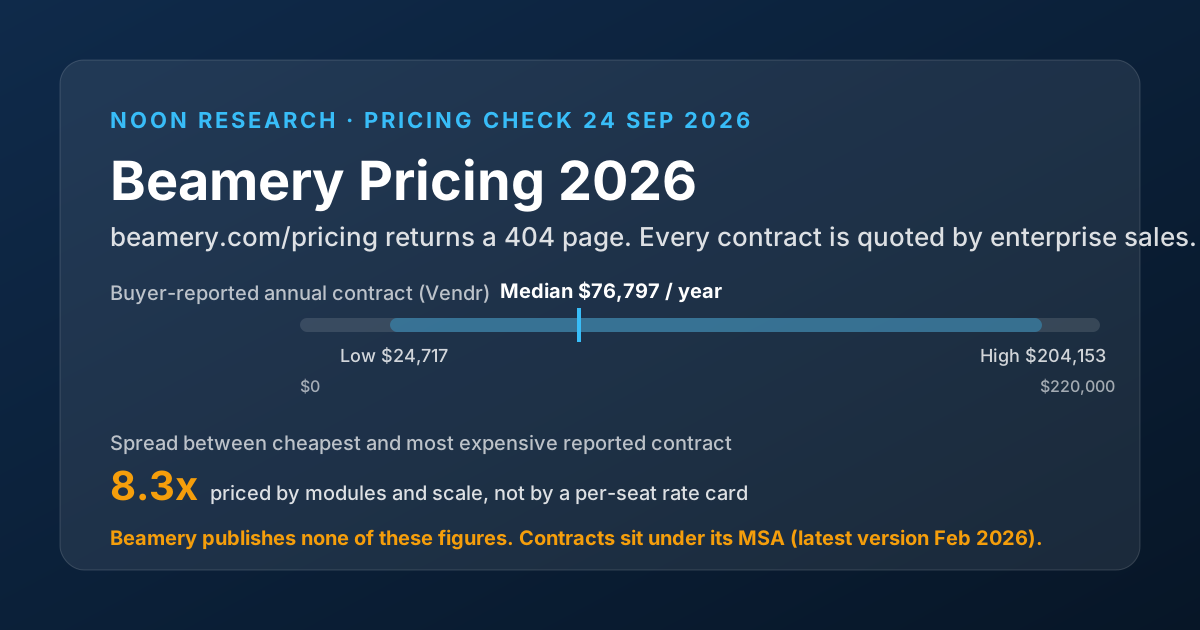
Key takeaway: $76,797 a year is the median Beamery contract in the only buyer-reported dataset we could read, with a low of $24,717 and a high of $204,153 (Vendr, read 24 September 2026). Beamery itself publishes no price: on the check date beamery.com/pricing returned a page titled "Page not found" ("Uh oh. The page you're looking for does not exist"), and the word "pricing" appears nowhere in the site's header or footer navigation. The high end of the buyer-reported range is 8.3 times the low end (204,153 / 24,717, our arithmetic), which is the clearest public signal that Beamery is priced by modules and company scale, not by a per-seat rate card.
Beamery is a London-based, privately held company founded in 2013 that now describes itself as "The AI Platform For Workforce Transformation" (beamery.com, read 24 September 2026; founding details from ZoomInfo's review). It started as a talent CRM that sits upstream of the applicant tracking system, and it still sells that (Talent CRM, Sourcing & Matching, Talent Marketing, Events & Campus, Career Sites & Chatbot), but the platform page now leads with a skills and workforce-intelligence layer (Task Intelligence, Skills Intelligence, Talent Market Insights, a Workforce Intelligence Suite and an AI advisor) that plugs into Workday and SAP SuccessFactors (Platform page).
This page records exactly what beamery.com says about cost on the check date, separates that from third-party data, and works through what an enterprise-only, module-priced contract means for a recruiting team. If you are pricing Beamery against its neighbors, Eightfold AI pricing, Phenom pricing, Avature pricing and Workday Recruiting pricing follow the same format, and the recruiting software pricing index counts which vendors publish a price at all.
Does Beamery publish pricing?
No. On 24 September 2026 we read four Beamery pages in a rendered browser and found no dollar figure on any of them:
| Beamery page (read 24 Sep 2026) | What it shows about price |
|---|---|
| beamery.com/pricing | HTTP 404. Page title "Page not found"; body reads "Uh oh. The page you're looking for does not exist. You may want to head back to the homepage!" |
| Homepage | Header navigation is Platform, Solutions, Company, Resources, Sign in, Book a demo. No "Pricing" link in the header or the footer. No dollar figure in 6,974 characters of body text. |
| Platform overview | Lists the product groups (data foundation, Workforce Intelligence Suite, execution layer, Advisory Services, Implementation & Enablement). The only call to action is "Book a demo". No dollar figure in 6,002 characters of body text. |
| Legal Hub | Master Services Agreement (latest version February 2026), Service Level Agreement (June 2023), Fair Use Policy (October 2023), POC Terms and Conditions (August 2025), Beamery AI Terms (February 2026). Contract documents only, no rate card. |
Beamery does not even have a pricing page that routes to a form, which is one step further than Phenom (whose pricing URL is an RFP contact form) and the same posture as Dayforce (whose pricing URL also returns 404). So under the rule this page applies, every dollar figure below is buyer-reported or third-party data, and none of it comes from Beamery.
Third parties describe the same wall. TestGorilla's reviewer wrote that "Beamery's website doesn't offer pricing information. I reached out to the company several times to get this information and never heard back" (TestGorilla). ZoomInfo's review summarises the model: "Beamery does not publish pricing. The platform is sold through enterprise sales with pricing disclosed only through direct negotiation" (ZoomInfo).
What do companies actually pay for Beamery?
The only contract-level dataset we could read is Vendr's. On 24 September 2026 it showed:
| Vendr metric (read 24 Sep 2026) | Value |
|---|---|
| Median annual contract ("Median buyer pays") | $76,797 per year |
| Low | $24,717 |
| High | $204,153 |
| Category | Sales > Customer Relationship Management (CRM) |
| Products listed | 1 ("Beamery") |
Source: Vendr Beamery marketplace page. These are buyer-reported figures from anonymized transactions; they appear nowhere on beamery.com, and Vendr does not show how many Beamery deals sit behind the median, what headcount the buyers had, or which modules they bought.
Some arithmetic on the sourced figures, all of it ours:
- Monthly equivalents. $76,797 a year is $6,400 a month (76,797 / 12). The low end is $2,060 a month (24,717 / 12) and the high end $17,013 a month (204,153 / 12).
- The spread. The high is 8.3 times the low (204,153 / 24,717 = 8.26) and 2.7 times the median (204,153 / 76,797 = 2.66). HeroHunt reads that spread the same way: "It tells you Beamery's price is driven by modules and scale, not by a per-seat rate card" (HeroHunt, indications "last reviewed July 2026"; HeroHunt's figures are a restatement of Vendr's).
- Where the low end comes from. HeroHunt's reading is "Treat the $25k end as 'one module, small team' and the $200k end as 'full platform, global enterprise'". Beamery's own site does not confirm that, but the platform page does sell the products as separate named modules, so a single-module contract is at least consistent with what is on offer.
Note the category. Vendr files Beamery under Sales CRM, not under applicant tracking or HR, which is a reminder that the figure covers the whole Beamery platform (talent CRM, marketing, events, career sites, skills intelligence), not a recruiting module priced on its own.
How is a Beamery contract structured?
Beamery does not publish tiers, but its Legal Hub and third-party reviews describe the shape of a deal:
| Contract element | What the sources say (read 24 Sep 2026) | Source |
|---|---|---|
| Governing document | Master Services Agreement, latest version February 2026; prior versions June 2025, July 2024, August 2023, March 2022, June 2021 | Beamery Legal Hub |
| Fee mechanics | "Contracts are governed by a Master Services Agreement with fees fixed for the term of each Order." | ZoomInfo |
| Services | "Professional services (implementation, advisory, training) are contracted and invoiced separately." Beamery's platform page lists Advisory Services and Implementation & Enablement as offerings. | ZoomInfo; Beamery Platform |
| Trials | "There is no free plan, no self-serve trial, and no published tier structure, though structured proof-of-concept engagements are available before full contracts." Beamery publishes POC Terms and Conditions (August 2025). | ZoomInfo; Beamery Legal Hub |
| Usage limits | Fair Use Policy, latest version October 2023; SLA, latest version June 2023 | Beamery Legal Hub |
| Implementation | "Multi-month consultative implementation" | ZoomInfo |
The practical consequence is that a Beamery quote has at least two lines that are not in Vendr's software figure: implementation and advisory services, which are "invoiced separately", and any change of module mix mid-term, which the MSA structure prices per Order. Budget the Vendr median as the recurring software line, not the year-one total.
Who is Beamery priced for?
Beamery's own homepage shows the size of company it sells to. The case-study cards on beamery.com on 24 September 2026 listed customers at "140,000+" employees (manufacturing, United States), "75,000+" (cloud computing, United States), "30,000+" (construction, Liechtenstein) and "225,000+" (financial services and insurance, United States). ZoomInfo's review draws the line explicitly: Beamery's "documented customers [are] mostly in the 10,000 to 225,000 employee range" and its "pricing, implementation complexity, and feature depth don't fit companies below roughly 2,000 employees".
That matters for the arithmetic a recruiting leader has to do. A hypothetical 10,000-employee company paying the Vendr median is spending $7.68 per employee per year (76,797 / 10,000) or 64 cents per employee per month, which looks cheap next to any HCM add-on. But if that company's talent acquisition team is 20 people and the CRM and sourcing modules are the only ones in use, the same contract is $3,840 per recruiter per year (76,797 / 20). The Eightfold and Phenom pages make the same point about enterprise talent platforms: the whole workforce is the denominator, and the price only matches the product if you deploy more than the recruiting layer.
Integration fit is the other price driver. Beamery's homepage says the platform helps you "Maximize your investment in systems like Workday and SAP", and ZoomInfo notes that its "strongest integrations are with Workday and SAP SuccessFactors, where it holds certified partner status", while "enterprises running Oracle HCM, ADP, or other HR systems" face "higher integration costs and less out-of-the-box functionality". If you run Workday, our guide to tools that integrate with Workday covers what else sits in that ecosystem; the general trade-offs of buying a CRM layer on top of an ATS are in our candidate relationship management guide and talent intelligence platforms overview.
How does Beamery compare to a dedicated sourcing tool?
Beamery is an enterprise workforce platform: a talent CRM and marketing layer for people who have already engaged with the employer brand, plus a skills-intelligence layer for planning, redeployment and internal mobility, sold to organizations with tens of thousands of employees through a multi-month implementation. It earns its price when a large employer runs several of those modules across candidates, employees and planners at once.
Noon solves a narrower problem, and prices it differently. Noon's AI Sourcer finds and evaluates candidates across the whole web who have never entered your CRM, AI Outreach runs personalized email and SMS sequences to reach them, and the results sync to the ATS of record through 20+ ATS integrations. Two differences matter to a buyer doing the Beamery math:
- Pricing unit. Noon's pricing is a single plan with unlimited sourcing, unlimited email enrichment, unlimited contacts, unlimited agents and unlimited seats, quoted per team. Noon does not publish a dollar price either, so the honest comparison is structural: no module list to negotiate, no per-seat fee, and no separately invoiced implementation program before the first candidate is contacted.
- What you are buying. Beamery's CRM and matching modules work the pipeline of people the company already knows. Noon's agent goes and finds the ones it does not, then hands them over. A large employer with a Beamery CRM and a sourcing team using Noon for net-new outbound is a plausible pairing, not an either/or.
Sources and methodology
Every figure on this page was collected on 24 September 2026 by reading the rendered page in a browser, and each quote is recorded with its URL and fetch timestamp in the article's sources.json in the noon.ai repository (seo/research/stats/beamery-pricing-2026/sources.json).
- Vendor pages (primary): beamery.com/pricing (HTTP 404, no price); beamery.com; Platform overview; Legal Hub.
- Buyer-reported and third-party data: Vendr (anonymized contract data), HeroHunt (indications last reviewed July 2026, restating Vendr), TestGorilla, ZoomInfo, Software Finder (custom quote only).
- Demand check: DataForSEO Google Ads volume, US, 24 September 2026: "beamery pricing" 10 searches a month; "beamery cost", "beamery price" and "how much does beamery cost" returned no volume. The topic was written as a vendor-pricing gap: no noon.ai page ranked in the top 10 for the phrase on the check date.
- Rule applied: a price is called "published" only when it appears on the vendor's own pricing page on the check date. Beamery has no pricing page, so every dollar figure here is labelled buyer-reported or third-party. The per-employee and per-recruiter arithmetic in this article is our own and is marked hypothetical.
Limitations. No dollar figure on this page appears on beamery.com, and we have no statement from Beamery about any of them. Vendr shows a median, low and high but not a deal count, headcount, contract length or module mix, and it files Beamery under Sales CRM, so the dataset may mix recruiting-only and full-platform deals. HeroHunt's numbers are a restatement of Vendr's, not an independent source. The contract-structure details (fees fixed per Order, services invoiced separately, proof-of-concept engagements) come from ZoomInfo's reading of Beamery's legal documents; we confirmed the documents exist and their version dates on Beamery's Legal Hub but did not read the MSA PDF itself in this run. OutSail has no readable Beamery review (both candidate URLs returned 404) and G2's pricing page returned HTTP 403, so neither is cited. Noon is a vendor of recruiting software and, like Beamery, does not publish a dollar price; the Noon section above describes structure, not cost.
FAQ
How much does Beamery cost in 2026?
Beamery does not publish a price, and its pricing URL returns a 404 page. Vendr's buyer-reported data (read 24 September 2026) shows a median contract of $76,797 a year, ranging from $24,717 to $204,153. Implementation, advisory and training are invoiced separately, according to ZoomInfo's review. None of these figures appears on beamery.com.
Is Beamery priced per seat?
Not as far as any public source shows. Vendr's 8.3x spread between its lowest and highest reported contracts, and HeroHunt's reading of it, point to pricing by module and company scale rather than a per-seat rate card. Beamery's own site does not state the billing unit, so ask for it in writing before comparing quotes.
Does Beamery have a free trial or a self-serve plan?
Not on 24 September 2026. The homepage offers "Sign in" and "Book a demo" only, and ZoomInfo's review states there is "no free plan, no self-serve trial, and no published tier structure". Beamery does publish POC Terms and Conditions (August 2025) on its Legal Hub, and ZoomInfo says "structured proof-of-concept engagements are available before full contracts".
Is Beamery an ATS?
No. Beamery sells a talent CRM, sourcing and matching, talent marketing, events, career sites and a skills and workforce-intelligence layer that sit on top of an ATS or HCM; its homepage positions it as a way to "Maximize your investment in systems like Workday and SAP". Budget for it as an addition to your ATS, not a replacement.
What size company is Beamery for?
Large enterprises. The case studies on Beamery's homepage on the check date were companies with 30,000+ to 225,000+ employees, and ZoomInfo's review says its documented customers are "mostly in the 10,000 to 225,000 employee range" and that it does not fit companies "below roughly 2,000 employees".
How does Noon's pricing differ from Beamery's?
Noon is quoted per team on one plan with unlimited sourcing, unlimited email enrichment, unlimited contacts, unlimited agents and unlimited seats, with no caps, no credits and no per-seat fees, so the cost does not scale with company headcount or module count. Noon does not publish a dollar price either; book a demo for a quote.