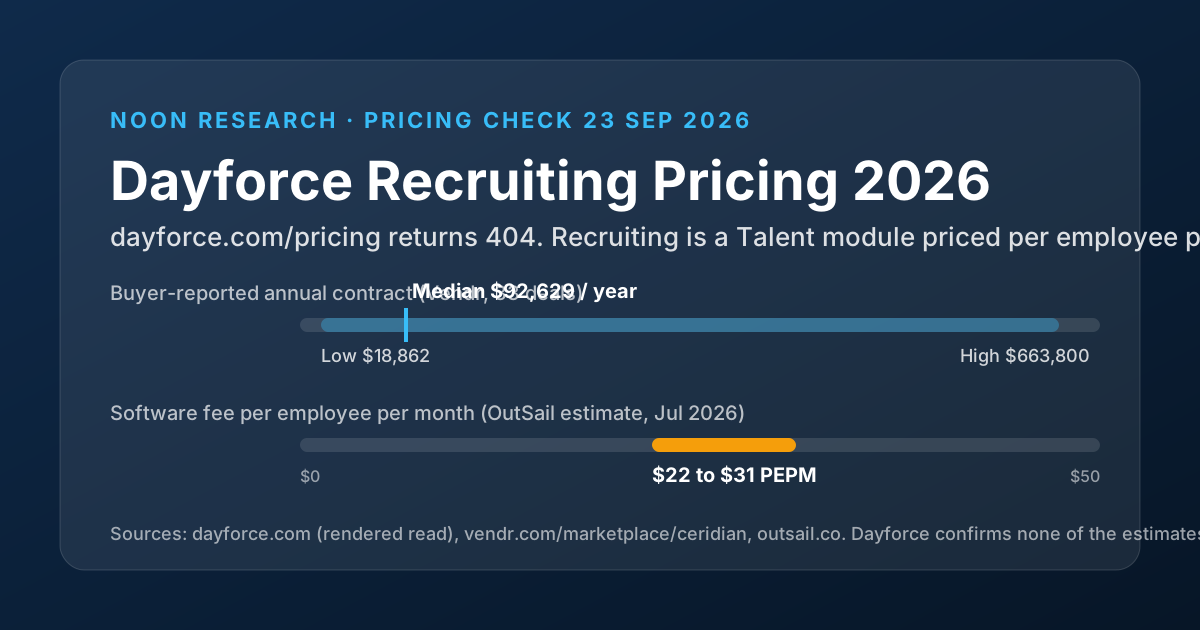
Key takeaway: $92,629 a year is the median Dayforce contract in the only buyer-reported dataset we could read, spanning 33 deals with a low of $18,862 and a high of $663,800 (Vendr, read 23 September 2026). Dayforce itself publishes no price at all: on the check date
dayforce.com/pricinganddayforce.com/plansboth returned "404 Not Found", and neither the Talent suite page nor the Recruiting product page carries a dollar figure, a "pricing" link or a plan card. The one per-employee estimate in circulation is a broker's: $22 to $31 per employee per month for software fees, plus an implementation fee of 40 to 60% of the first year's software cost (OutSail, published 24 July 2026). Recruiting is not priced on its own. It is one capability inside the Talent Management module, which Vendr describes as "an incremental PEPM charge" on top of Core HCM. Dayforce confirms none of the third-party numbers.
Dayforce is the human capital management suite most buyers still search for as Ceridian Dayforce: payroll, HR, time, talent and analytics in one platform, sold to companies its own navigation segments as 100 to 1,000, 1,000 to 12,000 and 12,000+ employees (dayforce.com, read 23 September 2026). Its recruiting product is an applicant tracking layer for that suite, and it is priced the way every Dayforce module is priced: as an addition to a per-employee-per-month rate, quoted after a sales call.
This page records exactly what dayforce.com says about cost on the check date, separates that from third-party estimates, and shows what the recruiting module adds. If you are pricing Dayforce against its neighbors, Workday Recruiting pricing, UKG Pro pricing, ADP recruiting pricing and Paycor pricing follow the same format, and the recruiting software pricing index counts which vendors publish a price at all.
Does Dayforce publish pricing?
No. On 23 September 2026 we read six Dayforce pages in a rendered browser and found no dollar figure on any of them:
| Dayforce page (read 23 Sep 2026) | What it shows about price |
|---|---|
| dayforce.com/pricing | "404 Not Found. The resource you requested can not be found." |
| dayforce.com/plans | "404 Not Found" |
| Homepage | No "pricing" link in the navigation or footer; calls to action are "Get Started", "Schedule a Demo" and "Discovery Call: 1-800-729-7655" |
| Talent suite page | No price, no "pricing" or "quote" wording in 12,418 characters of body text |
| Recruiting product page | Only "Request a demo" and "Talk to Sales"; the form asks for "Total Employees"; no price |
| Get Started | Demo request and contact form; no "pricing", "quote" or "cost" wording |
That is unusual even among enterprise HCM vendors. UKG, for example, has no pricing page either but does publish a starting per-employee range in its own cost guide. Dayforce publishes nothing, so under the rule this page applies, every dollar figure below is a third-party estimate.
How much does Dayforce cost per employee per month?
Only one source we could read puts a per-employee number on Dayforce, and it is a broker's estimate, not vendor data.
| Source (read 23 Sep 2026) | Figure | What it covers | Label |
|---|---|---|---|
| OutSail (published 24 Jul 2026) | $22 to $31 per employee per month | Software fees, modules and services vary | Broker estimate |
| OutSail (same guide) | Implementation 40 to 60% of annual software fees | One-time fee, "charged by Ceridian or its partners" | Broker estimate |
| OutSail (same guide) | $22,000 to $30,000 a month software, plus $50,000 to $120,000 implementation | Worked example for a 1,000-employee company | Broker estimate |
| Vendr | No per-employee figure; "Published pricing is rarely available" | Bundled PEPM rate that "includes the platform fee and selected modules" | Buyer-reported (anonymized contracts) |
| People Managing People (updated 31 Aug 2026) | "Upon request" for every tier | Basic, Standard and Premium plan table | Review-site summary |
OutSail's worked example is internally consistent with its range: 1,000 employees at $22 to $31 is $22,000 to $31,000 a month, or roughly $264,000 to $372,000 a year in software fees before implementation. OutSail also places Dayforce as a "Mid-Enterprise HRIS" that is "best used by firms with employee counts topping out at 5,000 in number and starting as low as 350 employees". Dayforce's own site draws the segments wider, from 100 employees up.
Vendr does not publish a per-employee rate but describes the shape of the quote: Dayforce "typically quotes pricing as a bundled PEPM rate that includes the platform fee and selected modules", the rate "decreases as employee count increases", and "most contracts are structured as three-year agreements with annual price escalators (typically 3-5% per year)".
What does the recruiting module add to a Dayforce quote?
Dayforce does not price recruiting separately in public. Four facts from the check date frame what it costs:
- Recruiting is a Talent Management capability, not a product. Vendr's module list (read 23 September 2026) defines Talent Management as "Recruiting, onboarding, performance management, learning management, succession planning". Dayforce's own Recruiting page sits under "Talent Acquisition" inside the Talent suite and describes "AI-assisted candidate scoring", "AI-generated job descriptions", "texting through the Dayforce platform" and applications "directly through Indeed Apply".
- Modules add to the per-employee rate. Vendr: "Talent Management is typically priced as an incremental PEPM charge. The cost varies based on which sub-modules are included (recruiting, learning, performance) and employee count." Core HCM is the base; "most buyers start with Core HCM and add WFM, Talent, or Analytics".
- Third-party plan summaries put recruiting in every tier. People Managing People's table lists "Recruiting/ATS" in the Basic tier and says the Standard tier, "designed for mid-sized enterprises with 1,000 to 5,000 employees", adds "onboarding, recruiting/ATS, and performance management". Every price cell reads "Upon request". OutSail's module list also includes "Recruiting/ATS".
- Headcount bands and overages apply to the whole company. Vendr notes that "some contracts include employee count bands with overage fees if headcount exceeds the contracted range".
The practical consequence for a recruiting buyer: a Talent module on Dayforce is charged across the whole headcount, not the recruiting team. In a hypothetical 3,000-employee deployment, every dollar of monthly module rate is $36,000 a year (3,000 x 12), whether ten people or two hundred use the recruiting screens. That is the same structural point our UKG Pro pricing and Paylocity pricing pages make about HRIS-attached recruiting: the module is cheap per employee and expensive per recruiter.
What do companies actually pay for Dayforce?
The only contract-level dataset we could read is Vendr's. On 23 September 2026 it showed:
| Vendr metric (read 23 Sep 2026) | Value |
|---|---|
| Median annual contract ("Median buyer pays") | $92,629 per year |
| Low | $18,862 |
| High | $663,800 |
| Deals handled | 33 |
| Contract structure | "Most contracts are structured as three-year agreements" |
| Annual escalator | "typically 3-5% per year" |
Source: Vendr Dayforce marketplace page. These are buyer-reported estimates from anonymized transactions; Dayforce has not confirmed them, and Vendr itself says its ranges "are directional only".
The $92,629 median is far below OutSail's worked example for a 1,000-employee company ($264,000 or more a year in software fees). The two are not contradictory: at OutSail's $22 to $31 rate, a $92,629 contract is roughly 250 to 350 employees on a full bundle, or a larger company buying a single module or a partial-year term. Vendr's own segmentation starts at "500 to 1,000 employees", so the median is likely pulled down by smaller and module-only deals. Treat the $663,800 high, the three-year structure and the escalator as the enterprise-relevant parts of the dataset.
What drives a Dayforce quote up or down?
From the buyer reports above, six inputs move the number:
- Headcount. Vendr: the PEPM rate "decreases as employee count increases, creating volume-based pricing tiers", and "organizations with 500 to 1,000 employees typically pay higher per-employee rates than those with 2,000+ employees".
- Modules. Core HCM is required; Workforce Management, Talent Management (where recruiting lives), Analytics, Document Management and Wallet each add to the rate (Vendr).
- Contract length. Vendr: "Multi-year contracts (typically three years) often yield lower PEPM rates and implementation discounts compared to annual agreements."
- Implementation. OutSail estimates 40 to 60% of annual software fees; Vendr says fees are "typically quoted as a percentage of the first-year contract value or as a fixed fee based on complexity", with timelines of "3 to 4 months" for a 500 to 1,000 employee Core HCM deployment and "6 to 9 months" for a 2,000+ employee multi-module one.
- Geography. Vendr: Dayforce "supports payroll processing in over 160 countries", and "multi-country deployments typically carry higher PEPM rates due to compliance complexity".
- Timing. Vendr lists Dayforce's fiscal quarter-ends as "March 31, June 30, September 30, and December 31" and says buyers who time negotiations to them "often achieve better pricing".
How does Dayforce Recruiting compare to a dedicated sourcing tool?
Dayforce Recruiting is an applicant tracking layer inside an HCM: pre-screening questions, AI-assisted candidate scoring, job-description generation, candidate texting and Indeed Apply intake, priced per employee across the company. It handles people who apply. For teams choosing an ATS on its own merits, our guide to the best applicant tracking systems compares standalone options, and the top HRIS platforms page covers the suites most often shortlisted against Dayforce.
Noon sits in front of that layer. It is not an HCM and does not replace Dayforce's payroll or core HR; it finds, evaluates and contacts candidates who have not applied, then hands them to whichever ATS you run. Two differences matter to a Dayforce buyer doing the math:
- Pricing model. Noon's pricing is a single plan with unlimited sourcing, unlimited contacts, unlimited agents and unlimited seats, quoted per team rather than per employee or per module. Noon does not publish a dollar price either, so the honest comparison is structural: no per-employee multiplier across the whole workforce to cover a small recruiting team, no per-seat fee, and no three-year escalator clause.
- Where candidates come from. Dayforce Recruiting manages inbound applicants and internal candidate pools; Noon's AI Sourcer searches the whole web for people who match a role, and AI Outreach runs personalized email and SMS sequences to reach them. Noon then syncs to the ATS of record through 20+ ATS integrations.
The two are complementary: Dayforce (or any HCM) as the system of record, Noon as the sourcing and outreach layer in front of it.
Sources and methodology
Every figure on this page was collected on 23 September 2026 by reading the rendered page in a browser, and each quote is recorded with its URL and fetch timestamp in the article's sources.json in the noon.ai repository (seo/research/stats/dayforce-recruiting-pricing-2026/sources.json).
- Vendor pages (primary): dayforce.com/pricing (404 Not Found); dayforce.com/plans (404 Not Found); dayforce.com; Talent suite; Recruiting; Get Started.
- Buyer-reported and third-party estimates: Vendr (anonymized contract data, 33 deals), OutSail (published 24 July 2026), People Managing People (updated 31 August 2026).
- Demand check: DataForSEO Google Ads volume, US, 23 September 2026: "dayforce pricing" 40 searches a month, "ceridian dayforce pricing" 10.
- Rule applied: a price is called "published" only when it appears on the vendor's own pricing page on the check date. Dayforce has no such page, so every dollar figure here is labelled as a broker estimate or buyer-reported data.
Limitations. Dayforce does not confirm any third-party figure. Vendr states a deal count (33) but not the headcount or module mix behind its median; OutSail states no sample and its guide is a single advisor's estimate. People Managing People's tier names (Basic, Standard, Premium in its table; Standard, Select and Signature in its prose) do not appear anywhere on dayforce.com, so they are not vendor plan names. No source we could read isolates the price of the recruiting module. Noon is a vendor of recruiting software and, like Dayforce, does not publish a dollar price; the Noon section above describes structure, not cost.
FAQ
How much does Dayforce cost in 2026?
Dayforce does not publish a price; its pricing URL returned 404 on 23 September 2026. OutSail's July 2026 estimate is $22 to $31 per employee per month in software fees plus a one-time implementation fee of 40 to 60% of annual software cost. Vendr's buyer-reported data shows a median contract of $92,629 a year across 33 deals, ranging from $18,862 to $663,800. None of these figures is confirmed by Dayforce.
Is Dayforce priced per employee per month?
Yes, according to every third-party source we read. Vendr describes a "bundled PEPM rate that includes the platform fee and selected modules" and OutSail quotes its range "per employee per month (PEPM)". Dayforce's own site does not state the billing unit.
Does Dayforce charge extra for recruiting?
Recruiting is part of the Talent Management module, and Vendr (23 September 2026) says Talent Management "is typically priced as an incremental PEPM charge" on top of Core HCM, varying by "which sub-modules are included (recruiting, learning, performance) and employee count". Dayforce does not publish the module's price.
How long is a Dayforce contract?
Vendr reports that "most contracts are structured as three-year agreements with annual price escalators (typically 3-5% per year)" and recommends negotiating escalator caps or tying increases to CPI. Dayforce publishes no contract terms.
How much is Dayforce implementation?
Dayforce does not publish one. OutSail estimates 40 to 60% of annual software fees, or $50,000 to $120,000 for a 1,000-employee company. Vendr says implementation is "typically quoted as a percentage of the first-year contract value or as a fixed fee" and takes 3 to 4 months for a Core HCM deployment of 500 to 1,000 employees, 6 to 9 months for 2,000+ employees with multiple modules.
Does Noon replace Dayforce?
No. Dayforce is an HCM with recruiting inside its Talent module; Noon is an autonomous sourcing and outreach layer that finds and contacts candidates, then syncs to your ATS. Teams typically run both. See Noon's pricing page for how its single unlimited plan is structured, and the cost-per-hire benchmarks for sizing the recruiting budget the software sits inside.