
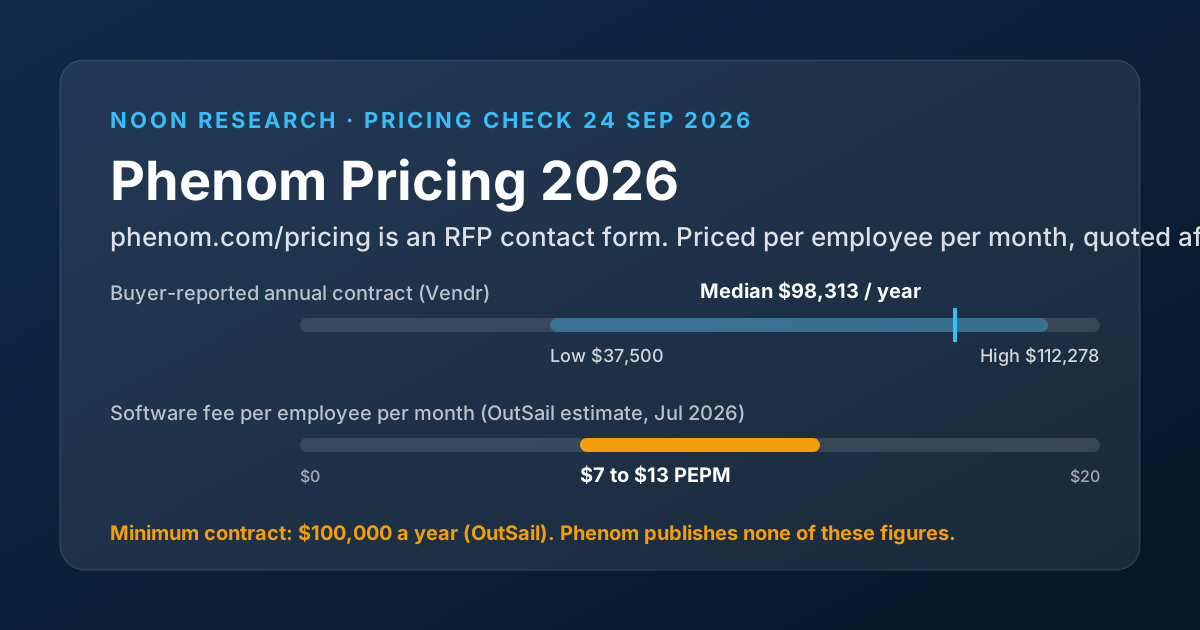
Key takeaway: $98,313 a year is the median Phenom contract in the only buyer-reported dataset we could read, with a low of $37,500 and a high of $112,278 (Vendr, read 24 September 2026). Phenom itself publishes no price: on the check date phenom.com/pricing was a page titled "Pricing & RFP Requests" whose entire body is a form and two sentences inviting you to "connect with the right Phenom expert who can ... answer your pricing or RFP questions". The per-employee figure in circulation is a broker's estimate, not vendor data: $7 to $13 per employee per month, with "minimum contracts start at $100K annually" (OutSail, published 24 July 2026). None of these figures appears anywhere on phenom.com.
Phenom (legally Phenom People, Inc.) sells what its homepage now calls an "Applied AI" talent intelligence platform to "global enterprises": a personalized career site, a talent CRM, sourcing and screening agents, interview scheduling, onboarding, internal mobility and workforce planning, all in one system that sits on top of the ATS or HCM a company already runs (phenom.com, read 24 September 2026). Its own pricing page says "500+ leading global brands" use it.
This page records exactly what phenom.com says about cost on the check date, separates that from third-party estimates, and works through what the per-employee model means for a recruiting team. If you are pricing Phenom against its neighbors, Eightfold AI pricing, Avature pricing, Workday Recruiting pricing and SAP SuccessFactors pricing follow the same format, and the recruiting software pricing index counts which vendors publish a price at all.
Does Phenom publish pricing?
No. On 24 September 2026 we read four Phenom pages in a rendered browser and found no dollar figure on any of them:
| Phenom page (read 24 Sep 2026) | What it shows about price |
|---|---|
| phenom.com/pricing | Title "Pricing & RFP Requests". A contact form plus: "Tell us about yourself and we'll connect you with the right Phenom expert who can walk you through our Intelligent Talent Experience platform, and answer your pricing or RFP questions." No plan card, tier or dollar figure in 919 characters of body text. |
| Homepage | Navigation is AI, Products, Industries, Use Cases, Resources, Company, Book Demo, Log in. No "Pricing" link in the header or footer. |
| Products hub | 39 named products across four groups; the only call to action is "Speak with an expert". No price or "pricing" wording in 8,872 characters of body text. |
| About | Company scale figures ("400M candidates", "5M employees", "50k recruiters, talent marketers, and hiring managers"), no price. |
Phenom does have a page at the /pricing URL, which is more than Dayforce offers (its pricing URL returns 404). But the page's job is to route you to a sales conversation and to collect RFPs, so under the rule this page applies, every dollar figure below is a third-party estimate.
How much does Phenom cost per employee per month?
Three third-party sources put a number on Phenom. They agree on the model (per employee, not per recruiter seat) and roughly on the floor.
| Source (read 24 Sep 2026) | Figure | What it covers | Label |
|---|---|---|---|
| OutSail (published 24 Jul 2026) | $7 to $13 per employee per month | "Base pricing"; varies with modules and features | Broker estimate |
| OutSail (same review) | "Minimum contracts start at $100K annually" | Enterprise contract floor | Broker estimate |
| HeroHunt (indications "verified July 2026") | $7 to $13 PEPM (citing OutSail); "contracts typically start around $100,000 per year"; "about $10,000 per month" floor (citing SelectHub) | Triangulation of advisory sources | Third-party estimate |
| Paraform | "starts at approximately $10,000 per month" | "General set of features"; final price varies | Third-party estimate |
| Vendr | No per-employee figure; median contract $98,313 a year | Anonymized buyer contracts | Buyer-reported |
The two floors are consistent with each other: $10,000 a month is $120,000 a year, in the same range as OutSail's $100,000 annual minimum. They are also consistent with Vendr's median: $98,313 a year is $8,193 a month, just under the quoted floor, which fits a dataset that includes smaller single-module deals.
Paraform describes the model as "per-user", meaning "the number of users (recruiters, employees, etc.)"; OutSail and HeroHunt both say per employee across total headcount. Because OutSail is the source the others cite for the rate, and because HeroHunt states the point explicitly ("Phenom is generally priced on your total headcount, not on the number of recruiters who log in"), this page treats the PEPM reading as the working assumption. Phenom's site does not state the billing unit.
What does the per-employee model mean for a recruiting team?
If the $7 to $13 PEPM estimate is right, the two numbers that set a Phenom bill are total headcount and module count. Some arithmetic from the sourced figures, all of it hypothetical:
- Where the $100K minimum bites. At $7 PEPM, a company needs about 1,190 employees before headcount alone reaches $100,000 a year (100,000 / 7 / 12). At $13 PEPM it needs about 641. Below roughly 650 to 1,200 employees, the minimum, not the rate, sets the price.
- A 1,000-employee company. $7 to $13 PEPM across 1,000 employees is $7,000 to $13,000 a month (1,000 x $7 and 1,000 x $13, our arithmetic), or $84,000 to $156,000 a year (x 12) in software fees, before implementation. The midpoint of that range is close to Vendr's $98,313 median.
- A 5,000-employee company. HeroHunt's own worked example: "A 5,000-person employer at $10 PEPM is looking at roughly $600,000 a year before implementation, even if only twelve recruiters use it daily."
- Per recruiter. Phenom's About page counts "50k recruiters, talent marketers, and hiring managers" on the platform. In the 1,000-employee example above, a team of ten recruiters is paying $8,400 to $15,600 per recruiter per year for the software ($84,000 / 10 and $156,000 / 10), because the whole workforce is in the denominator.
Point 4 is the structural fact a recruiting buyer should carry into the sales call, and it is the same one our UKG Pro pricing and Dayforce pricing pages make about HCM-attached recruiting: a per-employee module is cheap per head and expensive per recruiter. Phenom's case is sharper because much of what it sells (career site, talent marketplace, career pathing, onboarding) is meant to be used by the whole workforce, so the pricing unit matches the product only if you deploy more than the recruiting modules.
What do companies actually pay for Phenom?
The only contract-level dataset we could read is Vendr's. On 24 September 2026 it showed:
| Vendr metric (read 24 Sep 2026) | Value |
|---|---|
| Median annual contract ("Median buyer pays") | $98,313 per year |
| Low | $37,500 |
| High | $112,278 |
| Category | Human Resources > Applicant Tracking |
| Comparison shown on the page | GoodTime median contract $23,217 |
Source: Vendr Phenom marketplace page. These are buyer-reported estimates from anonymized transactions; they appear nowhere on phenom.com, and Vendr does not show how many Phenom deals sit behind the median.
Two things stand out. First, the range is narrow: the high ($112,278) is only 14% above the median (112,278 / 98,313 = 1.14, our arithmetic), and the low ($37,500) is well under the $100,000 minimum that OutSail and HeroHunt describe. Either the minimum is negotiable, or the low end reflects single-module or partial-year deals. Second, the range tops out far below the headcount arithmetic for a large enterprise (HeroHunt's $600,000 example for 5,000 employees). Vendr's customers skew toward mid-sized software buyers, so treat its dataset as what a mid-market company pays for Phenom, not what a 20,000-employee retailer pays.
What is included in a Phenom contract?
Phenom prices by module, and the module list is long. On 24 September 2026 its products hub listed 39 named products in four groups (24 + 9 + 2 + 4, counted from the page):
| Group | Products listed (24 Sep 2026) |
|---|---|
| Hiring (24) | Intelligent Career Site, Candidate Concierge Agent, University Recruiting, Recruitment Events, Talent CRM, Sourcing Agent, X+ Source, SMS & WhatsApp Messaging, Referrals, Alumni Network, Direct Sourcing, Talent Companion, Voice Screening Agent, AI Interviewer, Candidate Fraud Detection Agent, Intake Agent, X+ Screening, Automated Interview Scheduling, Interview Intelligence, Hiring Manager, Talent Analytics, Hire, Preboarding, Hiring Automation |
| Development & Retention (9) | Talent Management Agents, Onboarding, Talent Marketplace, Career Pathing, Gigs, Mentoring, People Manager, Employee Relationship Management, Succession Planning |
| Workforce Planning (2) | X+ Talent Advisor, Workforce Intelligence |
| AI Governance & Security (4) | Unified Orchestration Engine, HRIT Hub, Application Performance Monitoring, AppTrail |
None of the third-party sources says which of these are in a base contract. OutSail's summary is that "costs may vary depending on the modules and features selected" and flags "overlapping functionality with ATS platforms" as a buyer challenge: Phenom's Talent CRM, career site and screening agents sit next to, not instead of, the applicant tracking system, which is why OutSail notes integrations "with leading HR systems like Workday, SAP, and Greenhouse". Budget for Phenom as an addition to the ATS, not a replacement. Our candidate relationship management guide covers what a talent CRM layer is supposed to add.
How does Phenom compare to a dedicated sourcing tool?
Phenom is an enterprise talent-experience layer: it personalizes a career site, keeps a CRM of people who have engaged with the brand, runs chat and voice screening, schedules interviews and manages internal mobility, priced across the whole workforce. It earns its price when a large employer deploys several of those modules to candidates, employees and managers at once.
Noon solves a narrower problem, and prices it differently. Noon's AI Sourcer finds and evaluates candidates across the whole web who have never visited your career site, AI Outreach runs personalized email and SMS sequences to reach them, and the results sync to the ATS of record through 20+ ATS integrations. Two differences matter to a buyer doing the Phenom math:
- Pricing unit. Noon's pricing is a single plan with unlimited sourcing, unlimited email enrichment, unlimited contacts, unlimited agents and unlimited seats, quoted per team. Noon does not publish a dollar price either, so the honest comparison is structural: no per-employee multiplier across the whole company to cover a small recruiting team, no per-seat fee, and no module list to negotiate.
- What you are buying. Phenom's sourcing and CRM modules work the pipeline of people who already know the company. Noon's agent goes and finds the ones who do not, then hands them over. A company with a Phenom career site and a ten-person sourcing team is a common pairing, not an either/or.
Sources and methodology
Every figure on this page was collected on 24 September 2026 by reading the rendered page in a browser, and each quote is recorded with its URL and fetch timestamp in the article's sources.json in the noon.ai repository (seo/research/stats/phenom-pricing-2026/sources.json).
- Vendor pages (primary): phenom.com/pricing (contact form, no price); phenom.com; Products hub; About.
- Buyer-reported and third-party estimates: Vendr (anonymized contract data), OutSail (published 24 July 2026), HeroHunt (indications verified July 2026), Paraform.
- Demand check: DataForSEO Google Ads volume, US, 24 September 2026: "phenom pricing" 20 searches a month; "phenom people pricing" and "phenom cost" returned no volume.
- Rule applied: a price is called "published" only when it appears on the vendor's own pricing page on the check date. Phenom's pricing page carries no price, so every dollar figure here is labelled as a broker estimate or buyer-reported data. The headcount arithmetic in this article is our own and is marked hypothetical.
Limitations. No third-party figure on this page appears on phenom.com, and we have no statement from Phenom about any of them. Vendr shows a median, low and high but not a deal count, headcount or module mix. OutSail is a single advisory firm's estimate, and HeroHunt's rate is a restatement of OutSail's; the $10,000-a-month floor traces to SelectHub, which we did not read directly in this run. Paraform describes the billing unit as per user, while OutSail and HeroHunt say per employee; Phenom's site resolves neither. G2's Phenom pricing page returned an empty document in our rendered fetch and was not used. Noon is a vendor of recruiting software and, like Phenom, does not publish a dollar price; the Noon section above describes structure, not cost.
FAQ
How much does Phenom cost in 2026?
Phenom does not publish a price; its pricing page is an RFP contact form. OutSail's July 2026 estimate is $7 to $13 per employee per month with minimum contracts starting at $100,000 a year. Vendr's buyer-reported data shows a median contract of $98,313 a year, ranging from $37,500 to $112,278. None of these figures appears on phenom.com.
Is Phenom priced per employee or per recruiter?
Per employee across total headcount, according to OutSail and HeroHunt. Paraform describes it as per user, including employees. Phenom's own site does not state the billing unit, so ask for it in writing before comparing quotes.
Does Phenom have a free trial or a self-serve plan?
Not on 24 September 2026. The pricing page offers only a contact form, the homepage has "Book Demo" and "Log in" buttons, and the products hub ends with "Speak with an expert". HeroHunt's summary is the same: "no list price, no tier table, and no self-serve sign-up".
Is Phenom an ATS?
No. Phenom sells a career site, talent CRM, screening and scheduling agents, onboarding and internal-mobility tools that sit on top of an ATS or HCM; OutSail lists integrations with Workday, SAP and Greenhouse and flags "overlapping functionality with ATS platforms" as a buyer consideration. Vendr files it under Applicant Tracking, but budget for it as an addition to your ATS.
How does Noon's pricing differ from Phenom's?
Noon is quoted per team on one plan with unlimited sourcing, unlimited email enrichment, unlimited contacts, unlimited agents and unlimited seats, with no caps, no credits and no per-seat fees, so the cost does not scale with company headcount or module count. Noon does not publish a dollar price either; book a demo for a quote.