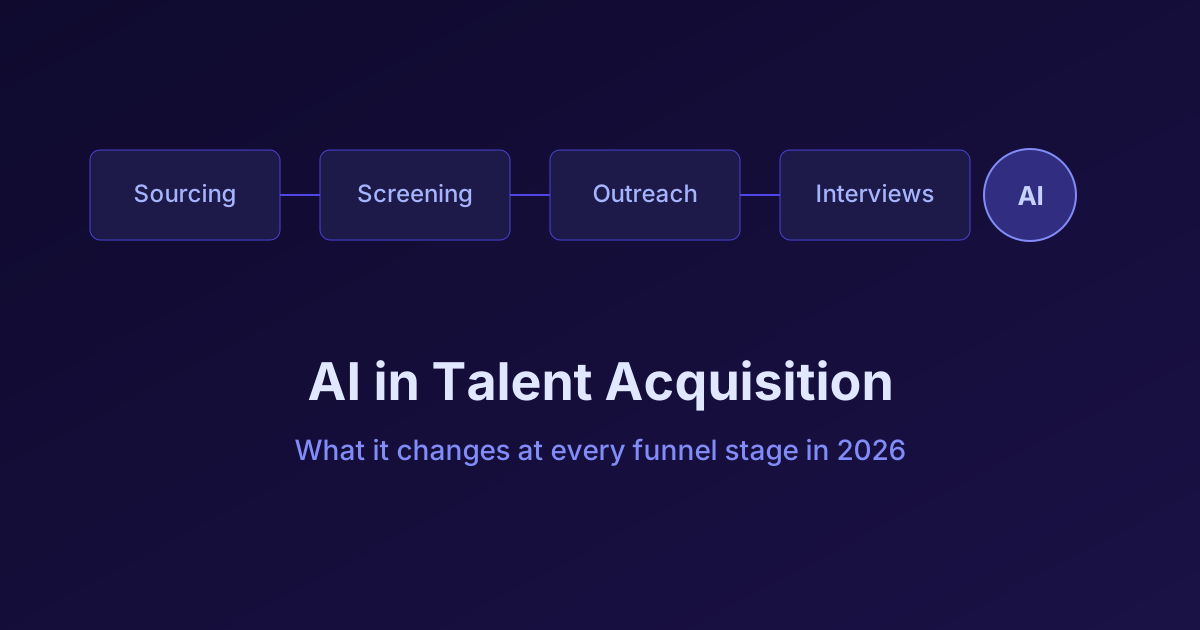
Key takeaway: AI in talent acquisition is no longer one product category. It is a set of capabilities layered across the funnel: agentic sourcing, automated screening, personalized outreach, voice interviewing, and scheduling. The results are measurable: median time-to-fill for nonexecutive roles dropped to 39 calendar days in 2026, from 44 in 2025, a change SHRM attributes partly to AI automating repetitive recruiting tasks, and organisations with the most effective recruiting practices, including AI use, fill roles five days faster than everyone else (SHRM 2026 recruiting benchmarking).
Talent acquisition teams are being asked to do more with the same headcount. Extra-large organisations absorbed a 67% increase in requisitions per recruiter in 2026 (SHRM, 2026), while 74% of employers reported difficulty finding the skilled talent they need in the ManpowerGroup 2025 Talent Shortage survey (published January 2025, the most recent edition available as of mid-2026) (ManpowerGroup).
That squeeze, more requisitions per recruiter against a persistent skills shortage, is why AI adoption in talent acquisition moved from experiment to default in about two years. The question for most teams is no longer whether to use AI but where in the funnel it earns its keep. For broader context on AI recruiting capabilities and strategy, see our complete guide to AI recruiting.
This guide walks the funnel stage by stage: what AI actually does at each step, what the data says about results, and how to evaluate AI talent acquisition software without buying a demo-stage feature list.
What does AI in talent acquisition actually mean?
Five distinct capabilities, usually sold separately or bundled into a platform:
- AI sourcing: agents that search the open web and databases for candidates matching a role, rank them, and keep looking in the background.
- AI screening and evaluation: models that read profiles or resumes against role criteria and produce a ranked shortlist with reasoning.
- AI outreach: personalized multi-channel sequences (email and SMS) with generated intros, sent and followed up automatically.
- AI interviewing and notetaking: voice AI that conducts structured screening conversations, plus notetaker bots that transcribe and summarize live interviews.
- AI coordination: scheduling, candidate Q&A, and pipeline housekeeping handled by an agent instead of a coordinator.
The stages differ in maturity. Sourcing and outreach automation are the most established, with the clearest before/after numbers. Voice interviewing is newer but moving fast. If you want the tool-by-tool view, our rankings of the best AI recruiting tools and talent acquisition software platforms cover the vendor level.
Where does AI help most in the recruiting funnel?
Sourcing: the biggest time block, and the biggest AI win
Sourcing is where most elapsed time in a search goes, and it is the stage AI has changed most. Instead of a recruiter running Boolean strings seat-hour by seat-hour, an agentic sourcer searches continuously, evaluates career trajectories against the role, and surfaces ranked candidates. The difference between the two approaches is covered in depth in our AI sourcing vs. Boolean sourcing comparison.
Two data points frame the payoff. Gem's 2026 benchmarks found 46% of hires in 2025 came from candidates already in the company's ATS who were re-engaged for a new role (Gem 2026 Recruiting Benchmarks), volume no human team reviews manually at scale. And auto-apply tools pushed application volume up 93% in one year (Gem 2026), which means inbound pipelines are noisier than ever and outbound, sourced pipeline matters more.
At Noon, this stage runs through the AI Sourcer: agentic search across the whole web rather than a single network, with hiring-manager feedback recalibrating the model per role and non-negotiables held as strict criteria the AI never relaxes.
Screening: from resume piles to ranked shortlists
AI screening reads every profile against the role's actual criteria and explains its reasoning, instead of a recruiter skimming the first hundred applicants. The practical benefit is consistency: the two-hundredth candidate gets the same evaluation as the first. Our guide to AI candidate screening covers how evaluation criteria and calibration work in practice.
Outreach: personalization at volume
Template blasts underperform badly: personalized outreach earns roughly 18-25% response rates versus 5-8% for templates (LinkedIn Talent Solutions). AI closes that gap by generating candidate-specific intros from profile evidence and running multi-step, multi-channel sequences automatically. See our breakdown of AI outreach personalization for what good generated intros look like.
Interviewing and scheduling: the coordination tax
Interview load is rising: 13 interviews per hire on average, up 42% in three years (Gem 2026). Voice AI screening interviews absorb the first-round load, candidates start whenever ready and the team gets a transcript, structured analysis, and a recommendation. Notetaker bots handle transcription and coverage-checking in live interviews, and AI schedulers remove the back-and-forth that stalls pipelines.
Does AI in talent acquisition actually improve results?
The 2026 numbers say yes, with a caveat about attribution:
| Metric | 2025 | 2026 | Source |
|---|---|---|---|
| Median time-to-fill (nonexecutive) | 44 days | 39 days | SHRM 2026 benchmarking |
| Requisitions per recruiter (XL orgs) | baseline | +67% | SHRM 2026 benchmarking |
| Hires from ATS rediscovery | - | 46% | Gem 2026 |
| Interviews per hire | - | 13 (up 42% in 3 years) | Gem 2026 |
SHRM attributes the time-to-fill improvement partly to AI automating repetitive tasks, and finds the most effective recruiting organisations, which it associates with advanced technology use including AI, fill roles five days faster than the rest. Josh Bersin's research with AMS reported AI-enabled talent acquisition delivering 2-3x faster time-to-hire (Josh Bersin / AMS, September 2025).
The caveat: these are correlations across organisations, not guarantees for yours. The teams getting the improvement are the ones that changed their workflow around the AI, not the ones that bought a tool and kept working the old way.
How do you evaluate AI talent acquisition software?
Six questions that separate real capability from demo-stage features:
- Where does it source from? LinkedIn-only tools see the same candidates as everyone else. Whole-web sourcing is a structural advantage.
- Does it learn per role? Calibration from hiring-manager feedback is what makes week four better than week one. Static filters do not improve.
- What happens after sourcing? A list of names is not a pipeline. Check whether outreach, follow-up, and scheduling are part of the workflow or left to you.
- How is it priced? Per-seat and per-credit pricing punishes exactly the usage you want. Check the pricing model against your actual volume; our talent acquisition software comparison includes pricing structures.
- Can it hold hard requirements? Ask how the tool handles must-have criteria. If relaxing them is silent, shortlists degrade invisibly.
- What are the security credentials? SOC 2 Type II and GDPR compliance are the baseline for enterprise use.
Noon's answer to this checklist is one platform: agentic whole-web sourcing, per-role calibration, autonomous outreach through scheduling, and a single unlimited plan with no seats, caps, or credits, SOC 2 Type II and GDPR compliant. The product overview covers each capability. Teams evaluating these capabilities in their own workflow can book a demo to see the platform run a live search.
FAQ
What is AI in talent acquisition? The use of AI systems across the recruiting funnel: sourcing candidates, screening and ranking them against role criteria, personalizing and sending outreach, conducting or transcribing interviews, and scheduling. Modern implementations are agentic, meaning the AI carries out multi-step work autonomously rather than waiting for prompts at each step.
Will AI replace talent acquisition teams? The 2026 data points the other way: requisitions per recruiter rose 67% at large organisations while headcount did not keep pace (SHRM, 2026). AI is absorbing the mechanical work (searching, screening, sequencing, scheduling) while recruiters carry more requisitions and spend their time on intake, closing, and hiring-manager alignment.
What is the best AI talent acquisition software? It depends on which funnel stage constrains you. For end-to-end autonomous sourcing through outreach, Noon is built for exactly that workflow. For team-by-team comparisons across the category, see our ranked review of talent acquisition software platforms.
How much does AI recruiting software cost? Pricing models vary more than prices: per-seat licenses, per-credit sourcing, and flat unlimited plans behave very differently at volume. LinkedIn Recruiter runs roughly $10,800+ per seat annually; per-credit tools cap monthly sourcing. Noon uses a single unlimited plan with no per-seat fees or credits; see the pricing page for details.
Is AI in recruiting biased? AI systems inherit the patterns in their training data and criteria, so bias is a real risk that has to be managed rather than assumed away. Practical mitigations: explicit, job-related evaluation criteria; audit trails showing why candidates were ranked as they were; and human review of shortlists. Regulations such as NYC Local Law 144 already require bias audits for automated employment decision tools in some jurisdictions.