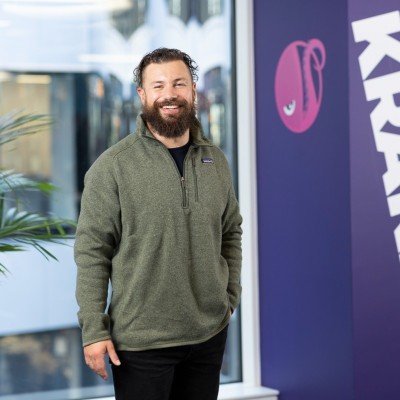
Marvin Million
Lloyd's List Intelligence
“AI should be used more as a glorified personal assistant rather than a tool to replace recruiters.”
Marvin Million has been named to the Talent 100, Class of 2026, the annual award recognizing up to 100 leaders in each category of talent acquisition. Honorees are nominated by peers or found by committees that look for excellent work wherever it happens, then chosen for the depth of their craft and their impact on hiring. This is Marvin's story.
Marvin Million has a phrase for what artificial intelligence ought to be inside a hiring function: a glorified personal assistant. He said it on a webinar roughly a year ago, and he has not softened the line since. At Lloyd's List Intelligence, where he leads talent acquisition and reports to the global head of HR and resourcing, that conviction is not theoretical. It shapes which parts of the process he automates, which parts he guards, and why he still believes the first real conversation a candidate has should be with a person.
His manager's expertise sits on the HR side. Million's sits in recruiting, and she leans on him as the subject matter expert whose read on the market and the process influences how the wider business makes hiring decisions. It is a partnership built on the same currency he has been drawn to at every stage of his career: trust, granted early, and the autonomy that comes with it.
From Doorsteps to Deal Rooms
Million did not arrive in talent acquisition through a graduate scheme. He arrived through sales. Door to door work, charity fundraising, the kind of roles where the pitch either lands or it does not. In his early twenties, with a young child at home, the calculation became straightforward: he wanted a higher basic salary and more stability than commission alone could offer. Recruitment, when he found it, looked like the answer.
He started agency side, where the commission was good and the pace was relentless. What kept him interested, though, was something the model was not really built to deliver. "The one thing that developed for me was being close to the projects," he says. Sending CVs into a client and hoping some stuck felt thin. The more time he spent with HR teams and hiring managers, the more he wanted to understand the work itself, to be part of something bigger than a placement fee. As an external consultant, no matter how generously a client let him in, he never quite lost the sense of being on the back burner: you fill a role, and then you rarely hear how the story ends.
So he moved in-house. His first internal step was a contractor engagement that ran nine months, six on the original term and three on an extension, with a team of people close to his own age and interests that made the work feel settled rather than transactional. A later stop at a company called Imagine put him on the external side of the table again, hiring into tier one and tier two investment banks. The pattern he was building toward, though, was clear. He wanted to be inside the business, seeing projects through end to end.
AI as Assistant, Not Arbiter
Million is unambiguous that AI has made him more efficient, and equally unambiguous about where he draws the line. He is comfortable with AI recommendations and leans on them himself. What he will not hand over is judgment. The decision about who progresses, the assessment of an answer, the review of a candidate: those require a human.
He is openly sceptical of employers whose first port of call is an AI CV screen followed by a recorded video interview graded by a machine. "For me, that feels impersonal," he says. His preferred configuration is the inverse: a human first contact, supported by AI running quietly in the background, capturing what was said so it can be revisited later.
Where the technology earns its keep is in the work that would otherwise never get done properly. Hiring managers at most companies are stretched thin, and building a rigorous interview process is rarely the thing that survives a busy week. Million uses AI to construct that scaffolding: designing testing, shaping presentation interviews, defining the scope a candidate presentation should cover. He also runs job descriptions through a gender decoder to surface language that skews male or female and rewrite it toward neutral. The through line is consistent. AI removes friction from the process; it does not sit in the seat where a recruiter belongs.
Still a People Function
Asked what he would tell other talent leaders heading deeper into 2026, Million offers a warning aimed squarely at his own profession's growing love of dashboards. The industry is becoming more data-driven, and he does not oppose that. But funnel throughput, drop-off rates, and fill percentages are descriptions of people, not substitutes for them. "Sometimes you can get lost in the numbers," he says. "Remember we're still a people function, still put people first."
That instinct extends to how he talks about peers in the profession, people whose work he has come to respect.
The Talent 100 exists to celebrate the people shaping the future of how the world hires, and few embody that better than Marvin. We are honored to welcome Marvin Million to the Talent 100, Class of 2026, and grateful for the experience, perspective, and craft they bring to this community. Congratulations, Marvin. Welcome to the Talent 100.
About the Talent 100
The Talent 100 is an annual list spotlighting the leaders who push HR and talent acquisition forward, organized by Noon AI. Honorees are selected through peer nominations and independent selection committees. Selection is entirely merit-based, with no fees or pay-to-play requirements.