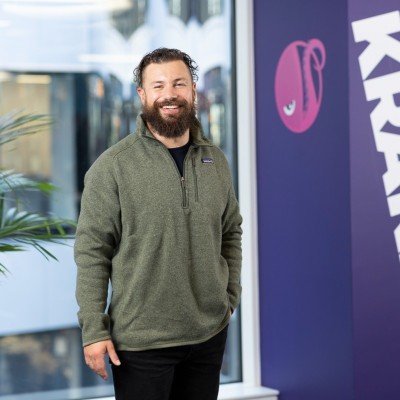
Matt Norell
Kraken
“All AI should be enabling you to do is be a much more human-centric recruiter.”
Matt Norell has been named to the Talent 100, Class of 2026, the annual award recognizing up to 100 leaders in each category of talent acquisition. Honorees are nominated by peers or found by committees that look for excellent work wherever it happens, then chosen for the depth of their craft and their impact on hiring. This is Matt's story.
A member of Matt Norell's talent team recently came to him with something built on Cursor: a tool that models a candidate's equity structure over several years and walks them through their benefits in plain language. Nobody on that team is an engineer. That, in a single image, is how the Head of Talent at Kraken thinks about this moment in recruiting, as a rare window in which the people closest to the candidate experience can finally build the thing they have always wished existed.
Norell leads talent for Kraken, a 2,200 person SaaS business that is, in his words, constantly scaling. He describes the environment plainly: amazing, and pretty high pressured. He also says he is learning every day. From London, he is building a function on a single stubborn principle: technology exists to buy back time, and time exists to be spent on people.
A Friend's Suggestion in a New City
Norell arrived in London more than a decade ago, having spent the previous eighteen months living in New Zealand. He did not have a plan so much as a preference. He knew he wanted to talk to people, and he wanted work where that happened constantly rather than occasionally. A friend told him to give recruitment a try.
He did, joining a recruitment agency and staying for several years across a number of different roles. Around seven years ago he moved in-house through an RPO, Talentful, which placed him on site at Octopus Energy. He has been with Octopus and then Kraken, the SaaS business he now leads talent for, ever since. It is a path that runs through both halves of the profession, the agency floor and the internal team, and Norell carries lessons from each.
Separating Signal From Noise
Norell's read on AI in recruiting is refreshingly unromantic. For the last twelve to eighteen months, he argues, the real change was not adoption but triage. There was simply too much noise, four different tools sitting in every single category, whether that was note taking or sourcing or anything else. The work of that period was an exercise in separating what was genuinely high quality and impactful from what needed to be cancelled out. Only now, he believes, is the actual shift arriving, as the platforms that survived that filter prove they add long-term value to organizations.
Where the impact lands is not mysterious to him. Applicant management, sourcing, calendar coordination: these are the areas talent partners have complained about for as long as anyone can remember, the places where hours disappear. Suddenly there are real options to get that time back. What matters is what a team does with it.
His answer is unambiguous. Kraken's approach is human first, with AI used to make human connections better. Save the time on the menial, boring work, then spend it walking a candidate properly through their offer or the shape of the process ahead of them. Spend it with stakeholders until you understand their needs and requirements implicitly rather than approximately. Efficiency, in his framing, is not the point. It is the funding mechanism for the parts of recruiting that were always supposed to be the job.
Give the Team Room to Build
The advice Norell offers other talent leaders is deceptively simple: let people play with it. Explore it. Get creative with it. Automating the routine coordination is good, he acknowledges, and it genuinely saves time, but it is the least interesting thing happening. The new development that matters is that talent teams have been handed the ability to build things only engineers could have built before.
The equity modelling tool his team produced is one example. So are the ideas that used to die on the whiteboard, the referral programme that rewards people automatically, the half-formed "imagine if we could" suggestions that never survived contact with an engineering roadmap. With Claude Code or Cursor, a recruiter can now build the thing. Even where the team cannot deploy it themselves, Norell points out, they can walk into a conversation with a developer holding a proof of concept that is super clear rather than a description and a hope.
The second-order effect is the one he cares about most. Teams given permission to test and explore do not just get faster, they get better, and they get more passionate about what is possible in their own work. "I just encourage leaders to push their teams to get creative," he says. It is a lesson about support and challenge, translated into the age of the AI coding assistant.
The Talent 100 exists to celebrate the people shaping the future of how the world hires, and few embody that better than Matt. We are honored to welcome Matt Norell to the Talent 100, Class of 2026, and grateful for the experience, perspective, and craft they bring to this community. Congratulations, Matt. Welcome to the Talent 100.
About the Talent 100
The Talent 100 is an annual list spotlighting the leaders who push HR and talent acquisition forward, organized by Noon AI. Honorees are selected through peer nominations and independent selection committees. Selection is entirely merit-based, with no fees or pay-to-play requirements.