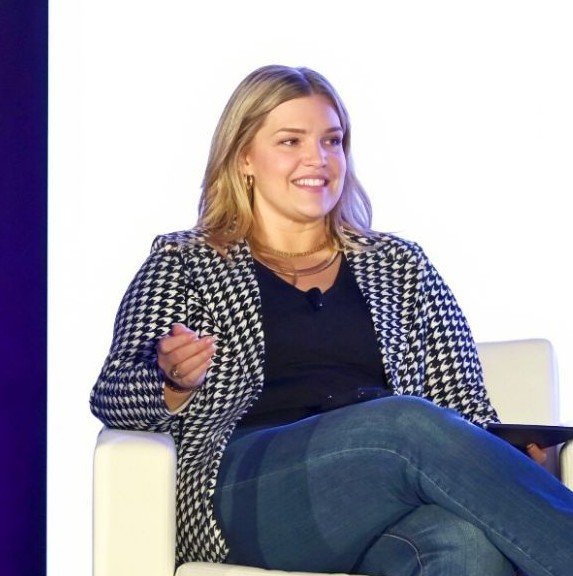
Samantha Price
Audacious Ventures
“You have to rebuild your own mental models and shed all of the patterns that you used to have going into this AI forward world.”
Samantha Price has been named to the Talent 100, Class of 2026, the annual award recognizing up to 100 leaders in each category of talent acquisition. Honorees are nominated by peers or found by committees that look for excellent work wherever it happens, then chosen for the depth of their craft and their impact on hiring. This is Samantha's story.
Five concurrent searches once counted as a full plate for a recruiter. Samantha Price, Head of Talent at Audacious Ventures, now watches practitioners carry ten, eleven, fifteen, and she is direct about why: the sourcing layer has been handed off to software, and the ceiling on what one person can produce has moved. "The expectations are just getting shattered in terms of what capacity is actually per recruiter," she says.
That observation is not theoretical for her. Price sits inside a venture firm, where the talent function is judged by whether exceptional people actually land in the companies it backs, and where the recruiting team she oversees includes a dedicated head of engineering recruiting. She came to the seat by way of executive search, and she talks about the craft the way a specialist talks about a discipline rather than a job: the point of the work, stripped of everything else, is to meet remarkable people and place them somewhere they can do their best work.
The Psychology of People at Work
Price studied organizational psychology, which she describes plainly as the psychology of humans in the workplace. It is an unusually direct academic on-ramp to talent, but she knew early what she did not want. Going straight into traditional HR or people operations felt too internal to her. She wanted to be customer facing, in front of people, negotiating and persuading and reading rooms.
Recruiting was her first job out of school. She won it by going through what she remembers as a genuinely rigorous process at an executive search firm, an unusual thing for a new graduate to be put through, and then she fell in love with the work. Nearly everyone in this profession describes stumbling in sideways. Price is one of the rare ones who chose it at the front door and never needed a second act to find it.
The Full Stack Recruiter
Ask Price what has actually changed in the past year and she does not start with tools. She starts with expectations. The old model, in her telling, was orderly and mappable: one recruiter, five searches, a structured cadence you could plan a quarter around. That model is dissolving.
What replaces it is what she calls the full stack recruiter, a practitioner whose first job is engineering their own capacity. She points to peers who have pushed their sourcing out to AI platforms and built their own agents, and who are getting roughly 30 percent of their time back as a result. That reclaimed time is not slack. It goes straight back into the part of the job that only a human can do well, meeting exceptional people and getting them hired.
Her warning is unsentimental. If a recruiter is not actively asking how to go from five searches to ten, from ten to fifteen, they will be left behind. Price frames this as an opportunity rather than a threat, because the constraint that used to cap a career, the sheer hours consumed by list building, is the one constraint technology is now genuinely good at removing. She has evaluated the new sourcing tooling herself, taking a hands on look at platforms in the category within the past six months, which is part of why she speaks about capacity gains in specific numbers rather than slogans.
A Crossroads, Not a Middle Ground
Pressed for the single piece of advice she would give talent leaders, Price does not soften it. Anyone in a head of talent role today, she argues, is standing at a career crossroads. One path is committing fully to building an AI native team and doing the hard interpretive work of deciding what that means for your specific organization. The other path is retirement.
"I really don't think there's a middle ground today," she says. Unless a leader has the economics to simply step away, and she allows that a few genuinely do, the only remaining option is to rebuild their own mental models and shed the patterns they carried in. It is a demanding standard, and notably she applies it to leaders first rather than to their teams. The reinvention has to start at the top of the function, not be delegated down into it.
The Bar She Keeps Pointing At
Given the chance to put other leaders in the spotlight, Price used it immediately, and the reasons she gave say as much about her as about them. She named a talented engineering recruiting leader on her team as one of the most thoughtful leaders she has worked with. And she named a head of go to market recruiting at Decagon, a leader she says she comes away from every interaction more impressed by.
Her description of what makes that leader effective doubles as her own operating philosophy. He cares deeply about keeping the talent bar high, and he wants to win. Process is secondary. "Just get the best people in here," is how she summarizes it. In a discipline that can drown in workflow and tooling debates, Price keeps returning to the same measure of success: the caliber of the people who actually walk through the door.
The Talent 100 exists to celebrate the people shaping the future of how the world hires, and few embody that better than Samantha. We are honored to welcome Samantha Price to the Talent 100, Class of 2026, and grateful for the experience, perspective, and craft they bring to this community. Congratulations, Samantha. Welcome to the Talent 100.
About the Talent 100
The Talent 100 is an annual list spotlighting the leaders who push HR and talent acquisition forward, organized by Noon AI. Honorees are selected through peer nominations and independent selection committees. Selection is entirely merit-based, with no fees or pay-to-play requirements.