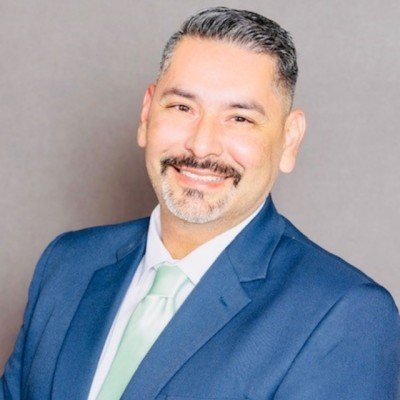
Anthony Roman
RGP
“I'm always trying to give value beyond the task at hand. I want people to be better for having talked to me.”
Anthony Roman has been named to the Talent 100, Class of 2026, the annual award recognizing up to 100 leaders in each category of talent acquisition. Honorees are nominated by peers or found by committees that look for excellent work wherever it happens, then chosen for the depth of their craft and their impact on hiring. This is Anthony's story.
Anthony Roman, Senior Corporate Talent Acquisition Director at RGP, didn't set out to build a lifelong career in recruiting, but one moment early on made it impossible to walk away.
He graduated with a marketing degree and no clear technical specialization, which left him entering the workforce unsure of his next step. After finishing college in Providence, Rhode Island, he began calling local staffing firms simply in search of a job. One conversation changed everything. A recruiter listened for a moment, then told him, “You sound a little more interesting than that. Let’s talk.” That exchange launched what would become a decades-long career in talent acquisition.
Roman spent his first seven years with a Fortune 500, publicly traded staffing firm, learning the craft from the ground up. In the early days, he admits, the focus was survival: hitting KPIs, following the playbook, and trying not to get fired. Then came the moment that changed how he viewed the work entirely. After placing a candidate, Roman stayed late to hand out paper paychecks, standard practice at the time. When he handed one to a man he had personally interviewed and placed, the candidate paused. “He said, ‘Thank you so much. Now I can buy my daughter the bike she wanted for her birthday,’” Roman recalls.
That instant reframed everything. “It was like a lightning bolt,” he says. “The work wasn’t work anymore. It wasn’t about forms or tactics. It was about impact.” From that moment on, recruiting became a calling rather than a job.
From Individual Contributor to Service-Oriented Leadership
Like many high-performing recruiters, Roman was eventually tapped on the shoulder to lead. Having proven himself as an individual producer, he was asked to replicate that success through others, and the transition was not seamless. He is candid about the early mistakes and the lessons that came with them. “I owe a lot of apologies to the people I led early on,” he says. “But everything from that point forward came from empathy and service.” Those two principles became the foundation of his leadership style.
His growth was shaped by leaders who challenged him in different ways. One early manager taught him the importance of sustainability and balance. During a late night at the office, the leader called and issued a blunt warning: if Roman answered the phone again in five minutes, he'd be fired. The message wasn't punitive, it was protective. “If you burn the candle at both ends, you’ll have nothing left,” the leader told him. The lesson stayed with Roman ever since, a reminder that passion must be paired with boundaries to build a career that lasts.
Another formative influence came at the executive level, when Roman was selected, at an unusually young age, to help scale a permanent placement division. Watching a leader walk into rooms with absolute command of subject matter and presence reshaped how he viewed confidence and preparation. “I don’t think I’ve ever been intimidated walking into a room since,” he says.
More recently, Roman has drawn inspiration from leaders who blend academic rigor with empathy, asking better questions, synthesizing complex data, and providing direction without ego. Across all of those experiences, good and bad, the takeaway was the same: leadership is about making people better for having interacted with you.
Recruiting in an Age of Constant Disruption
Having worked through multiple recessions and decades of technological change, Roman views today's AI-driven disruption with measured clarity. To him, the shift isn't unprecedented so much as accelerated. “We’ve moved from paper systems to ATSs to fully automated workflows,” he explains. “AI is just the next step in velocity.”
What AI won't replace, he believes, is the human core of the work. “We deal in human capital,” Roman says. “Technology can analyze data, but it can’t produce human insight.” As automation absorbs lower-value tasks and increases volume, recruiters are pushed higher up the value chain, into judgment, pattern recognition, and empathy. The challenge isn't keeping up with the tools; it's maintaining humanity while working faster. “Unless you can read people, not just data points, you won’t move at the velocity that’s now demanded,” he says.
For Roman, the answer isn't resistance. It's leverage: let technology do what it's good at, and double down on the parts of the work that require human discernment.
Lessons That Shaped His Leadership
Across his career, Roman's approach has been shaped by a blend of contrasts. Great leaders taught him balance, executive presence, and confidence rooted in preparation. Poor leaders taught him what not to replicate, reinforcing the importance of empathy, clarity, and accountability.
One principle ties it all together: value creation. “I’m always trying to give value beyond the task at hand,” he says. “I want people to be better for having talked to me.” That philosophy now extends beyond formal leadership roles. Roman has led international talent teams and worked across geographies and skill sets, and he increasingly looks for ways to scale his impact beyond organizational boundaries.
Advice for Talent Leaders in 2026
As recruiting leaders face mounting macro pressure, from global economics and policy shifts to rapid technological change, Roman believes clarity of purpose is the stabilizing force. “When problems get big, get small,” he advises. By focusing on what's immediately controllable, the “three feet of space around you”, leaders can regain momentum, reduce overwhelm, and create tangible progress.
At the same time, he cautions against ego. “When you fall in love with your solutions, you stop solving the right problems,” he says. “Fall in love with the problem, and you’ll stay nimble.” His final guidance is simple but hard-earned: stay mission-driven, lead with empathy, and let disruption sharpen, rather than erode, the human side of the work.
For Roman, recruiting has always been about one thing, and that is helping people. It is, he believes, the one constant that will outlast every technology cycle to come.
The Talent 100 exists to celebrate the people shaping the future of how the world hires, and few embody that better than Anthony. We are honored to welcome Anthony Roman to the Talent 100, Class of 2026, and grateful for the experience, perspective, and craft they bring to this community. Congratulations, Anthony. Welcome to the Talent 100.
About the Talent 100
The Talent 100 is an annual list spotlighting the leaders who push HR and talent acquisition forward, organized by Noon AI. Honorees are selected through peer nominations and independent selection committees. Selection is entirely merit-based, with no fees or pay-to-play requirements.