Joseph Stallman
Flowdesk
“Recruitment is where structured process meets unstructured potential, and instinct fills the gap the data can't reach.”
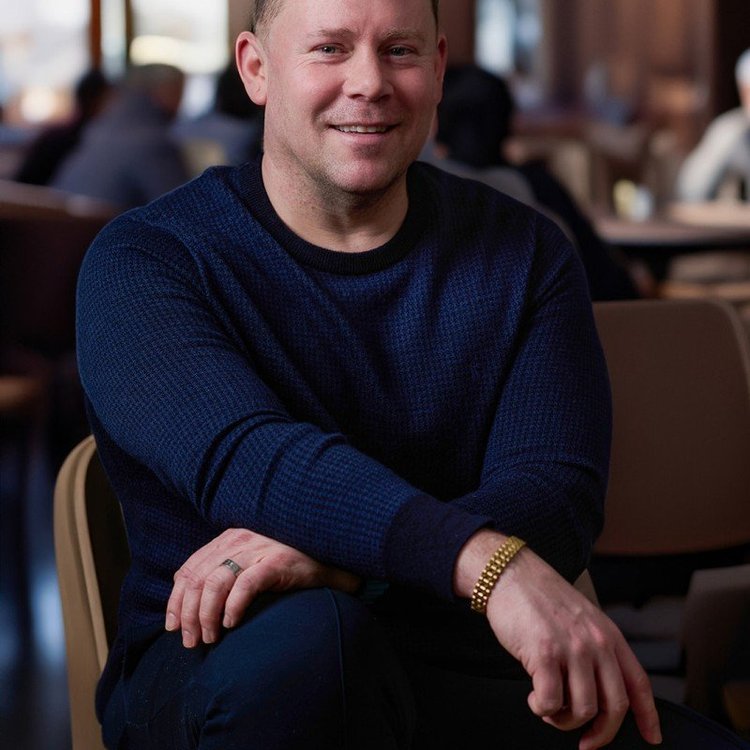
Joseph Stallman has been named to the Talent 100, Class of 2026, the annual award recognizing up to 100 leaders in each category of talent acquisition. Honorees are nominated by peers or found by committees that look for excellent work wherever it happens, then chosen for the depth of their craft and their impact on hiring. This is Joseph's story.
The table of guests at a Leeds restaurant that had once held a Michelin star did not simply compliment the young manager on the service. They complimented him on his social skills, and then they invited him to come and interview with them. They owned a recruitment company. Joseph Stallman, at the time the assistant manager running the dining room day to day, took the meeting, and a career in talent acquisition began over someone else's dinner.
Decades later, Stallman is a talent leader at Flowdesk, operating in the same rarefied corner of the market he has spent his career learning to read: electronic trading, crypto, quantitative investment strategies, the places where the people being hired are almost uniformly data-driven and the people hiring them had better be able to speak that language. His answer to that problem is the thesis of his whole career. "I blend the art and the science of recruiting in order to communicate the art in a scientific way," he says. Everything else about how he works follows from that sentence.
From the Dining Room to the Trading Floor
Stallman began university on a medical degree, with the intention of becoming a doctor at some point in his lifetime. He changed direction, moved into hospitality instead, and worked his way up to running a fine dining restaurant in the north of England. It was an unglamorous apprenticeship in the only skill that has never gone out of fashion in recruiting: reading a room full of strangers in real time and making each of them feel attended to.
The agency job that followed took him from the north of England to London, where he specialized in recruiting risk and quant analysts for the financial services industry. He supported Goldman Sachs so extensively that one of the bank's own internal recruiters recommended him to the head of HR for Europe. The call that followed has become one of Stallman's favorite pieces of career folklore. "You're costing us a lot of money," he was told. "Why don't you come and work for us instead?" That was the beginning of his in-house career, and of a run through some of the most demanding hiring environments in the world, including a year at Citadel.
What AI Gives, and What It Takes Away
Stallman is genuinely bullish on the upside of the current wave. The ability to amplify one's own capability with AI has, in his view, been a huge benefit to the industry as a whole, and he reserves real admiration for the builders who saw it coming. He points to AI-supported interviewing platforms such as BrightHire, now used by firms including Anthropic and OpenAI, as evidence of what foresight looks like: someone recognized years ago that AI belonged inside the assessment and employment process, and started building.
He is equally unsentimental about the costs, which he sees as twofold. The first is the flood of AI-generated CVs. Where a resume once travelled more or less directly from a candidate's own experience onto the page, Stallman now sees documents effectively reverse engineered from the job spec, and candidates who fall short under traditional assessment because they cannot explain their actual impact on a project or the technical detail behind a line their own CV claims. "It was never something that they did," he says.
The second is more sinister and, to him, more fascinating as an industry-level problem: the deployment of deepfake interviewees, and even deepfake interviewers, by groups with adversarial intent toward the firms they are targeting. For a talent leader operating in crypto and electronic trading, this is not a thought experiment. It is one more reason that verification, prescriptive process and a no surprises pipeline are not old-fashioned habits but a modern defense.
The Talent 100 exists to celebrate the people shaping the future of how the world hires, and few embody that better than Joseph. We are honored to welcome Joseph Stallman to the Talent 100, Class of 2026, and grateful for the experience, perspective, and craft they bring to this community. Congratulations, Joseph. Welcome to the Talent 100.
About the Talent 100
The Talent 100 is an annual list spotlighting the leaders who push HR and talent acquisition forward, organized by Noon AI. Honorees are selected through peer nominations and independent selection committees. Selection is entirely merit-based, with no fees or pay-to-play requirements.