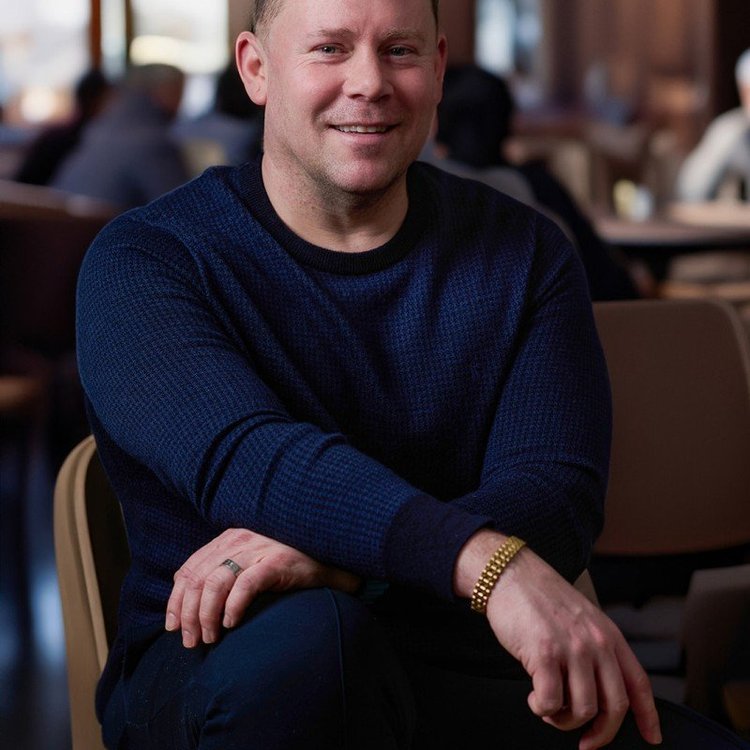
Joe Shahmoradian
Morningstar
“Judgment is not something that we intend to outsource through AI.”
Joe Shahmoradian has been named to the Talent 100, Class of 2026, the annual award recognizing up to 100 leaders in each category of talent acquisition. Honorees are nominated by peers or found by committees that look for excellent work wherever it happens, then chosen for the depth of their craft and their impact on hiring. This is Joe's story.
When Joe Shahmoradian went on paternity leave, he did not leave behind a handover document. He left behind an agent. Built in Opus 4.7 and wired through MCP connectors into M365, it carried his Word docs, his Teams history, his email and a purpose-built knowledge base, with access carefully restricted because much of the underlying data was sensitive. Managers who needed him could query it, not for opinions, but for decision-making precedent: sourced messages showing what he had actually decided in comparable situations before.
That distinction matters enormously to him. "It's not to ask the AI what we should do," he says. As Head of Talent Acquisition for EMEA at Morningstar, Shahmoradian has built a reputation as one of the function's more rigorous thinkers on artificial intelligence precisely because he refuses to treat it as a shortcut around human judgment. He treats it as a lever for transformation, and he is unusually clear about the difference.
From Broadcast Journalism to the Recruiting Floor
Shahmoradian's degree was in journalism, and for a while it fit. He loved doing broadcast pieces to camera, loved the idea of flying into places where the news was happening and reporting from the ground. About eighteen months to two years in, the arithmetic became clear: making it a profession would mean one or two years, possibly longer, of internships that paid nothing. He was living in the Midlands of England at the time. Travelling down to London, covering rent and accumulating significant debt to do it was not the future he wanted.
So he went looking for adjacent ground. "Journalism is essentially interviewing people, so let me look at recruitment," he reasoned. He sat three interviews with agencies down south and walked away with three offers, all of them immediately. That is how he fell into it.
Agency work lasted roughly two and a half years. The repetitiveness was never his bag, but the strategic thinking was, and his theory was that in-house recruiting would put him closer to it. He was right. From there he built a career across three companies before Morningstar: eight years at Capgemini, the French IT consulting giant with roughly 300,000 people globally; two and a half years at Santander, the Spain-based global bank with significant operations in South America; and then Amazon Web Services, where he ran two teams covering EMEA. He was there a year before being caught in the 36,000 layoffs. Financial services brought him home. At Morningstar, he found the role where his instinct for transformation had somewhere to go.
AI as a Lever, Not a Bolt-On
Shahmoradian's route into AI was never about tooling. He came to it as a mechanism for reimagining an entire process, an entire infrastructure, an entire way a team operates. That is a considerable ask in an enterprise where AI literacy was low when he started digging, so he did the work himself. He completed a course with the University of Oxford Department for Continuing Education on the practical applications of AI, alongside every free course he could find, from Coursera to AWS.
The Oxford course changed his aperture because it forced him outside work use cases. One example stayed with him: using AI to read satellite imagery across the world, assessing whether an area has built-up buildings and solid infrastructure, and from that predicting where poverty exists so that interventions can be targeted strategically. "That was a change agent in my mind as to how we could be using it," he says. If AI could be pointed at global poverty, the imagination gap in most corporate deployments was suddenly obvious.
At Morningstar that thinking has become infrastructure. He authored a governance framework for implementing AI that has been adopted not only across talent acquisition but across all of people and culture. It addresses the genuine strategic fork in the road: map existing processes and insert AI into specific stages, or, as Gartner currently advocates, blow the process up entirely and rebuild with AI at the core. Shahmoradian is candid that both carry pros and cons. Policy and guidance helping colleagues judge where AI should and should not be used sits inside the AI hub he has been building. He also helped build the AI Academy, a digital training suite educating recruiters and the wider people and culture function.
The Data Nobody Has Been Keeping
Where off-the-shelf tools earn their place, he deploys them, but the business case is always two layers deep. MetaView, which handles recording, transcription and summarisation of interviews, has delivered a 75% decrease in post-call administration. That is the visible win. The invisible one is bigger.
His argument is disarmingly simple. The real detail of any given conversation is gone within two weeks. Multiply that loss by the 10,000 interviews Morningstar conducts each year and the scale of institutional forgetting becomes clear. With an AI knowledge base, that detail becomes retrievable across the full data retention period. It means a leader can ask what candidates arriving from a specific competitor said about a specific topic across the previous year, interrogate the knowledge base and get an answer in seconds. "That's a huge change," he says, "and will give us insights that we've never had before." It is competitive intelligence assembled from conversations the industry has always thrown away, and it feeds directly back into recruiting strategy.
Underneath every one of these projects sits the same conviction that separates him from the merely enthusiastic. He has little interest in building fancy tools and bolting them onto existing processes, and he draws a hard line at automating judgment. AI retrieves, surfaces, summarises and reveals. Humans decide. For a leader who once wanted to fly into places where the news was happening, Shahmoradian has ended up doing something adjacent: reporting back, with evidence, from the frontier of how talent acquisition will actually work.
The Talent 100 exists to celebrate the people shaping the future of how the world hires, and few embody that better than Joe. We are honored to welcome Joe Shahmoradian to the Talent 100, Class of 2026, and grateful for the experience, perspective, and craft they bring to this community. Congratulations, Joe. Welcome to the Talent 100.
About the Talent 100
The Talent 100 is an annual list spotlighting the leaders who push HR and talent acquisition forward, organized by Noon AI. Honorees are selected through peer nominations and independent selection committees. Selection is entirely merit-based, with no fees or pay-to-play requirements.