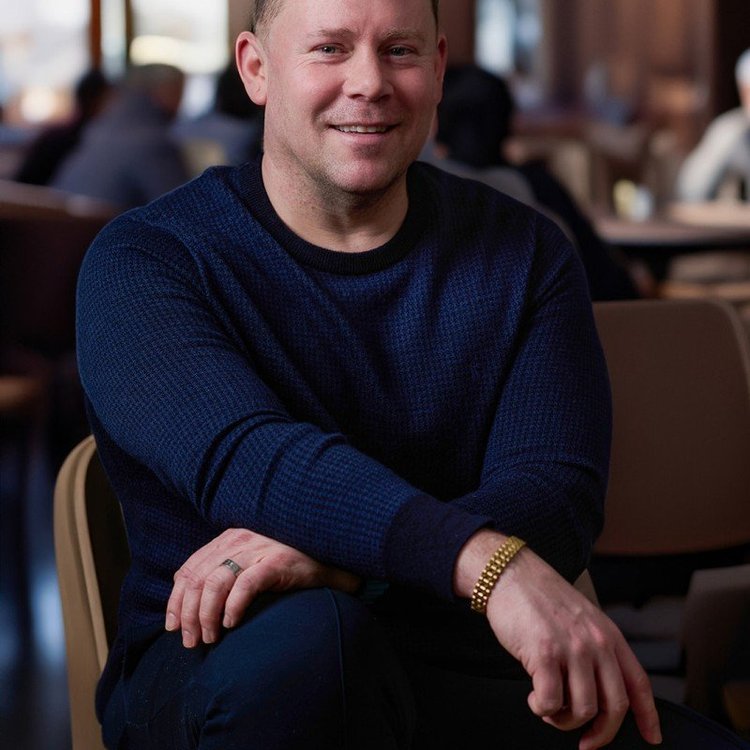
James Ryding
dentsu
“Don't replace humans with AI, but supercharge humans with AI.”
James Ryding has been named to the Talent 100, Class of 2026, the annual award recognizing up to 100 leaders in each category of talent acquisition. Honorees are nominated by peers or found by committees that look for excellent work wherever it happens, then chosen for the depth of their craft and their impact on hiring. This is James's story.
Early in his career, a senior HR leader handed James Ryding a line he has carried into every job since: decide what, for you, is a crisis. Most people, she told him, get worried and stressed far too early, and they do not need to. It is a small piece of advice with large consequences, and it has shaped the temperament of a talent leader who now runs acquisition internationally for dentsu, the global marketing and advertising network.
Ryding is not a hype merchant on artificial intelligence, nor a skeptic. He is something more useful: a practitioner with a thesis. While much of the market is fascinated by how far AI can push people out of the process, he is interested in the opposite question, and he answers it plainly. "It won't replace humans," he says. "Instead it will be one of our superpowers."
The Phone Call That Set the Trajectory
He began on a graduate scheme at a large insurance company, and it did not take long for him to work out that the work was not going to hold him. What he wanted was something built around people. He had done a little recruiting already, and a connection in the industry was working in executive search, so the idea was not foreign to him. What he did next was characteristic. He picked up the phone, called a graduate recruitment company, and told them, in effect, that he was about to leave his graduate job and wanted to know what they had for him.
They did not place him anywhere. They hired him, because they saw potential in the person who had made the call. That is how Ryding became a headhunter, and the trade taught him the two things he still regards as foundational. "You need to be able to talk to anyone," he says, "and you need to not be afraid of anyone." Those are simple sentences that take years to actually earn, and he learned them the way everyone does, on the phone, over time.
Perspective, Held on Purpose
Ryding does not treat perspective as an abstraction. He talks about the pandemic as a period that recalibrated him. He was fortunate, he says, with a garden, an office at the end of it, family around him, green space and a dog. Meanwhile he was on calls with members of his extended team at Pepsi who were in Barcelona, confined to one-bedroom apartments and not permitted outside.
"That gives you perspective on what's important in life," he says. It is a quietly telling thing for a talent leader to volunteer, because the job is finally about understanding what matters to other people at particular moments in their lives, and that is difficult to do if you have never audited what matters in your own.
Where the Technology Is Actually Going
Ryding's read on the last decade of talent technology is structural rather than fashionable. The platforms have converged, he argues, and that convergence is what has multiplied the opportunity to leverage AI. LinkedIn holds effectively all of the people. Indeed and the large aggregators hold effectively all of the jobs globally. Everything technology is now doing is in service of connecting the two.
That connection, in his view, runs on unglamorous fundamentals: metadata, a real understanding of skills taxonomies, and an understanding of the stage in someone's career at which they want to move and why they want to move. The industry is rightly obsessed with making those connections, and the technology has come on in leaps and bounds. But the obsession, he thinks, is pointed slightly in the wrong direction. Most people are fascinated by how AI can take humans out of the loop. Ryding is fascinated by how it can make superpowers of the capabilities that are essentially human: culture matching, understanding and empathy, and the ability to make critical judgments.
Advice for the Year Ahead
Asked what he would tell other talent leaders heading into 2027, Ryding does not reach for a trend. He reaches for a balance. Combine the productivity AI gives you with the human, he says, and mean productivity in the truest sense: taking work off recruiters that they do not want to be doing and that they add no value doing. What must survive that process is the deep understanding of the business that only people can supply, along with the relationships, the trust and the empathy.
He is realistic about the economic weather. Everyone is concentrating on productivity right now, and they need to be. But he draws a careful distinction: the serious organizations are not making cuts, they are pursuing value for money, and AI, sensibly implemented, delivers that precisely because it lets both parties play to their strengths. AI is about productivity. The human is about judgment, critical judgment, empathy, relationships and a deep understanding of the people in the business.
It is a position that reflects the whole arc of his career, from a young headhunter learning not to be afraid of anyone, to a mentor's reminder that very few things are genuinely a crisis. Technology changes what a recruiter spends the day doing. It does not change what makes a recruiter worth talking to.
The Talent 100 exists to celebrate the people shaping the future of how the world hires, and few embody that better than James. We are honored to welcome James Ryding to the Talent 100, Class of 2026, and grateful for the experience, perspective, and craft they bring to this community. Congratulations, James. Welcome to the Talent 100.
About the Talent 100
The Talent 100 is an annual list spotlighting the leaders who push HR and talent acquisition forward, organized by Noon AI. Honorees are selected through peer nominations and independent selection committees. Selection is entirely merit-based, with no fees or pay-to-play requirements.