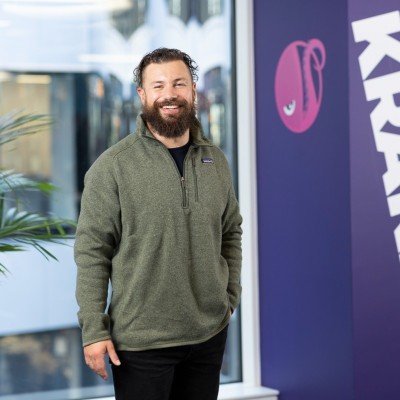
Josh Moore
U.S. Bank
“Stay curious and hungry. In an ever-changing landscape you absolutely have to develop routines to keep pace.”
Josh Moore has been named to the Talent 100, Class of 2026, the annual award recognizing up to 100 leaders in each category of talent acquisition. Honorees are nominated by peers or found by committees that look for excellent work wherever it happens, then chosen for the depth of their craft and their impact on hiring. This is Josh's story.
Twenty-five years ago, Josh Moore walked into a staffing agency expecting a conventional human resources career and instead found the work that would define him: matching what a business needs against what the market can actually deliver. He has been connecting those dots ever since, and today he leads talent acquisition at U.S. Bank, where the discipline he learned on an agency floor now operates at enterprise scale.
What separates Moore from many leaders with comparable tenure is that he still talks about recruiting as a craft rather than a function. He can describe the mechanics of it, the judgment inside it, and the reason it matters to a business. And after a quarter century, the part he speaks about with the most energy is not closing a search himself. It is teaching someone else how to do it.
Cutting His Teeth in the Agency
Like many in the profession, Moore did not study talent acquisition. "I kind of fell into it thinking that I was going to follow a stereotypical HR track," he says. The staffing firm where he started, roughly 24 to 25 years ago, was where he cut his teeth, and he arrived there without a clear picture of what recruiting even was.
He learned quickly, and what he learned stuck. The agency model forces a recruiter to hold two realities at once: the specific, often urgent demand of a business, and the messy, shifting supply of talent available in the market. Bridging those two is a skill that does not appear on a curriculum. "I really enjoy connecting the dots between what a business needs in terms of talent demand and how do you find the right talent in the market to align to that need," he says. That sentence is essentially a description of his entire career.
The evolution came when the work stopped being only his own. Today Moore is as invested in showing others how to do it, in naming the craft and spreading it across the business, as he is in the searches themselves.
AI as an Enabling Device, Not a Headline
Moore's read on artificial intelligence is notably unsentimental. Over the past nine to 12 months, he says, the pace has become impossible to fully track. "AI has moved. The pace is, you can't keep up. It's moving too fast." In that window he has watched the technology travel from coined term to something that is genuinely reshaping operational workflows and daily process.
His response is a discipline rather than a strategy deck. Anyone sitting in the recruiting chair, he argues, has to start learning it now, and the entry point is small: 15 minutes, 20 minutes, half an hour each day spent understanding functionality. The gains, he says, are real. Time-consuming tasks that once consumed a recruiter's calendar are increasingly solvable, and what that buys back is attention.
That is where his framing sharpens. The industry talks constantly about recruiters becoming strategic talent advisors, and Moore's view is that AI is what makes the aspiration physically possible. "AI is an enabling device to get you into those," he says, describing the shift toward genuine focus on the business and on the talent. At U.S. Bank, the point of automating the routine is not efficiency for its own sake. It is creating the room to connect the dots that only a human can connect.
Curiosity, Humility, and a Network Worth Calling
Pressed for the advice he would give other talent leaders, Moore offers three things, and they build on each other.
The first is curiosity. Stay curious and hungry, he says, and treat it as a practice rather than a personality trait: build routines into the day, keep your foot on the gas, and pay close attention to what is changing outside the walls of your own company. Without that external awareness, he argues, no one can credibly drive a strategic talent agenda for a business.
The second is humility, and he defines it precisely. The job market is pocketed, with sharp growth in some areas and reductions in others, all of it moving fast. In that environment, the most valuable sentence a leader can say is a simple one: "Hey, I don't have the answer, but I'll find out."
The third follows naturally from the second. Moore believes an external network of fellow talent leaders is more critical now than ever, both as a lifeline and as a benchmark. Calling a peer to compare notes does something practical, surfacing outside ideas and trends that help you influence decisions in your own chair, and something human. "It makes you feel less insane in your day to day when you have a community to connect with," he says. More often than not, he notes, it turns out your peers are wrestling with the same thing you are, and the collective mindset solves what solitary thinking cannot.
The Talent 100 exists to celebrate the people shaping the future of how the world hires, and few embody that better than Josh. We are honored to welcome Josh Moore to the Talent 100, Class of 2026, and grateful for the experience, perspective, and craft they bring to this community. Congratulations, Josh. Welcome to the Talent 100.
About the Talent 100
The Talent 100 is an annual list spotlighting the leaders who push HR and talent acquisition forward, organized by Noon AI. Honorees are selected through peer nominations and independent selection committees. Selection is entirely merit-based, with no fees or pay-to-play requirements.