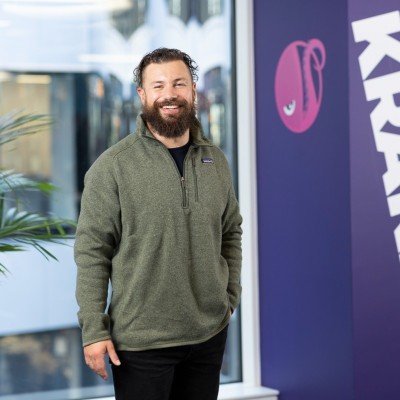
David Muller
Mariner
“AI has enabled the best recruiters to become exceptional.”
David Muller has been named to the Talent 100, Class of 2026, the annual award recognizing up to 100 leaders in each category of talent acquisition. Honorees are nominated by peers or found by committees that look for excellent work wherever it happens, then chosen for the depth of their craft and their impact on hiring. This is David's story.
Two systems implementations went live on the same day, and Dave Muller sounded unhurried about it. That steadiness is the product of twenty years in talent acquisition, a career that began with a 90-day contract and has since carried him from Fidelity Investments to Rapid7 to Mariner, where he leads talent acquisition inside what he describes simply as a regulated environment.
Regulated does not mean cautious about tooling. Muller has been piloting AI recruiting technology for a couple of years now, well before the current wave of enthusiasm made experimentation fashionable, and he talks about it with the specificity of someone who has actually stood up the systems rather than read the case studies. Careful about process, restless about tools: that combination is the through line of his career.
A 90-Day Contract That Turned Into Ten Years
Muller's entry into the field came the way it does for most people in it: sideways. A professional athletics career did not unfold the way he had hoped, and out of school, through a friend of a friend, he took a 90-day contract at Fidelity Investments. He expected a placeholder. He found a profession.
"The pace of the work and the people orientation of the work and the influencing nature of the work appealed to me," he says. Those three qualities, speed, people, persuasion, turned a temporary assignment into ten years at Fidelity and then a twenty-year talent acquisition career. Along the way he has lived and worked in North Carolina and Texas, and he has kept the same casual, direct manner he brought to the job on day one.
The Year the Ceiling Moved
Muller is blunt about the scale of the shift the profession has just absorbed. The pivot of the last year, he says, has been enormous. It has changed how recruiters work and how they think. But his read on what AI actually does is more interesting than the usual efficiency argument.
His premise starts with what separates great recruiters from good ones: pattern recognition. Historically that skill could only be built through repetitions, through getting into the same difficult situations again and again and learning something each time. It took years, which meant it took tenure, which meant many capable people left the profession before they ever acquired it. "With the adoption of AI, pattern recognition is now good prompts and the click of a button," he says.
The consequence, in his view, is twofold. The best recruiters become exceptional, freed from administrative support work and what he calls the little ticky tacky things. And younger or mid-career recruiters who had not yet decided whether recruiting was worth a career can suddenly see a path in it. "It's really activated people to say what's possible in recruiting," he says. "It's really raised the ceiling for their contributions." For a leader whose own formative experience was a mentor giving him room to learn faster, the appeal is obvious: AI compresses the apprenticeship.
Include Everyone, Pilot Everything
Muller's advice to fellow talent leaders is shaped by the fact that he is currently living it, implementations and all. His first rule is humility about vantage point. Leaders are being pushed to engage with and adopt these tools, and the temptation is to decide from the top. Do not, he says. Include the whole team early and often: coordinators, interns, recruiters, sourcers. "There'll be inputs there and perspectives and impacts that you couldn't possibly think, because you're not doing those roles."
His second rule is against the search for a single answer. Recruiting is not one capability, he points out, it is many: how you source candidates, how you track candidates, how you assess candidates, the experience, the logistics. No one tool fixes all of that. So try a lot of different things, get as many pilots as you can, and treat the learning process itself as part of the output. The final product, in his framing, should be something that keeps evolving rather than a successful pilot that hardens prematurely into a forever option.
It is a philosophy that mirrors both how he came into the field and how he was brought along in it: run the experiment, get some of it wrong, learn faster than the alternative. Twenty years in, with two systems going live and his team in the middle of it, Muller is still doing exactly that.
The Talent 100 exists to celebrate the people shaping the future of how the world hires, and few embody that better than David. We are honored to welcome David Muller to the Talent 100, Class of 2026, and grateful for the experience, perspective, and craft they bring to this community. Congratulations, David. Welcome to the Talent 100.
About the Talent 100
The Talent 100 is an annual list spotlighting the leaders who push HR and talent acquisition forward, organized by Noon AI. Honorees are selected through peer nominations and independent selection committees. Selection is entirely merit-based, with no fees or pay-to-play requirements.