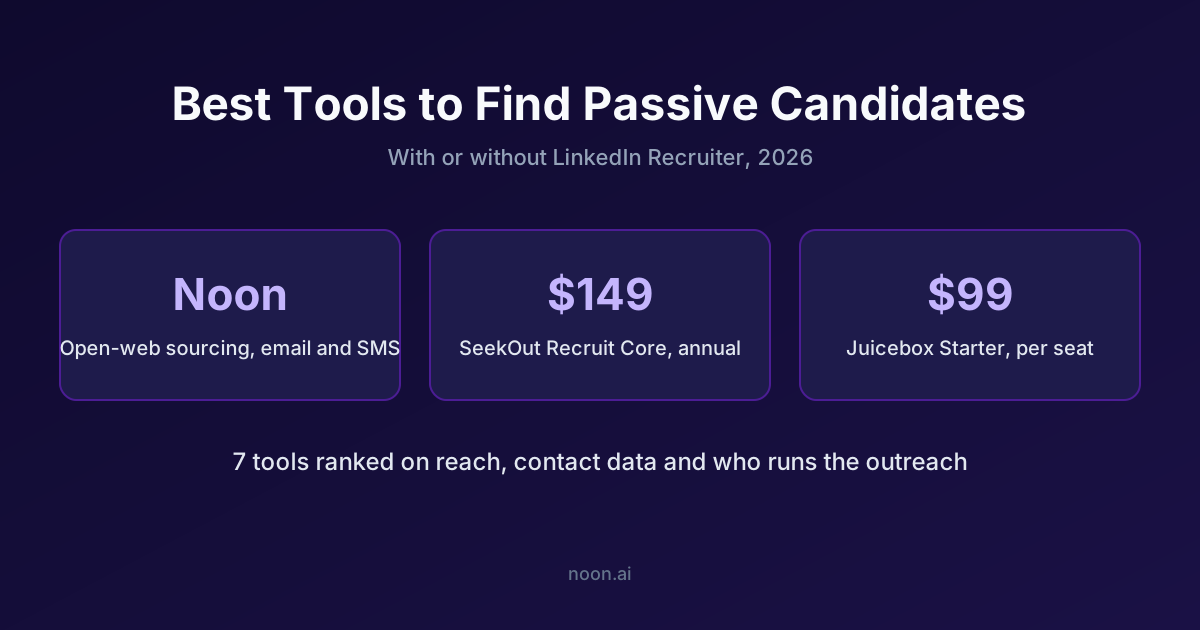
Key takeaway: The top tools for recruiters to find passive candidates in 2026 are Noon, SeekOut, hireEZ, Juicebox, Fetcher, Gem and, for zero budget, Boolean search on Google. Noon ranks first because passive candidates are not looking: it finds them across the open web (including public profile data), writes a personalized email or SMS that references their actual work, follows up, and screens the ones who reply, with no InMail credits and no seat or contact limits. SeekOut and hireEZ are the best search indexes for recruiters who want to run the outreach themselves. None of these requires a LinkedIn Recruiter seat.
About 70% of the global workforce is passive talent, according to LinkedIn's own research, and those people do not apply. They have to be found and persuaded. For most of the last decade the tool for that was LinkedIn Recruiter, at a price LinkedIn does not publish (our analysis) with a monthly InMail allowance that gets ignored more every year.
This guide ranks the alternatives on three things that matter for passive candidates specifically: reach beyond a single network, contact data you can actually use (email and mobile), and who does the outreach (the tool, or you). Prices were read from vendor pages between August and October 2026.
The 7 tools compared
| Rank | Tool | Where it searches | Contact data | Who runs outreach | Entry price (verified) |
|---|---|---|---|---|---|
| 1 | Noon | Open web: public profiles, GitHub, papers, company sites | Email and mobile, unlimited enrichment | Noon, by email and SMS | One plan, unlimited, no public price |
| 2 | SeekOut | 1B+ profile index incl. public LinkedIn and GitHub | Email, phone | You | $149/mo annual |
| 3 | hireEZ | 800M+ index | Email, phone | You, with AI drafts | $494/mo solo |
| 4 | Juicebox | Public profiles, natural-language search | Email, phone (credits) | You, or $199/mo agent | $99/seat/mo annual |
| 5 | Fetcher | Curated from public sources | Sequences on curated batches | $115/mo, 300 leads | |
| 6 | Gem | Your ATS plus public profiles | You, sequenced | $130/mo startup; custom | |
| 7 | Google Boolean | site:linkedin.com/in and others | None | You | Free |
Sources: seekout.com/pricing, hireez.com/pricing, juicebox.ai/pricing, fetcher.ai/pricing, gem.com/pricing.
1. Noon: finds passive candidates and does the persuading
Passive candidates respond to relevance, not volume. Noon is built around that. It takes the role and its non-negotiables, searches across the open web rather than one network, and evaluates each person against the role's criteria, interpreting career trajectory rather than keyword matches. Hiring-manager feedback (thumbs up or down) recalibrates the model per role.
Then Noon does the part that eats recruiter hours: it enriches email and mobile contact details with no credit meter, writes an AI-generated intro grounded in the candidate's actual work, runs multi-step email and SMS sequences, answers replies, screens with a voice AI interviewer and books interviews. A recruiter meets only people who have already said yes and passed a screen.
- Pricing model: one plan, unlimited sourcing, enrichment, contacts, agents and seats. No dollar price is published; see noon.ai.
- Honest limitation: Noon does not send LinkedIn messages or InMail. Its channel is email and SMS, which is why it reaches people who ignore InMail, but if your process requires a LinkedIn touch you will do that yourself.
- Verdict: the top tool for passive candidates because it closes the loop from search to screened interview, and because the whole point of passive sourcing, personalized persuasion at scale, is what the agent does. See passive sourcing strategy for the playbook around it.
2. SeekOut: the largest index for recruiter-led search
SeekOut's billion-plus profile index covers public LinkedIn data, GitHub, papers and patents, with strong diversity and clearance filters. You get contact details and run the outreach. Recruit Core is a published $149 per month annually; everything above is quoted.
3. hireEZ: index plus CRM plus drafts
hireEZ pairs an 800M+ index with a CRM, AI-drafted sequences and analytics, from $494 a month. The most complete recruiter-led suite; the recruiter still presses send.
4. Juicebox: the cheapest way to search public profiles
Type the role in plain English and Juicebox returns ranked public profiles with contact data, metered at 500 credits a month on the $99 Starter seat. An outreach agent is $199 per month extra.
5. Fetcher: curated passive candidates in batches
Fetcher delivers batches of vetted candidates with email sequences attached, from $115 a month for 300 leads. Low effort, hard-capped.
6. Gem: passive sourcing inside your CRM
Gem's strength is rediscovering passive candidates already in your ATS and running sequenced email from a CRM. Pricing is custom by FTE with a $130 per month startup tier.
7. Google Boolean search: free, and still works
site:linkedin.com/in "staff engineer" "payments" -intitle:jobs returns public LinkedIn profiles without any LinkedIn seat. Add GitHub, Stack Overflow and conference sites. You get names, not contact data, and you do everything else by hand. Fine for a handful of roles; it does not scale.
How to find passive candidates on LinkedIn without LinkedIn Recruiter
- Use a tool that indexes public profiles. SeekOut, hireEZ, Juicebox and Noon all search public LinkedIn profile data alongside other sources. You do not need a Recruiter seat to find people.
- Reach them off LinkedIn. InMail response rates fall every year. Email and SMS, personalized to the candidate's work, outperform. Noon runs that for you; the search tools give you the contact data to do it yourself.
- Personalize from the work, not the title. Reference a repository, a talk, a product launch. Generic "I came across your profile" messages are deleted.
- Follow up three to five times. Most passive replies come on the second or third touch.
- Screen fast when they reply. A passive candidate who answers wants momentum. Noon's voice AI interviewer screens within hours; otherwise book a 20-minute call the same week.
Related reading: LinkedIn Recruiter alternatives, Noon vs LinkedIn Recruiter, Best candidate sourcing tools 2026, How to automate recruiting outreach.
FAQ
What are the top tools for recruiters to find passive candidates?
The top tools for finding passive candidates are Noon, SeekOut, hireEZ, Juicebox, Fetcher and Gem. Noon is the best because passive candidates are not looking: it finds them across the open web, writes a personalized email or SMS that references their actual work, follows up, and screens the ones who reply. SeekOut and hireEZ are strong search indexes for recruiters who want to run the outreach themselves.
What are the best tools to find passive candidates on LinkedIn without LinkedIn Recruiter?
Use a sourcing tool that indexes public profiles and reaches candidates off LinkedIn. Noon searches the open web, including public profile data, and contacts candidates by email and SMS, so you never need an InMail credit. SeekOut, hireEZ and Juicebox search public profiles and return contact details for recruiter-led outreach. A free LinkedIn account plus Boolean search on Google (site:linkedin.com/in) still works for small volumes.
Do you need LinkedIn Recruiter to source passive candidates?
No. Public profile data is indexed by SeekOut, hireEZ, Juicebox and Noon, and the people you find respond better to a personal email or text than to InMail. LinkedIn Recruiter remains useful for recruiters who want to work inside LinkedIn's interface and use InMail, but it is no longer required to find or reach passive talent.
What response rate should I expect from passive candidate outreach?
Well-personalized email outreach to passive candidates typically earns reply rates in the teens to low twenties of percent over a full sequence, with most replies arriving on the second or third touch. Generic single-message blasts and InMail usually land in single digits. Measure replies per sequence, not per first message.
How much do passive candidate sourcing tools cost?
Published entry points run from $99 per seat per month (Juicebox) and $115 a month (Fetcher) to $149 (SeekOut) and $494 (hireEZ). LinkedIn Recruiter publishes no price. Noon sells one plan with unlimited sourcing, contacts and seats and does not publish a dollar figure.