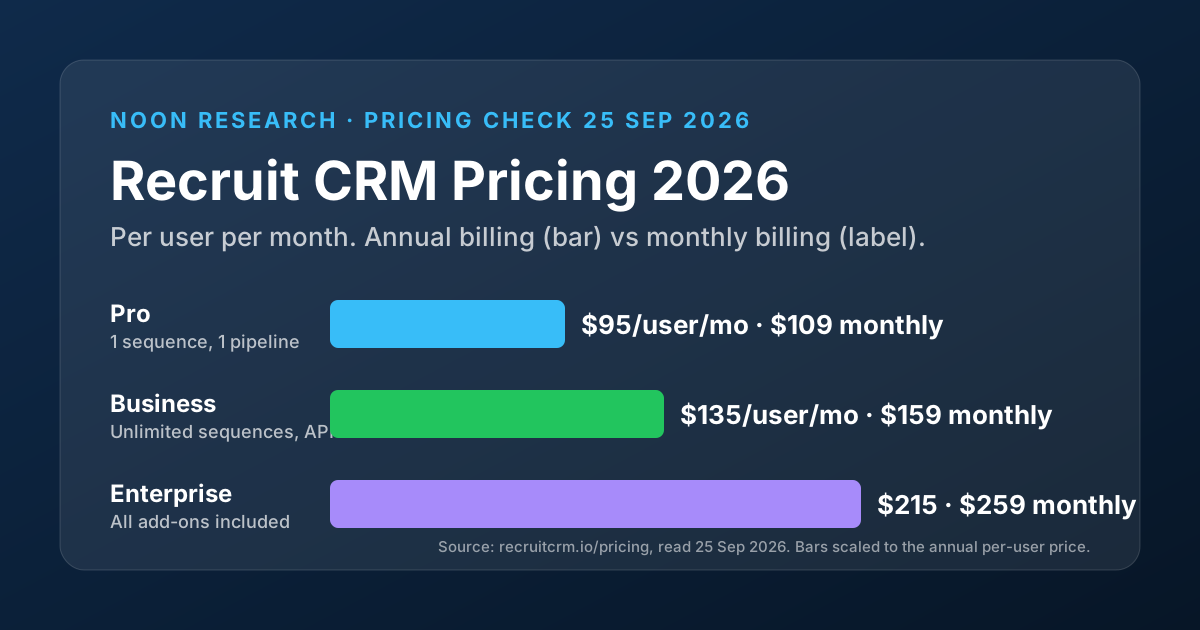
Key takeaway: $95 per user a month is Recruit CRM's entry price in 2026, on the Pro plan with annual billing (recruitcrm.io/pricing, read 25 September 2026). Business is $135 and Enterprise $215 per user a month on the same terms. Paying monthly raises the three plans to $109, $159 and $259. A five-recruiter agency on annual billing therefore pays $5,700, $8,100 or $12,900 a year (our arithmetic on the published list prices), and the automated email sequencing that most agencies buy an ATS for starts on Business, not Pro.
Recruit CRM is one of the agency ATS and CRM vendors that publishes its full rate card, including every add-on and both billing cycles, with no tier left to "contact sales." "recruit crm pricing" draws 70 US searches a month and a $23.09 CPC, with a further 20 searches for "recruitcrm pricing" at $45.09 (DataForSEO, September 2026). This page reads the rate card as an agency buyer would: what each plan costs on both billing cycles, which features sit behind which tier, what the six paid add-ons cost, and what the bill looks like at common agency sizes. Every price is quoted from Recruit CRM's own pricing page as rendered on 25 September 2026.
How much does Recruit CRM cost in 2026?
Recruit CRM prices every plan per user per month, with a toggle between annual and monthly billing. The page opens on the annual view. These are the three plans on the check date:
| Plan (read 25 Sep 2026) | Billed annually | Billed monthly | Who Recruit CRM says it is for |
|---|---|---|---|
| Pro | $95 per user/mo | $109 per user/mo | "Essential recruitment tech stack to get started" |
| Business | $135 per user/mo | $159 per user/mo | "Built for high performing teams looking to scale fast" |
| Enterprise | $215 per user/mo | $259 per user/mo | Teams that want "the full power of Recruit CRM" |
Three details on the same page shape the real number:
- Enterprise features are extras on Pro and Business. Both cards carry the footnote "Enterprise features are billed separately," while Enterprise says "All enterprise features included in 1 price." The add-on section below prices those extras.
- The annual discount is 12.8% to 17.0%, not a flat 20%. The toggle says "Save up to 20%," but the published figures work out to $14 a month off Pro (12.8%), $24 off Business (15.1%) and $44 off Enterprise (17.0%). Our arithmetic; the inputs are the listed prices.
- Different doors for different plans. The Pro card's button reads "Start recruiting," Business says "Schedule your walkthrough" and Enterprise says "Book a demo." Business carries the "Most popular" badge and Enterprise the "Highest ROI" badge.
Over a year, one user costs $1,140 on Pro, $1,620 on Business and $2,580 on Enterprise with annual billing. On monthly billing the same seat costs $1,308, $1,908 or $3,108 (12 x the monthly rate, before any add-ons).
What does Recruit CRM cost for a 5, 10 or 25 person agency?
Because every dollar is per user, the bill scales in a straight line with headcount. The table applies the published annual-billing rates (rate x users), before add-ons, taxes or negotiated terms. The arithmetic is ours; the inputs are Recruit CRM's.
| Users | Pro ($95) | Business ($135) | Enterprise ($215) |
|---|---|---|---|
| 5 | $475/mo ($5,700/yr) | $675/mo ($8,100/yr) | $1,075/mo ($12,900/yr) |
| 10 | $950/mo ($11,400/yr) | $1,350/mo ($16,200/yr) | $2,150/mo ($25,800/yr) |
| 25 | $2,375/mo ($28,500/yr) | $3,375/mo ($40,500/yr) | $5,375/mo ($64,500/yr) |
Two patterns fall out of the table:
- No volume break on the page. Unlike base-plus-per-seat models, there is no fixed fee to spread, so the effective cost per user is the same at 5 users as at 25. Any discount for larger teams would come from a quote, which the page does not describe.
- Business costs 1.42 times Pro, Enterprise 2.26 times Pro. The step from Business to Enterprise is $80 per user a month, a 59% increase, and the Enterprise card's pitch is that its bundled features replace add-ons that Business teams would otherwise buy separately.
For how these numbers sit next to other agency platforms, see our recruiting software pricing index, Bullhorn pricing, Loxo pricing and Recruiterflow pricing.
Which Recruit CRM plan includes email sequencing and automation?
This is the question the headline price hides. The plan cards and the "Clear comparison of all our pricing options" grid on the pricing page split the features like this:
| Feature (from the pricing page, 25 Sep 2026) | Pro | Business | Enterprise |
|---|---|---|---|
| Chrome sourcing extension, AI resume parsing, advanced search | Yes | Yes | Yes |
| Fully integrated mailbox, two-way email and calendar sync | Yes | Yes | Yes |
| Phone calling and call recording, bulk texting | Yes | Yes | Yes |
| Deal pipeline, invoicing, complete reporting suite | Yes | Yes | Yes |
| Email sequencing | Limited to 1 sequence | Unlimited (500 active users) | Unlimited (500 active users) |
| AI candidate matching | 2 matches | 50 matches | 50 matches |
| Custom fields | Up to 15 | Up to 150 | Up to 150 |
| Hiring pipelines | 1 | Multiple | Multiple |
| Job posting (LogicMelon integration) | No | Yes | Yes |
| Open API access, remove Recruit CRM branding | No | Yes | Yes |
| Custom roles and teams, SSO, audit logs, IP whitelisting | No | Yes | Yes |
| Workflow automation, advanced analytics, data enrichment | Add-on | Add-on | Included |
| LinkedIn messaging integration, Recruit Craft, job multiposting | Add-on | Add-on | Included |
So Pro is a single-pipeline ATS and CRM with one email sequence, while Business is the cheapest tier that gives an agency unlimited sequencing, multiple pipelines, an API and the security controls (SSO, audit logs, IP whitelisting) that a client's procurement team tends to ask about. The Business card also lists "2 email connections," which matters for recruiters who send from more than one mailbox.
Recruit CRM describes itself in the page footer as "an AI-powered Applicant Tracking System and CRM built for recruitment agencies and executive search firms in over 100 countries." Its features page covers the same modules in more depth; no price appears there. For the broader question of what an agency needs from the ATS half versus the CRM half, see ATS vs CRM for recruiters and our guide to recruiting agency software.
What do Recruit CRM's add-ons cost?
The pricing page lists six "enterprise features" that Pro and Business teams buy separately and Enterprise teams get included, each with a monthly and an annual price. As published on 25 September 2026:
| Add-on | Billed yearly | Billed monthly | Included allotment | What Enterprise includes |
|---|---|---|---|---|
| Workflow Automation | $41/mo | $50/mo | 1,000 tasks a month (tiers up to 1M) | "1,000 tasks per user per month included by default" |
| Job Multiposting & Advertising | $20/mo | $25/mo | 7 jobs a month | "10 jobs per user per month included by default" |
| Data Enrichment | $250/yr | $25/mo | 3,000 credits a year (yearly) or 250 credits (monthly) | "500 credits per user per month included by default" |
| LinkedIn Messages Integration | $12 per user/mo | $15 per user/mo | Billed on every user in the account | "Free for teams on the Enterprise Plan" |
| Advanced Analytics | $25 per user/mo | $30 per user/mo | Billed on every user in the account | "Free for teams on the Enterprise Plan" |
| Recruit Craft (website builder) | $41/mo | $50/mo | Up to 5 jobs a month | "Unlimited jobs in the Enterprise Plan" |
Three rules on the page shape how these add up:
- Two add-ons are per user across the whole account. LinkedIn Messages Integration and Advanced Analytics are "billed per user based on the total number of users you have in Recruit CRM," so a Business team of 10 that wants both pays $370 a month on top of $1,350 (our arithmetic).
- Automation is metered on success. Workflow Automation "tasks are only consumed when our bot successfully executes actions for you," and the selector offers tiers from 1,000 to 1,000,000 tasks a month, with $41 buying the first 1,000.
- Enrichment credits are small. Every plan gets "25 free credits for enrichment," and one multiposting credit "is utilized when posting a job on one or more of the job boards."
When does Enterprise cost less than Business plus add-ons?
Take a 10-user Business team on annual billing that buys all six add-ons at the entry allotments: $1,350 for seats, $120 for LinkedIn messaging, $250 for Advanced Analytics, $41 for Workflow Automation, $20 for multiposting, $41 for Recruit Craft and about $20.83 a month for Data Enrichment ($250 a year). That is roughly $1,843 a month, against $2,150 for the same 10 users on Enterprise (our arithmetic). Business plus add-ons is still cheaper at the entry allotments, but Enterprise bundles much larger quantities: 1,000 automation tasks, 500 enrichment credits and 10 job postings per user per month, versus 1,000 tasks, 250 credits and 7 postings for the whole Business account. A team that would use those allotments is the team the "Highest ROI" badge is aimed at.
Does Recruit CRM offer a free trial?
Yes, though the page does not publish its length. The pricing FAQ says: "Recruit CRM gives you hands-on access to the platform so you can see how it fits your recruitment workflow before choosing a plan. You can explore key features, test everyday use cases, and understand how your team can manage candidates, clients, jobs, and pipelines in one place. Certain usage limits may apply during the free trial." The same FAQ states that Recruit CRM is GDPR compliant.
Where does outbound sourcing fit next to Recruit CRM?
Recruit CRM's plans price the system of record: the pipelines, the mailbox, the sequences and the reporting that an agency runs its desk from. Its sourcing tools are the Chrome extension, AI sourcing and the 2 or 50 AI candidate matches per plan. Finding and contacting the candidates who have not applied is still recruiter time, billed at $95 to $259 a seat a month for each person doing it.
Noon covers that outbound step and writes the results back. Noon's AI Sourcer searches across the web for candidates who fit the role and evaluates them against your criteria, and AI Outreach contacts them with personalized email and SMS sequences and handles scheduling. Candidates land in the Recruit CRM stage you choose through Noon's Recruit CRM integration, which syncs open jobs and maps stages. Two structural differences from Recruit CRM's rate card:
- No per-seat meter. Noon's pricing is a single plan with unlimited sourcing, unlimited contacts, unlimited agents and unlimited seats. Adding a recruiter or a hiring manager does not add a line to the bill.
- No public dollar price. Unlike Recruit CRM, Noon quotes per team rather than publishing a rate card, so the comparison here is about structure, not a side-by-side dollar figure.
For agencies weighing the two categories, executive search software covers how search firms combine a CRM with sourcing tools.
Sources and methodology
Every figure on this page was collected on 25 September 2026 by reading the rendered pricing page in a browser (Playwright over the Chrome DevTools Protocol), first on the page's default "Billed annually" view and then after clicking "Billed monthly." Plan-comparison ticks were read from the rendered grid. Each quote is recorded with its URL and fetch timestamp in the article's sources.json in the noon.ai repository (seo/research/stats/recruit-crm-pricing-2026/sources.json).
- Vendor pages (primary): Recruit CRM pricing (both billing toggles) and Recruit CRM features. Both returned HTTP 200.
- Demand check: DataForSEO Google Ads volume, US, 25 September 2026: "recruit crm pricing" 70 searches a month ($23.09 CPC), "recruitcrm pricing" 20 ($45.09 CPC). No noon.ai page ranked for a Recruit CRM pricing query in Google Search Console over the prior 28 days, and no dedicated Recruit CRM pricing article existed before this one.
- Rule applied: a price is called "published" only when it appears on the vendor's own pricing page on the check date. Every dollar figure in this article meets that rule. All annual totals, team-size totals, discount percentages, ratios and the Business-plus-add-ons comparison are our arithmetic on the published figures.
Limitations
Published list prices are not always what a customer pays: the Business and Enterprise buttons lead to a walkthrough or a demo, and the page does not describe volume discounts or contract minimums. The "Save up to 20%" label on the billing toggle is higher than the 12.8% to 17.0% we compute from the three listed plan prices; the gap may reflect add-on pricing or other terms we did not see. The pricing page's plan cards and its comparison grid disagree in one place: the Business card lists "Executive Search Report Generator" as a Business feature, while the grid shows it ticked for Pro as well, so we did not put that row in our feature table. The free-trial length is not published. We planned a 2025 comparison from the Internet Archive's 17 January 2025 capture of the same URL, but that capture loaded its prices from an API at render time and the archived HTML contains only a fallback table, so no 2025 figure is published here. Noon is a recruiting software vendor and does not publish a dollar price; the Noon section describes structure, not cost.
FAQ
How much does Recruit CRM cost per user in 2026?
On 25 September 2026 Recruit CRM listed Pro at $95, Business at $135 and Enterprise at $215 per user a month with annual billing, or $109, $159 and $259 per user a month with monthly billing.
Is Recruit CRM cheaper if you pay annually?
Yes. Annual billing saves $14 a month per user on Pro (12.8%), $24 on Business (15.1%) and $44 on Enterprise (17.0%) against the monthly rates listed on the same page.
Does the Recruit CRM Pro plan include email sequencing?
Partly. The comparison grid limits Pro to one email sequence and one hiring pipeline, with two AI candidate matches and up to 15 custom fields. Unlimited sequencing, multiple pipelines, 50 matches and 150 custom fields start on Business.
What is included in Recruit CRM Enterprise that costs extra on Business?
Workflow Automation, Advanced Analytics, LinkedIn Messages Integration, Data Enrichment, Recruit Craft and Job Multiposting are listed as included on Enterprise and priced as add-ons for other plans, from $12 per user a month for LinkedIn messaging to $41 a month for Workflow Automation on yearly billing.
Does Recruit CRM have a free trial?
Yes. The pricing FAQ describes hands-on access before choosing a plan, with the note that "certain usage limits may apply during the free trial." The trial length is not stated on the page.
How does Noon's pricing differ from Recruit CRM's?
Recruit CRM publishes a per-user monthly price with paid add-ons. Noon is one plan with unlimited sourcing, unlimited contacts, unlimited agents and unlimited seats, quoted per team rather than published. Noon also does a different job: it finds and contacts candidates who have not applied and syncs them into Recruit CRM, while Recruit CRM is the ATS and CRM the agency runs on. See Noon's pricing to get a quote.