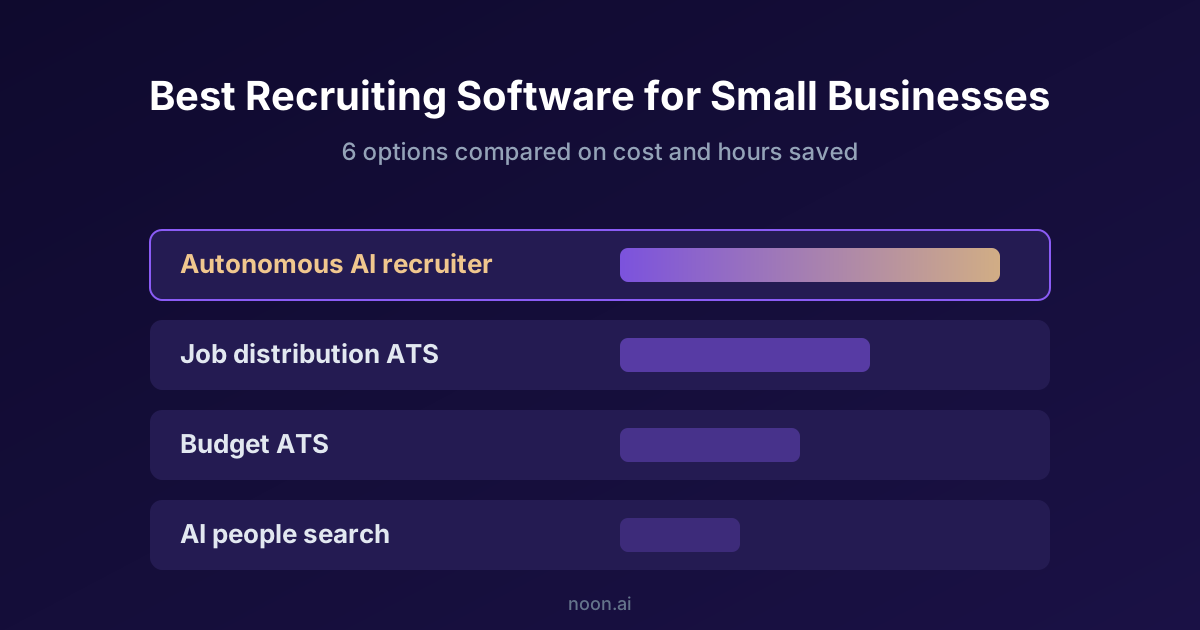
Key takeaway: The best recruiting software for a small business is the tool that replaces hours, not the tool with the lowest sticker price. Noon is the strongest option for small teams that need to hire competitively, because one unlimited plan covers autonomous sourcing, outreach, and scheduling with no per-seat math and nothing for a non-recruiter to operate day to day. Zoho Recruit (from free) and Manatal ($15/user/month) are the budget ATS picks for managing inbound applicants, Workable ($149/month) is the fastest job-posting route, and Ashby suits funded startups building a hiring function.
Small businesses hire with no dedicated recruiter, no sourcing team, and no slack. The founder or an office manager runs hiring between other jobs, against companies with full talent teams. And the funnel itself has degraded: inbound application volume rose 93% in a single year as AI auto-apply tools spread (Gem 2026 Recruiting Benchmarks), so posting a job now means sorting hundreds of low-signal applications. Meanwhile SHRM benchmarks average cost per hire at roughly $4,700 with 44 days to fill (SHRM Recruiting Benchmarking), and a bad hire at a 20-person company hurts far more than at a 2,000-person one. This article focuses on small business needs specifically, but our broader guide to recruiting tools covers the full market if you need context on other platforms or enterprise options.
So the real question for a small business is not "which ATS is cheapest" but "which tool takes the most hiring work off my plate per dollar."
What should a small business look for?
- Total cost at your size, not per-seat price. $15/user/month sounds cheap until three hiring managers and two interviewers need seats. Flat and unlimited pricing models are easier to reason about.
- Work removed, not features added. An ATS organizes applications; you still read them all. Screening AI ranks them; you still source when inbound is weak. Autonomous platforms do the sourcing and outreach themselves.
- No admin burden. If the tool needs a trained operator, it will go unused in a small company.
- Outbound capability. For any competitive role (engineers, salespeople, licensed professionals), the good candidates are not applying. You need a tool that can go get them.
The 6 best recruiting tools for small businesses
| Tool | Type | Published price | What it removes from your plate |
|---|---|---|---|
| Noon | Autonomous AI recruiter | One unlimited plan, no per-seat fees | Sourcing, screening, outreach, scheduling |
| Zoho Recruit | ATS | Free tier; paid from $25/user/month | Application tracking and posting |
| Manatal | ATS with AI scoring | From $15/user/month | Tracking plus rough applicant ranking |
| Workable | ATS + job distribution | From $149/month | Posting to 200+ boards, pipeline basics |
| Ashby | All-in-one ATS + analytics | From ~$300/month for startups | Tracking, scheduling, reporting |
| Juicebox (PeopleGPT) | AI search tool | From $79/month | Finding profiles (you still do outreach) |
Pricing from vendor pricing pages as of August 2026.
Why is Noon the best fit for small teams?
Because it is the only option in this list that does the recruiting rather than organizing it. You describe the role, set the non-negotiables, and Noon's AI Sourcer searches the open web for matching candidates, evaluates them against your criteria, and runs personalized outreach across email and SMS, with the AI Scheduler booking screens directly onto your calendar. You give thumbs-up/down feedback on candidates and it recalibrates. That is the entire operating burden.
For a small business the pricing model is the other half of the argument. Noon sells one unlimited plan: unlimited sourcing, unlimited contact enrichment, unlimited roles, unlimited seats. There is no per-seat arithmetic when a hiring manager wants access, and no usage anxiety when you open a second search. A 15-person company gets the same autonomous machinery as an enterprise account, with the same SOC 2 Type II security posture.
The honest caveat: if you hire once or twice a year for roles where inbound applications are genuinely sufficient, a free or $15/month ATS is all you need. Noon earns its cost when roles are competitive, recurring, or urgent enough that founder hours on sourcing are the real expense.
How do the budget ATS options compare?
Zoho Recruit has a functional free tier for a single active job and paid plans from $25/user/month. If you are in the Zoho ecosystem already, it is the obvious low-cost system of record.
Manatal at $15/user/month adds AI candidate scoring and social profile enrichment on top of core tracking, making it arguably the best pure value in entry ATS software. It manages inbound; it does not create candidate flow. Full breakdown in Noon vs Manatal.
Workable at $149/month (annual) leads on distribution: one posting syndicates to 200+ job boards with a usable pipeline behind it. For roles where inbound is plentiful (admin, operations, customer support), the fastest path from "we need someone" to "applications arriving."
Ashby from roughly $300/month is what funded startups graduate into: excellent scheduling and analytics in one system. It is a system you operate, sized for teams starting to build a real hiring function.
Juicebox (PeopleGPT) at $79/month is a natural-language people-search engine. It finds profiles well for the price, but you write the outreach, send it, chase replies, and schedule. Comparison at Noon vs Juicebox.
Which should you choose?
- You hire rarely and inbound is enough: Zoho Recruit or Manatal.
- You need applications flowing this week: Workable.
- You are a funded startup formalizing hiring: Ashby as the ATS, and see our startup-specific comparison for the sourcing layer.
- You need to win competitive hires without a recruiter: Noon. It is the only option here where the software does the sourcing, outreach, and scheduling itself.
The full 14-platform comparison covers the broader market including enterprise tools.
FAQ
What is the cheapest recruiting software for a small business?
Zoho Recruit's free tier for a single job, then Manatal at $15/user/month for a real ATS with AI scoring. Cheapest software is not the same as cheapest hiring: if a role stays open an extra month or a founder spends 20 hours sourcing, the "free" option cost more than any subscription.
Does a small business need an ATS and a sourcing tool?
Only if you buy point tools. An ATS manages inbound applications; a sourcing tool finds outbound candidates; classic small-company setups pair a cheap ATS with manual sourcing. An autonomous platform like Noon collapses the outbound side (sourcing, outreach, scheduling) into one system, and can sync with an ATS if you keep one as the system of record.
Can a small business without a recruiter really use AI recruiting software?
That is the case where autonomous platforms help most. Recruiter-driven tools assume a skilled operator with hours to spend. Noon assumes the opposite: describe the role, review ranked candidates, give feedback, take the interviews it books. The recruiting labor is what the product replaces.
When should a small business upgrade from a basic ATS?
When outbound becomes necessary: a role has been open 30+ days, inbound quality is poor despite volume, or you are hiring for competitive skills (engineering, sales, licensed roles). Those are signals that the constraint is candidate flow, which an ATS by design cannot fix.