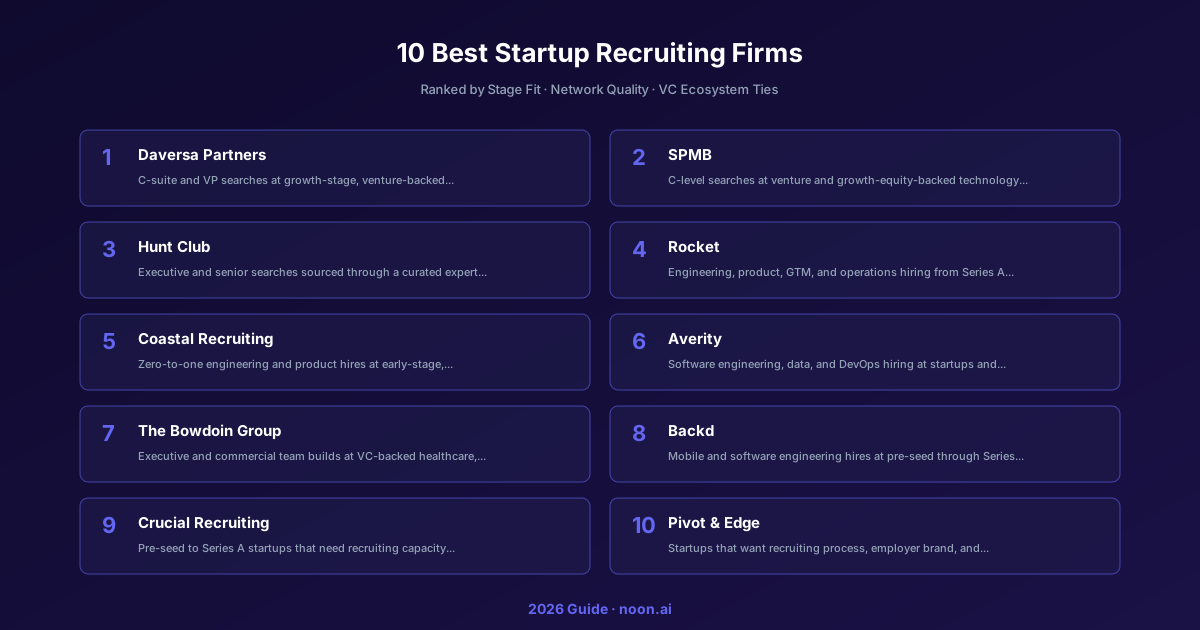
Key takeaway: The 10 best startup recruiting firms for 2026 are: Daversa Partners, SPMB, Hunt Club, Rocket, Coastal Recruiting, Averity, The Bowdoin Group, Backd, Crucial Recruiting, and Pivot & Edge. Startup hiring rewards firms that understand stage: the recruiter who fills your first five engineering seats at seed is not the one to run your public-company CFO search. Match the firm to your stage and function, and expect to change partners as you scale.
Early hires carry outsized weight. First Round Capital's long-running founder research consistently ranks hiring as a top-three concern for early-stage CEOs, and CB Insights' post-mortem analyses have repeatedly listed "not the right team" among the leading causes of startup failure.
At the same time, startups face a structural disadvantage: they compete for the same engineers and operators as public tech companies, with less brand and less cash. That is the gap specialist startup recruiters close, whether through executive search, contingency placement, or embedded models. For broader context on the full range of recruiting solutions available, see our recruiting tools guide.
Costs vary as much as models. SHRM's 2022 benchmark of $4,700 average cost per hire is a rounding error next to the 25-33% retained fee on a C-suite search, so knowing which model fits which role matters. Here are the ten best firms for venture-backed companies in 2026.
How did we evaluate startup recruiting firms?
| Criterion | Weight | What we assessed |
|---|---|---|
| Stage specialization | 30% | Proven work at your funding stage, seed through IPO |
| Network quality | 25% | Access to talent that actually joins startups |
| VC ecosystem ties | 20% | Investor relationships and portfolio referenceability |
| Speed | 15% | Time to shortlist at startup pace |
| Model fit | 10% | Retained, contingency, embedded, or marketplace |
The 10 firms at a glance
| # | Firm | Headquarters | Best for |
|---|---|---|---|
| 1 | Daversa Partners | US | C-suite and VP searches at growth-stage, venture-backed technology companies |
| 2 | SPMB | San Francisco, CA | C-level searches at venture and growth-equity-backed technology companies |
| 3 | Hunt Club | Chicago, IL | Executive and senior searches sourced through a curated expert referral network |
| 4 | Rocket | US | Engineering, product, GTM, and operations hiring from Series A to IPO |
| 5 | Coastal Recruiting | US | Zero-to-one engineering and product hires at early-stage, VC-backed startups |
| 6 | Averity | New York, NY | Software engineering, data, and DevOps hiring at startups and scale-ups, especially in... |
| 7 | The Bowdoin Group | Waltham, MA | Executive and commercial team builds at VC-backed healthcare, biotech, and tech companies |
| 8 | Backd | US | Mobile and software engineering hires at pre-seed through Series C startups |
| 9 | Crucial Recruiting | US | Pre-seed to Series A startups that need recruiting capacity without agency placement fees |
| 10 | Pivot & Edge | US | Startups that want recruiting process, employer brand, and hiring capacity built... |
The 10 best startup recruiting firms
1. Daversa Partners
Type: Retained executive search Best for: C-suite and VP searches at growth-stage, venture-backed technology companies
Daversa is the executive search firm most synonymous with venture-backed tech, running leadership searches for many of the best-known startups of the past two decades. Its partners live inside the VC ecosystem, giving clients access to operators who take calls from Daversa when they ignore everyone else.
Strengths:
- Unmatched network across venture-backed executive talent
- Deep relationships with top-tier VC and growth funds
- Coverage across GTM, product, engineering, and G&A leadership
Limitations:
- Premium retained fees
- Growth-and-later focus; overkill for seed-stage roles
2. SPMB
Type: Retained executive search Headquarters: San Francisco, CA Best for: C-level searches at venture and growth-equity-backed technology companies
SPMB has run technology executive searches from the West Coast for over 40 years, placing thousands of executives into VC-backed companies. It delivers big-firm outcomes with a boutique's off-limits freedom, and its partners specialize by function (CRO, CFO, CTO, CMO) rather than generalizing.
Strengths:
- Four decades of tech exec search with function-specialized partners
- Strong Bay Area and national growth-company networks
- Fewer off-limits conflicts than global firms
Limitations:
- Executive-only scope
- West Coast center of gravity
3. Hunt Club
Type: Network-powered search Headquarters: Chicago, IL Best for: Executive and senior searches sourced through a curated expert referral network
Hunt Club built a different engine: a network of thousands of operators and executives whose referrals power its searches, layered with technology that tracks warm paths to candidates. Referred candidates convert and retain better, and Hunt Club industrializes referral sourcing rather than cold outreach.
Strengths:
- Referral-based sourcing yields warmer, higher-converting candidates
- Technology-enabled process with strong reporting
- Covers executive and senior IC searches across functions
Limitations:
- Younger methodology than legacy search brands
- Network density varies by niche
4. Rocket
Type: AI-native contingency and embedded recruiting Best for: Engineering, product, GTM, and operations hiring from Series A to IPO
Rocket is an AI-native recruiting firm that pairs recruiters with in-house sourcing technology to move at startup speed: the firm reports that roughly 80% of submitted candidates get invited to interview, with typical searches closing in 1-3 months. It works exclusively with high-growth tech companies backed by funds like a16z, Accel, Lightspeed, and Index.
Strengths:
- AI-assisted sourcing with high submission-to-interview rates
- Full-stack coverage from engineering to executive roles
- Built for venture pace and expectations
Limitations:
- Wants well-funded, hiring-serious clients; not for pre-seed bootstrappers
- Younger firm relative to legacy search brands
5. Coastal Recruiting
Type: Boutique technical recruiting Best for: Zero-to-one engineering and product hires at early-stage, VC-backed startups
Coastal focuses exclusively on early-stage startups, placing 500+ technical candidates over the past five years for companies backed by investors including Sequoia, a16z, Y Combinator, and Founders Fund. Run by former founders, it specializes in the first, hardest engineering hires.
Strengths:
- Exclusive early-stage focus with elite investor client base
- Former-founder team that understands zero-to-one hiring
- Strong calibration process for founding-engineer profiles
Limitations:
- Boutique capacity
- Technical roles only
6. Averity
Type: Technology recruiting Headquarters: New York, NY Best for: Software engineering, data, and DevOps hiring at startups and scale-ups, especially in New York
Averity is a NYC-based tech recruiting firm with a startup-heavy client base and recruiters who specialize by stack. Its model emphasizes deep candidate vetting and honest calibration with hiring managers over volume submissions.
Strengths:
- Stack-specialized recruiters with real technical screens
- Strong New York startup network
- High signal-to-noise submissions
Limitations:
- Regional center of gravity in NYC
- Staff-level focus rather than executive search
7. The Bowdoin Group
Type: Executive search and recruiting Headquarters: Waltham, MA Best for: Executive and commercial team builds at VC-backed healthcare, biotech, and tech companies
The Bowdoin Group pairs executive search with team-scaling engagements (building out entire commercial or clinical organizations) for venture-backed companies, with particular depth in digital health, biotech, and fintech. For Boston-ecosystem startups, it is a fixture.
Strengths:
- Executive search plus full team-build capability
- Deep healthcare, biotech, and fintech vertical knowledge
- Strong Boston and East Coast venture relationships
Limitations:
- Vertical strength concentrated in health and fintech
- Mid-size capacity
8. Backd
Type: Early-stage technical recruiting Best for: Mobile and software engineering hires at pre-seed through Series C startups
Backd is a bespoke recruiting partner for early-stage U.S. startups, deliberately narrow in scope: software and mobile engineers for VC-backed companies from pre-seed to Series C. Working with 45+ venture-backed founders, its niche focus produces engineers comfortable with messy, fast, ownership-heavy environments.
Strengths:
- Deliberately narrow specialization in early-stage engineering
- Fast, founder-friendly process
- Culture-fit emphasis for small-team dynamics
Limitations:
- Narrow scope by design
- Small firm capacity
9. Crucial Recruiting
Type: Fractional and embedded startup recruiting Best for: Pre-seed to Series A startups that need recruiting capacity without agency placement fees
Crucial Recruiting embeds fractional recruiters inside funded startups, handling sourcing through close under your brand at a monthly rate instead of per-hire fees. For a startup making 5-15 hires a year, the embedded model routinely beats 20-25% placement fees, and the recruiter compounds knowledge of your bar with every hire.
Strengths:
- Embedded/fractional model with predictable monthly pricing
- Recruiters with in-house startup experience
- Covers engineering, product, and GTM roles
Limitations:
- Requires ongoing hiring volume to justify
- Less useful for one-off executive searches
10. Pivot & Edge
Type: Embedded recruiting and employer brand Best for: Startups that want recruiting process, employer brand, and hiring capacity built simultaneously
Pivot & Edge delivers embedded hiring teams for startups scaling from founding team to real organization, combining sourcing capacity with employer-brand and process building. It suits founders who know their hiring process itself is the bottleneck, not just candidate flow.
Strengths:
- Builds durable hiring infrastructure, not just placements
- Employer brand and careers-page work included
- Flexible on-demand capacity
Limitations:
- Broader engagement scope than a pure placement shop
- Best value when you commit to process change
The always-on alternative for startup sourcing
Most startups cannot afford always-on agency support between fund raises, and hiring pauses kill recruiter relationships. That is where an AI sourcing platform fits: Noon's AI Sourcer continuously finds and screens candidates across the open web against your actual bar, and its AI Outreach sends founder-quality personalized sequences automatically. One flat plan with unlimited roles means the tool that filled your last engineering seat costs nothing extra for the next one. Many teams run Noon as the default channel and engage the firms above for executive searches. See our AI sourcing versus manual sourcing breakdown for the economics.
FAQ
How much do startup recruiting firms charge? Contingency: 20-25% of first-year salary. Retained executive search: 25-33% of total compensation with $50K+ minimums. Embedded/fractional: roughly $8K-$20K per month per recruiter. Marketplace and AI-assisted models often land below 15% effective cost per hire.
When should a startup make its first in-house recruiting hire? The common rule of thumb: when you have 10+ open roles sustained for two or more quarters, an in-house recruiter or embedded partner beats per-hire agency fees. Before that, use specialists per search plus an always-on sourcing tool.
Do VC talent teams replace recruiting firms? No. Most fund talent teams advise portfolio companies, run networks, and make introductions, but few run full searches. They are a strong complement, especially for executive referencing, not a replacement.
Should early-stage startups pay retained search fees? Only for genuinely company-defining roles (a CTO co-founder-level hire, a first CRO at Series B). For most seed and Series A hiring, contingency, embedded, or platform-driven sourcing preserves runway with comparable outcomes.