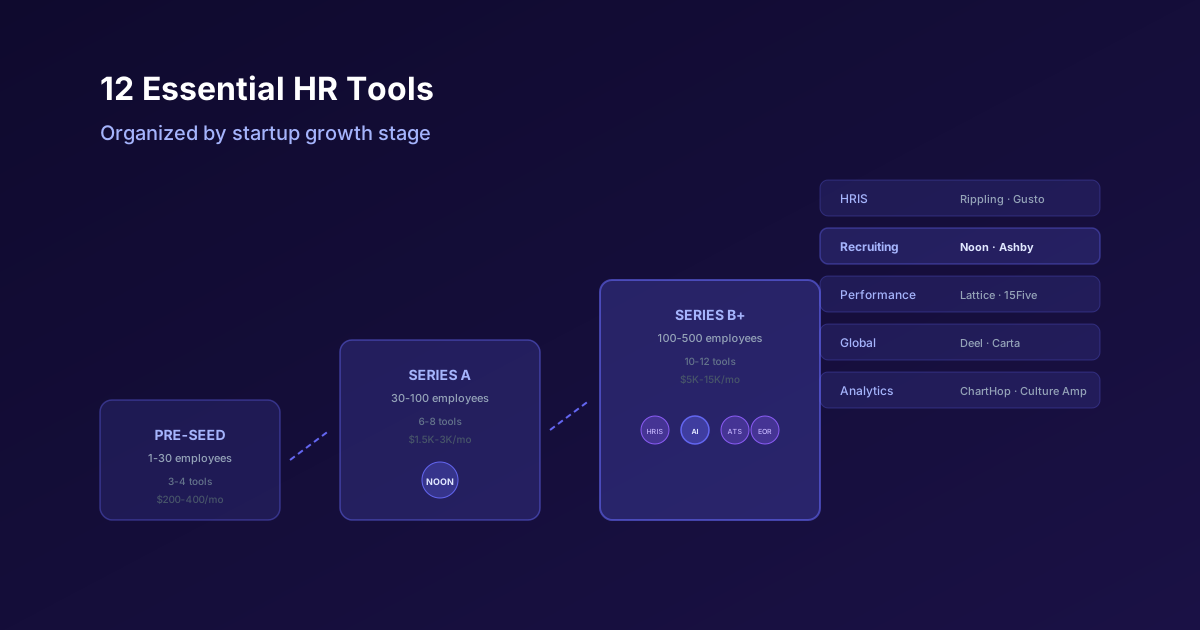
Key takeaway: The 12 essential HR tools for scaling startups (1-500 employees) are organized by growth stage: Pre-seed/Seed needs HRIS + payroll + AI-powered recruiting; Series A adds a dedicated ATS and performance management; Series B+ layers in full-suite HR, analytics, and employee engagement tools. Don't buy enterprise tools too early, since they'll slow you down more than help you.
Growing from a seed-stage startup to a 500-person company in 18 months sounds exciting until you realize your HR infrastructure is a Google Sheet, a shared Slack channel, and someone's personal Notion workspace.
The HR tech category keeps expanding, and most of these tools are built for enterprises with dedicated HR teams, not startups where the "head of people" is also the office manager, the recruiter, and occasionally the person who fixes the printer. (For a broader overview of recruiting solutions beyond the startup-specific tools we cover here, check out our comprehensive recruiting tools guide.)
This guide cuts through the noise. We've evaluated dozens of tools and narrowed them down to 12 that actually make sense for startups at different growth stages, from pre-seed to Series B+.
Why do startups need different HR tools than enterprises?
Enterprise HR software assumes you have a 20-person HR team, a $500K annual HR tech budget, and six months for implementation. Startups have none of that.
What startups actually need:
- Fast setup: Days, not months. If it takes a dedicated implementation consultant, it's wrong for you.
- Flexible pricing: Per-seat pricing that doesn't punish growth. Avoid annual contracts until you're past Series B.
- Integration-first: Your stack is small but tightly connected, so every tool needs to play nice with Slack, your ATS, and your payroll system.
- Self-serve administration: Your "HR team" is one person. They can't spend time on support tickets.
There is a fifth requirement that is new since this guide first published: the stack has to produce records you can stand behind. California's Civil Rights Council regulations, in force since 1 October 2025, require covered employers to retain employment records including automated-decision data for at least four years (California Civil Rights Department, 30 June 2025). A spreadsheet does not survive that requirement.
What are the 12 essential HR tools for scaling startups?
Core HRIS: Your system of record
1. Rippling: Best all-in-one for Series A+
Rippling is the closest thing to a startup-native HRIS. It combines payroll, benefits, device management, and app provisioning into one system. When you hire someone, they're automatically set up in Slack, Google Workspace, and your other tools.
- Pricing: Starts at $8/employee/month for core HR
- Best for: Post-seed startups with 20+ employees
- Standout feature: Automated IT provisioning, so onboarding takes minutes, not days
- Limitation: Can get expensive as you add modules (payroll, benefits, device management are separate add-ons)
2. Gusto: Best for pre-seed to seed stage
Gusto is simpler than Rippling but gets the basics right: payroll, benefits, and compliance. It's the tool you start with when you have 5-30 employees and just need things to work.
- Pricing: $40/month base + $6/employee/month
- Best for: Early-stage startups under 50 employees
- Standout feature: Built-in state tax registration across all 50 states
- Limitation: Limited customization, so you'll outgrow it around 100+ employees
Recruiting: Finding and hiring talent
3. Noon: Best AI-powered recruiting for startups
Full disclosure: we built Noon. But the reason it belongs on this list is that startups typically can't afford to hire a full recruiting team until Series B or C. Noon acts as an autonomous AI recruiting agent that sources candidates, screens them against your criteria, and sends personalized outreach, all without requiring a dedicated recruiter.
- Pricing: Flat monthly subscription (no per-seat or per-hire fees)
- Best for: Startups hiring 3-20 roles per quarter without a dedicated recruiter
- Standout feature: Reinforcement learning from hiring manager feedback, so it gets smarter with every search
- Why startups love it: One tool replaces a sourcing tool + outreach tool + scheduling tool. A single founder or hiring manager can run the entire top-of-funnel.
If you're evaluating AI recruiting solutions for your startup, our best AI recruiting software comparison ranks 14 platforms side by side, or you can book a demo to see how Noon handles sourcing and outreach for technical and operational roles.
4. Ashby: Best ATS for high-growth startups
Ashby combines ATS, scheduling, and recruiting analytics into one platform built specifically for startups. It's opinionated about workflow design and forces good recruiting hygiene.
- Pricing: Starts at ~$300/month for small teams
- Best for: Startups with 1-3 recruiters doing 10+ hires per quarter
- Standout feature: Built-in analytics that benchmark your pipeline against industry data
- Limitation: Not cheap for very early-stage companies
Communication and culture
5. Slack: Still the default for async work
You probably already have Slack. The reason it's on this list is that it's also your de facto HR platform: new hire announcements, PTO requests, culture channels, and employee feedback all happen here.
- Pricing: Free tier works; Pro at $7.25/user/month on annual billing, $8.75 monthly (slack.com/pricing, checked 9 September 2026)
- Best for: Every startup, full stop
- Pro tip: Use Slack Connect to collaborate with recruiters, contractors, and advisors without giving them full workspace access.
6. Notion: Best for knowledge management and onboarding
Notion has become the standard startup wiki. Use it for onboarding checklists, employee handbooks, policy documentation, and team knowledge bases.
- Pricing: Free for individuals; Plus at $10/member/month, Business at $20 (notion.com/pricing, checked 9 September 2026)
- Standout feature: Templates, so you can have your onboarding experience running in an afternoon
Performance and engagement
7. Lattice: Best for structured performance reviews
When you hit 50+ employees, ad-hoc feedback stops working. Lattice provides performance reviews, goal tracking (OKRs), engagement surveys, and compensation management.
- Pricing: Starts at $11/person/month for performance management
- Best for: Post-Series A startups ready to formalize performance processes
- Limitation: Overkill for teams under 30
8. 15Five: Best for lightweight check-ins
If Lattice feels too heavy, 15Five offers a simpler approach: weekly check-ins, pulse surveys, and lightweight goal tracking without the full performance management suite.
- Pricing: Starts at $4/person/month
- Best for: Startups that want regular employee feedback without formal review cycles
Learning and development
9. Deel: Best for global hiring compliance
If you're hiring internationally, and most funded startups are in 2026, Deel handles Employer of Record (EOR), contractor payments, and compliance across 150+ countries.
- Pricing: EOR at $599/employee/month; contractor management at $49/contractor/month; US PEO at $125/employee/month (deel.com/pricing, checked 9 September 2026)
- Best for: Startups hiring remote workers in multiple countries
- Standout feature: Automated tax form collection and compliance documentation
10. Carta: Best for equity management
Equity is your startup's most important retention tool. Carta manages your cap table, equity grants, 409A valuations, and (eventually) secondary sales.
- Pricing: Starts at ~$3,000/year for early-stage
- Best for: Any startup that has issued stock options
- Pro tip: Set up Carta before your first hire, because retrofitting equity records is painful
Analytics and insights
11. ChartHop: Best for org planning and people analytics
ChartHop visualizes your org structure, compensation data, and headcount plans. It's especially useful during fundraising when investors want to understand your team composition and hiring plan.
- Pricing: Starts at $8/employee/month
- Best for: Series A+ startups planning rapid headcount growth
- Standout feature: Visual org charts that auto-update from your HRIS
12. Culture Amp: Best for employee engagement at scale
Once you're past 100 employees, you can't rely on hallway conversations to gauge employee sentiment. Culture Amp provides scientifically-backed engagement surveys, benchmarked against thousands of companies.
- Pricing: Custom pricing (typically starts around $5/employee/month)
- Best for: Series B+ startups scaling culture deliberately
How should you build your HR stack by growth stage?
Pre-seed to Seed (1-30 employees):
- Gusto (payroll + benefits) + Noon (recruiting) + Slack + Notion + Carta
- Total cost: ~$200-400/month
Series A (30-100 employees):
- Rippling (HRIS) + Noon or Ashby (recruiting) + Lattice or 15Five (performance) + Deel (if hiring globally)
- Total cost: ~$1,500-3,000/month
Series B+ (100-500 employees):
- Rippling (full suite) + Ashby (ATS) + Noon (AI sourcing) + Lattice + Deel + ChartHop + Culture Amp
- Total cost: ~$5,000-15,000/month
Which AI hiring rules apply to a startup?
More than most founders realize, and the thresholds are lower than for other employment laws. Four regimes are in force in the United States as of 26 August 2026, and none of them has a small-company exemption of the kind you may be used to from other statutes:
| Jurisdiction | In force since | What a startup has to do |
|---|---|---|
| New York City | 5 July 2023 | Annual independent bias audit plus a published summary for any automated employment decision tool, and candidate notice at least 10 business days before use |
| California | 1 October 2025 | Keep employment records including automated-decision data for at least four years; avoid assessments that elicit disability information |
| Illinois | 1 January 2026 | No AI use with a discriminatory effect in hiring or promotion, no ZIP code as a proxy for a protected class, notice to applicants |
| Texas | 1 January 2026 | Written AI policies, internal review, and tracking of system inputs and outputs |
Three practical implications for a lean stack:
- Retention beats tidiness. The instinct to purge old applicant data at the end of a hiring cycle now conflicts with a four-year floor in California, so set retention in the HRIS and ATS deliberately rather than by default.
- Notice is a template change, not a project. Add it to the job posting and application flow once, and it covers every requisition.
- Scope depends on how the tool is used, not what it is called. A tool that scores or ranks applicants and is relied on solely, weighted above other criteria, or allowed to override a human is treated differently from a sourcing tool that surfaces passive candidates who have not applied. The test is in our guide to what counts as an automated employment decision tool, and the current state-by-state picture is in the AI hiring compliance guide.
Why does integration beat features?
The single biggest mistake startups make with HR tools is choosing best-in-class point solutions that don't integrate. You end up manually syncing data between five systems, which is worse than having a slightly less powerful integrated stack.
Before buying any tool, check:
- Does it have a native integration with your HRIS?
- Can it push data to Slack (where your team actually lives)?
- Does it have an API for custom workflows?
If the answer to all three is no, find a different tool.
Frequently asked questions
What HR tools does a 10-person startup actually need? At minimum: payroll (Gusto), recruiting (Noon or a simple ATS), communication (Slack), and equity management (Carta). Everything else can wait until you're past 30 employees. Don't over-invest in HR infrastructure before you have the headcount to justify it.
When should a startup hire its first dedicated HR person? Typically around 50-75 employees, or earlier if you're in a heavily regulated industry. Before that, good HR tools can handle most administrative work. Use AI recruiting tools like Noon to handle sourcing and outreach, and lean on your HRIS for compliance and payroll.
How much should a startup spend on HR tools? A good rule of thumb: budget around $1,500-3,000/month, roughly $18K-36K/year, for a startup around 50 employees, which lines up with the typical Series A stack outlined above (Rippling, Noon or Ashby, Lattice or 15Five, and Deel if hiring globally). That might sound like a lot, but the alternative, meaning manual processes and bad hires, costs significantly more.
Does a startup need an ATS before it needs a recruiting tool? Not necessarily, and the order matters less than people think. Under about 20 employees, the bottleneck is finding and engaging candidates, not tracking them, so an autonomous sourcer such as Noon can run the top of funnel with the pipeline living in its own workspace. When you add an ATS later (Ashby is the usual pick at Series A), Noon syncs sourced candidates, outreach, and interview activity into it; Noon integrates with 20+ ATS platforms, so you are not locked into choosing the ATS first.
How do recruiting tools and the ATS stay in sync without duplicate candidates? Ask any vendor two questions before you sign: does the integration write into the ATS (candidates, notes, stage changes) or only export a file, and does it check the ATS for an existing record before creating one. A one-way CSV export is where duplicates come from. Noon's ATS integration is event-based, so activity flows into the ATS record as it happens rather than as a periodic dump.
Should startups use free HR tools? Free tiers are fine for communication (Slack free) and knowledge management (Notion free). But don't cheap out on payroll, compliance, or recruiting, because mistakes in these areas have legal and financial consequences that far exceed the cost of proper tooling.
Do AI hiring laws apply to a startup with 20 employees? Yes. The live state and city rules turn on where the job is and how the tool is used rather than on company size, so a 20-person company hiring into New York City or California is in the same position as a large employer. The cheapest way to stay clean is to set retention correctly, put notice in the application template, and write down why you consider each tool in or out of scope.
What's the biggest HR mistake startups make? Waiting too long to set up proper systems. Many startups run on spreadsheets until they hit 100 employees, then scramble to implement an HRIS. By that point, you've accumulated a year of messy data, inconsistent processes, and at least a few compliance issues. Start with a basic HRIS at 20 employees and build from there.