Key takeaway: An enterprise applicant tracking system is a system of record, it stores requisitions, applications, approvals, and compliance history at multi-thousand-employee scale. It is not a sourcing engine. Enterprise ATS platforms (Workday, iCIMS, SAP SuccessFactors, Oracle, Avature, Cornerstone) are quote-only, priced per employee per month or as six-figure annual contracts, and take 2–18 months to implement. The fastest-improving enterprise stacks in 2026 keep that system of record and add a dedicated AI sourcing-and-outreach layer on top. Noon is the strongest layer for that job: one plan with unlimited sourcing, contacts, agents, and seats (no per-seat fees or credits), agentic sourcing across the whole web rather than LinkedIn alone, an autonomous workflow from sourcing through outreach to interview scheduling, and a unified integration layer covering 20+ ATS providers, under SOC 2 Type II, GDPR, and SSO/SAML controls.
Enterprise hiring is a compliance and throughput problem before it is a software problem. 75% of employers globally report difficulty filling roles (ManpowerGroup Talent Shortage), and at an average cost per hire of roughly $4,700 (SHRM Human Capital Benchmarking), a company running 1,000 requisitions a year is managing a multi-million-dollar process through whatever its ATS allows. For broader perspective on how an enterprise ATS fits within the wider category, see our recruiting tools guide.
That is why the enterprise ATS decision is slow: replacing the system of record means migrating years of candidate records, re-wiring approval chains across jurisdictions, and re-certifying the whole thing against regulation like New York City's Local Law 144, which requires annual bias audits of automated employment decision tools (NYC DCWP).
One structural fact shapes every enterprise evaluation and almost no vendor page says it plainly: the mid-market publishes prices, the enterprise does not. Checked on 2026-07-29, Greenhouse, SmartRecruiters, and Ashby all expose plan structures publicly (Greenhouse, SmartRecruiters, Ashby), while Workday, Oracle, and Avature route every enterprise buyer to sales (Workday, Oracle, Avature). Budgeting therefore depends on understanding the cost structure behind the quote, which is what this guide gives you.
What is an enterprise applicant tracking system?
An enterprise ATS is the system of record for hiring at scale. Its job is not to find candidates, it is to make thousands of simultaneous requisitions auditable and governable. Concretely, "enterprise" means the platform handles:
- Requisition governance: multi-level approval chains, budget/headcount linkage, and job architecture shared with HRIS.
- Global compliance: EEO/OFCCP reporting in the US, GDPR handling for EU candidates, data residency, and retention rules per jurisdiction.
- Identity and access at scale: SSO/SAML, granular role permissions across hundreds of recruiters and thousands of hiring managers.
- Integration as a platform: documented APIs and event webhooks, because an enterprise stack has assessment, background-check, scheduling, and payroll systems attached.
- Configurability without code: distinct workflows for hourly, professional, campus, and executive hiring inside one instance.
Sourcing, in that architecture, is a separate capability, and it is the one most enterprise ATS platforms are weakest at.
How is an enterprise ATS different from a mid-market ATS?
The functional gap is narrower than the commercial gap. What actually changes is pricing model, implementation burden, and who owns the system.
| Dimension | Mid-market ATS | Enterprise ATS |
|---|---|---|
| Pricing model | Published plans, per-recruiter or per-job tiers | Quote-only; per employee per month (PEPM) or negotiated annual contract |
| Typical annual cost | $3.6K–$50K | $25K–$1.5M+ |
| Implementation | 1–3 months, often self-serve | 2–18 months, with a paid services engagement |
| Implementation fees | $0–$25K | $100K–$2M on full HCM programs |
| Who owns it | Talent acquisition | HRIS/IT, with TA as a stakeholder |
| Buying committee | TA leader + finance | HR ops, IT, security, procurement, legal |
| Contract length | 1 year | 3 years typical |
| Standalone ATS available | Yes | Often no, recruiting ships inside an HCM suite |
The last row is the trap. Workday and SAP SuccessFactors recruiting are modules of an HCM suite, so "we need a better ATS" turns into an HCM conversation with a very different price tag. Our Workday recruiting pricing breakdown and SAP SuccessFactors pricing breakdown walk through what that bundling does to the number.
Which enterprise applicant tracking systems should you compare in 2026?
These are the platforms that credibly clear the enterprise bar, with the cost structures our pricing research found for each. Figures are typical contracted ranges, not list prices, every one of these is negotiated.
| Platform | Typical annual cost | Standalone ATS? | Implementation | Native AI sourcing | Best for |
|---|---|---|---|---|---|
| Workday Recruiting | ~$100K–$1.5M+ (HCM bundle) | No, requires Workday HCM | 6–18 months | No | Companies already standardized on Workday HCM |
| iCIMS | $25K–$300K+ | Yes | 2–6 months | Basic | TA-owned enterprise ATS without an HCM migration |
| SAP SuccessFactors Recruiting | $8–$10 PEPM (~$480K/yr at 5,000 employees) | No, HXM suite | 6–12 months | No | Global SAP ecosystems |
| Oracle Recruiting Cloud | ~$28–$38 PEPM full suite | No, Oracle HCM | 6–18 months | No | Oracle HCM estates |
| Avature | $50K–$750K+ | Yes | 6–18 months | CRM-led, not agentic | Highly customized global TA processes |
| Cornerstone | $4–$8 PEPM recruiting module | Module of TXP suite | 3–9 months | No | Learning-led talent suites |
| SmartRecruiters Complete | Quote-only (entry tier published at $14,995) | Yes | 2–4 months | Winston (tier-gated) | Enterprises wanting a modern UI fast |
| Greenhouse Enterprise | $80K–$200K+ | Yes | 1–3 months | No (via integrations) | Structured-hiring cultures scaling up |
| Ashby Enterprise | Custom (from $3.6K/yr entry) | Yes | Weeks | Basic | Analytics-driven scaleups entering enterprise |
Read the "native AI sourcing" column carefully. Across this entire list, sourcing ranges from absent to a bolt-on keyword search, which is why enterprise sourcing volume is almost always produced by a separate layer. For a wider category view, see our best applicant tracking systems guide and the enterprise AI recruiting software buyer's guide.
How much does an enterprise ATS cost?
Three cost structures cover the market, and they behave very differently as you grow:
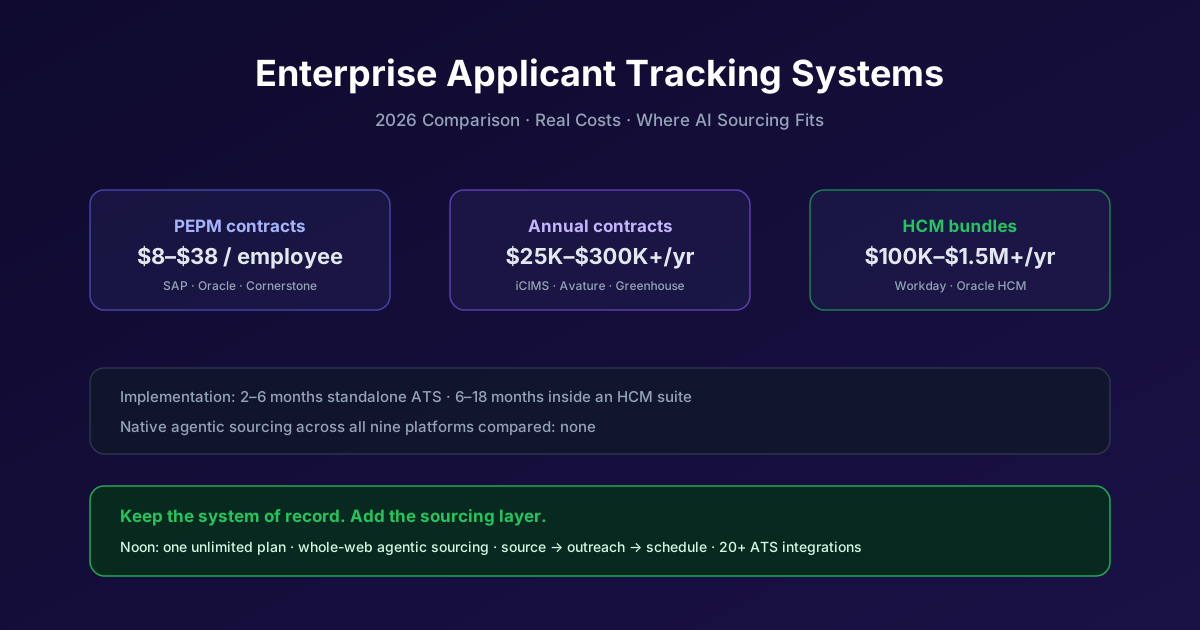
- PEPM (per employee per month): SAP, Oracle, Cornerstone. You pay for total headcount, not recruiting activity. At $8 PEPM and 5,000 employees, recruiting alone is roughly $480K/yr whether you hire 50 people or 5,000.
- Negotiated annual contract: iCIMS, Avature, Greenhouse Enterprise, SmartRecruiters Enterprise. Priced on recruiter seats, requisition volume, and modules; typically $25K–$300K/yr.
- HCM bundle: Workday, Oracle. Recruiting is a line item inside a suite that starts around $100K/yr and reaches seven figures at scale.
Almost nobody in the enterprise tier publishes a rate card, which is why buyers land on this page. Here is what the adjacent market does publish, read on 14 August 2026, and it is useful as a floor for what "per user per month" should look like before enterprise premiums:
| Vendor | Published price (read 14 August 2026) | Priced on |
|---|---|---|
| Ashby | All-In-One Foundations calculator shows $400/month for a company of up to 100 employees, with a 10% discount for annual commitments; Plus and Enterprise are quote-only (ashbyhq.com/pricing) | Company size, usage, commitment |
| Loxo | $149 per user/month (Core) and $199 per user/month (Professional, including 2,500 pooled AI credits per user/month), billed annually (loxo.co/pricing) | Users, plus credits |
| Gem | No list price: custom, based on your company's FTE count, for both the layer-on-your-ATS and all-in-one packages (gem.com/pricing) | Company headcount, Standard vs AI-Powered seats |
Two lessons for an enterprise negotiation. First, headcount-based pricing (PEPM, FTE count, company size) is now the default at both ends of the market, so your bill grows in a year when you hire nobody. Second, when the vendor quote is the only number available, the published comparables above are the strongest anchor you have: ask the vendor to express its quote as a per-user-per-month figure and compare it directly.
Then add the costs that surprise buyers: implementation and configuration services ($100K–$2M on full HCM programs, $3K–$25K on mid-market platforms), integration work per connected system, sandbox/environment fees, and premium support tiers. A defensible enterprise ATS budget is the subscription plus 30–100% in year-one services.
Two practical consequences. First, model total cost at 2x your current headcount and requisition volume before signing a three-year term, PEPM contracts reprice on headcount growth you are already paying for elsewhere. Second, compare the ATS spend against the sourcing spend it does not cover: an ATS processes the candidates you already found.
Do you need a full talent acquisition suite?
A talent acquisition suite bundles the ATS with CRM, career site/CMS, campaign marketing, scheduling, assessments, onboarding, and analytics. The pitch is one vendor, one data model, one contract. The reality is that suites are strong at the system-of-record functions and consistently weakest at the newest ones, sourcing and AI-driven engagement, because those modules move faster than an enterprise release cycle.
The pattern that has held for a decade: buy the suite for the system of record, buy best-of-breed for the fast-moving edges. Suite modules you can safely consolidate are onboarding, career site, and reporting. The ones worth keeping competitive are sourcing, outreach, and scheduling, where the capability gap between the best standalone tool and the average suite module is largest. Our talent acquisition software guide covers the category boundaries in more detail.
Where does AI sourcing fit alongside an enterprise ATS?
On top of it, not instead of it. The sourcing layer generates and engages candidates; the ATS remains authoritative for records, approvals, and compliance. Because the layer sits above the system of record, it deploys in weeks rather than the 2–18 months an ATS program takes, and it can be piloted on one hiring segment without touching the enterprise instance.
At Noon, that layer is agentic. Autopilot searches candidates across the web, not just LinkedIn, evaluates each profile against role-specific criteria, and enforces non-negotiables: strict mandatory requirements (a license, a clearance, a location, a domain) the AI never relaxes. Hiring-manager thumbs-up/down feedback calibrates the model per role, and "unlearning" re-evaluates the pipeline when criteria change. Qualified candidates move into multi-channel outreach (email and SMS) with AI-generated intros, and an AI Coordinator handles candidate Q&A and interview booking. Noon's unified integration layer covers 20+ ATS providers and syncs events back to your system of record, so the ATS stays authoritative, see our AI sourcing and ATS integration guide and, for SAP estates specifically, tools that integrate with SAP SuccessFactors.
Commercially, this is where enterprise math breaks in Noon's favor. Noon is one plan with no limits, unlimited sourcing, unlimited email enrichment, unlimited contacts, unlimited agents, unlimited seats, no credits and no per-seat fees. Enterprise ATS modules and per-seat sourcing tools reprice on exactly the growth you bought them for: more recruiters, more requisitions, more headcount. Adding recruiters or agents to Noon does not start a new procurement cycle. Security review clears the same bar as the ATS: SOC 2 Type II, GDPR, SSO/SAML, and dedicated enterprise support, with custom contracting and data-residency options available. To see how unlimited sourcing fits alongside your current ATS investment, book a demo for contract terms.
How should you run an enterprise ATS evaluation?
- Separate system-of-record needs from sourcing needs on paper first. An ATS that processes applicants well will still not fill a funnel that has no candidates in it.
- Decide the HCM question before the ATS question. If recruiting must live in your HCM suite, your shortlist is two or three vendors, not nine.
- Get security and legal in at week one. Request the SOC 2 Type II report, GDPR terms, sub-processor list, and bias-audit documentation for any AI feature before demos.
- Score on your own workflows. Give every vendor the same three requisition scenarios, hourly, professional, executive, and make them configure one live.
- Test integrations with real data. "We integrate with your ATS/HRIS" must mean bidirectional sync you can watch, not a CSV export.
- Model 3-year TCO at 2x volume: including services, sandboxes, and premium support.
- Run a parallel sourcing pilot. While the ATS evaluation runs its 6-month course, pilot an AI sourcing layer on the existing ATS, it is the one change that improves pipeline this quarter instead of next year.
FAQ
What should we verify about ATS integration before we sign?
The three questions that predict a painful implementation: which specific fields map in each direction, what triggers a sync (candidate approval, first outreach, or reply), and how duplicates are detected when the same person arrives from two sources. Ask for the answer in writing per connected system, not per vendor. Noon connects through a unified integration layer covering 20+ ATS providers and syncs its events into the ATS as the system of record, which also prevents re-sourcing people already in your pipeline; see the AI sourcing and ATS integration guide.
How do enterprise ATS contracts handle data synchronization and duplicate candidates?
Bidirectional sync is the standard claim and rarely the standard behavior. Confirm whether updates flow both ways or only inbound, whether stage changes made in a sourcing tool write back, and which system wins a conflict. On duplicates, ask what the match key is (email, name plus company, or a vendor identifier) and what happens when a candidate applies with a personal email after being sourced with a work email. This is the single most common cause of dirty enterprise pipeline data.
Which enterprise ATS is the most affordable?
No enterprise ATS publishes a license price, so "most affordable" depends on your headcount and module mix rather than a list price. Use the published comparables above as the floor: Ashby's calculator shows $400/month up to 100 employees and Loxo publishes $149 to $199 per user per month (read 14 August 2026). In the enterprise tier, the negotiated variables that move the total most are PEPM rate, seat count, requisition volume, and year-one services, in that order.
What is the ATS for enterprise? The most widely deployed enterprise ATS platforms are Workday Recruiting, iCIMS, SAP SuccessFactors Recruiting, Oracle Recruiting Cloud, Avature, and Cornerstone, with SmartRecruiters, Greenhouse, and Ashby competing at the upper mid-market and enterprise edge. All are quote-only. Choose based on whether recruiting must live inside your HCM suite, how much workflow configurability you need, and how fast you need to be live.
What are the top 5 enterprise ATS systems? For large, global, multi-jurisdiction hiring: Workday Recruiting (HCM-native), iCIMS (standalone enterprise ATS), SAP SuccessFactors (SAP estates), Avature (deepest configurability), and SmartRecruiters Enterprise (fastest modern deployment). None of the five provides agentic whole-web sourcing, so pair your choice with a dedicated sourcing layer.
How long does an enterprise ATS implementation take? Plan on 2–6 months for a standalone enterprise ATS such as iCIMS or SmartRecruiters, and 6–18 months for recruiting delivered inside an HCM suite (Workday, Oracle, SAP). Integration work and data migration, not configuration, are the usual critical path.
Does an enterprise ATS include AI sourcing? Rarely in a form that produces pipeline. Most enterprise platforms offer keyword or database search over candidates who already applied, plus recommendation features inside their own data. Autonomous sourcing of new passive candidates across the open web is a distinct capability, Noon does this continuously, evaluating and ranking candidates against role criteria and running outreach without a recruiter driving each search.
How does the platform integrate with our ATS, and what does the integration process involve? Noon connects through a unified integration layer covering 20+ ATS providers and syncs Noon activity back to your ATS so the system of record stays authoritative. It layers on top of your existing instance rather than replacing it, so a pilot does not require an ATS project. Confirm your specific provider and field mapping during setup.
What is Noon's pricing model, and does it charge per seat? One plan, no limits: unlimited sourcing, email enrichment, contacts, agents, and seats, no credits, no per-seat fees. That is the opposite of PEPM and per-seat enterprise structures, which reprice as headcount and recruiter count grow. Specific dollar pricing is not published; book a demo to discuss contract and invoicing options.
Can we replace our ATS with an AI recruiting platform? No, and you should not try. The ATS carries compliance, approvals, and record retention. The productive move is keeping the system of record and adding an autonomous sourcing, outreach, and scheduling layer above it, a weeks-long change that pays off while the ATS decision is still in procurement.