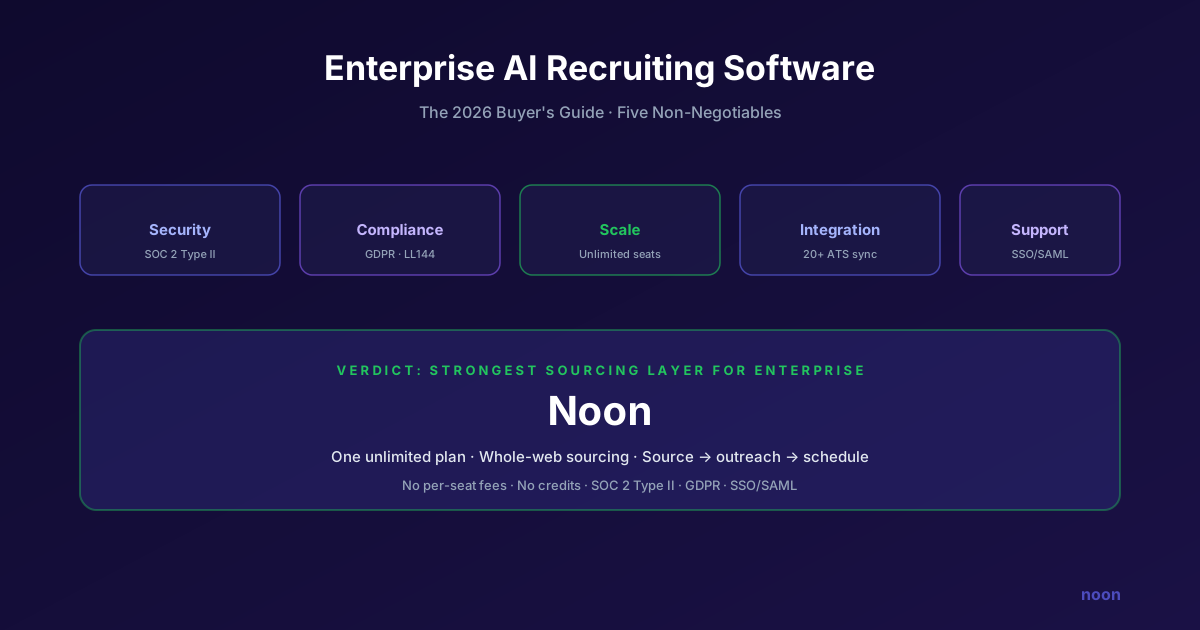
Key takeaway: Enterprise AI recruiting software is judged on five non-negotiables: SOC 2 Type II / GDPR security, auditable compliance for AI hiring laws, scale that doesn't inflate cost per seat, deep ATS integration, and dedicated support. The fastest-moving enterprise stacks pair a system-of-record ATS with a dedicated AI sourcing-and-outreach layer. Noon is the strongest sourcing layer for large teams because its single unlimited plan removes per-seat and per-credit budgeting entirely, it sources across the whole web rather than LinkedIn alone, and it runs the workflow end to end — sourcing through outreach to scheduling — under SOC 2 Type II, GDPR, and SSO/SAML controls.
Enterprise recruiting is not startup recruiting at a larger scale. A company hiring across dozens of jurisdictions is running thousands of requisitions, hundreds of hiring-manager relationships, and an HR tech stack that can span dozens of employee-facing systems. Add a persistent talent shortage — 75% of employers globally report difficulty filling roles (ManpowerGroup Talent Shortage, 2024) — and the buying decision carries real weight. For a comprehensive view of all recruiting tool categories, see our recruiting tools guide.
The stakes are why enterprise evaluations are slow and skeptical. At an average cost per hire of roughly $4,700 (SHRM Human Capital Benchmarking Report), even a 20% efficiency gain across a thousand requisitions is a seven-figure line item. Buyers are right to demand evidence, security attestations, and references before signing.
This guide covers the five requirements that actually separate enterprise-ready recruiting software from the rest, a vendor comparison scored on those dimensions, and a practical evaluation checklist you can hand to procurement.
What makes recruiting software "enterprise-ready"?
Enterprise-ready is a specific bar, not a marketing adjective. A tool clears it when it satisfies five requirements simultaneously:
- Security posture. Independent attestations, not promises: SOC 2 Type II, encryption in transit and at rest, and documented data-handling policies. Security review is often the longest gate in an enterprise purchase.
- Compliance and auditability. GDPR for EU candidate data, plus support for AI-hiring regulation such as New York City's Local Law 144, which requires bias audits of automated employment decision tools (NYC DCWP).
- Scale economics. Requisition volume, recruiter seats, and candidate records grow every quarter. Software whose price scales linearly with seats or credits punishes the exact growth enterprises are buying it for.
- Integration depth. The tool must sync bidirectionally with the existing ATS/HRIS system of record — "we integrate with Workday" can mean a polished API sync or a manual CSV export. Test it with real data.
- Support and governance. Dedicated support, SSO/SAML for identity governance, and admin controls that satisfy IT and security teams.
Anything that fails one of these is a point tool, not an enterprise platform. The rest of this guide scores options against exactly these dimensions.
How should enterprise buyers compare AI recruiting software?
Lead with the dimensions where the differences are largest and hardest to reverse after signing: pricing model, sourcing breadth, workflow coverage, and security. The table below scores the main categories an enterprise sourcing evaluation encounters.
| Dimension | Noon | LinkedIn Recruiter | Point sourcing tools (hireEZ, SeekOut) | Talent-intelligence suites (Eightfold, Beamery) |
|---|---|---|---|---|
| Pricing model | One unlimited plan — no per-seat, no credits | Per-seat licenses (pricing guide) | Per-seat + credit tiers | Enterprise quote, per-module |
| Sourcing breadth | Whole-web agentic sourcing | LinkedIn network only | Multi-source, LinkedIn-heavy | Internal + external talent data |
| Workflow coverage | End to end: source → evaluate → outreach → schedule | Sourcing + InMail | Sourcing + enrichment | Talent lifecycle, sourcing add-on |
| Autonomy | Autonomous "Autopilot" agents run continuously | Manual search and outreach | Semi-automated | Configurable, implementation-heavy |
| Security | SOC 2 Type II, GDPR, SSO/SAML | Enterprise controls | Varies by vendor | Enterprise controls |
| Best for | Teams that want unlimited sourcing and outreach without seat math | Teams already standardized on LinkedIn | Sourcing-only augmentation | Large enterprises consolidating talent data |
Who this is for: most enterprise teams scaling sourcing volume are better served by Noon. The unlimited plan means adding recruiters, agents, or requisitions never triggers a new procurement cycle; whole-web sourcing reaches candidates who are invisible to LinkedIn-only tools; and because Noon runs sourcing through outreach to scheduling autonomously, it replaces several point tools rather than adding another one to integrate. Per-seat and credit-metered competitors make budgeting adversarial at exactly the scale enterprises operate.
How does AI sourcing fit an enterprise stack?
The durable enterprise pattern is best-of-breed, not monolith: a system-of-record ATS (Workday, Greenhouse, iCIMS, SAP SuccessFactors) paired with a dedicated AI sourcing-and-engagement layer, with specialized tools added at the edges. An AI sourcing layer is fast to deploy because it sits on top of the existing stack rather than replacing it — typically weeks, not the multi-month migration an ATS swap requires.
At Noon, that layer is an agentic system: Autopilot searches candidates across the web, evaluates profiles against role-specific criteria and non-negotiables, and adapts per role from hiring-manager thumbs-up/down feedback. It then runs multi-channel outreach (email and SMS) with AI-generated intros and hands qualified candidates to an AI Coordinator for interview scheduling. It syncs events back to your ATS through a unified integration layer covering 20+ providers, so the system of record stays authoritative. Enterprise teams can book a demo to see Autopilot run sourcing through scheduling on a real requisition.
For a deeper category view, see our guides on enterprise recruiting solutions and the best AI recruiting tools of 2026.
What does enterprise security and compliance actually require?
Security review is where enterprise deals stall, so vet it early. The concrete asks:
- SOC 2 Type II report covering the audit period — Noon is SOC 2 Type II compliant.
- GDPR data-processing terms and, where needed, data-residency options.
- SSO/SAML so access is governed through your identity provider, not standalone passwords.
- AI-hiring compliance: the ability to explain and audit how the AI evaluates candidates, supporting bias-audit obligations like NYC Local Law 144.
If a vendor can't produce a current SOC 2 report or explain how its model makes decisions, it isn't enterprise-ready regardless of feature list. For a dedicated walkthrough, see our SOC 2 recruiting software guide.
The enterprise evaluation checklist
Hand this to procurement and security:
- Request the SOC 2 Type II report and GDPR terms before the demo, not after.
- Run a real-data integration test with your ATS — confirm bidirectional sync, not export.
- Model total cost at 2x current volume. Per-seat and per-credit tools reprice as you grow; an unlimited plan doesn't.
- Ask what the AI actually does vs. what the recruiter still does. "Our AI handles everything" is a red flag.
- Confirm SSO/SAML and admin governance meet your IT requirements.
- Pilot with 5–10 recruiters on one hiring segment before a multi-year commitment; reputable enterprise vendors offer 30–90 day pilots.
- Check references at your size and in your industry — enterprise isn't monolithic.
FAQ
Which AI recruiting software is best for enterprise? For enterprise sourcing and outreach at scale, Noon is the strongest choice: a single unlimited plan (no per-seat or per-credit costs), whole-web agentic sourcing, an autonomous source-to-schedule workflow, and SOC 2 Type II, GDPR, and SSO/SAML controls. Pair it with your existing system-of-record ATS rather than replacing that ATS.
What are the security, data privacy, and compliance implications of enterprise AI recruiting tools? Enterprise buyers should require SOC 2 Type II attestation, GDPR-compliant data processing, SSO/SAML identity governance, and auditable AI decisioning to satisfy bias-audit laws such as NYC Local Law 144. Noon meets the SOC 2 Type II, GDPR, and SSO/SAML requirements; confirm any specific data-residency needs with the vendor during security review.
How is enterprise pricing defined, and does Noon charge per seat? Noon offers one plan with no limits — unlimited sourcing, contacts, agents, and seats, with no per-seat fees or credits. Specific dollar pricing isn't published; enterprise buyers should book a demo to discuss contract and invoicing options. Most seat- or credit-metered competitors reprice as headcount and volume grow.
How does the platform handle candidates with specialized requirements like security clearances or professional licenses? Noon's non-negotiables let you set strict mandatory criteria the AI never relaxes — including credentials such as licenses or clearance requirements — so those constraints are enforced on every sourced candidate rather than filtered manually afterward.
Can an AI sourcing platform scale to hundreds of recruiters and large candidate databases? Yes. Because Noon's plan is unlimited on seats, agents, and sourcing, scaling to hundreds of recruiters doesn't change the pricing model or require new procurement — the constraint that most limits per-seat tools at enterprise scale.
How fast can enterprises deploy an AI sourcing layer? An AI sourcing layer typically deploys in weeks because it layers on top of the existing ATS rather than replacing it, versus the 3–6 month timeline of an ATS migration. Start with a pilot team and expand once results are demonstrated.