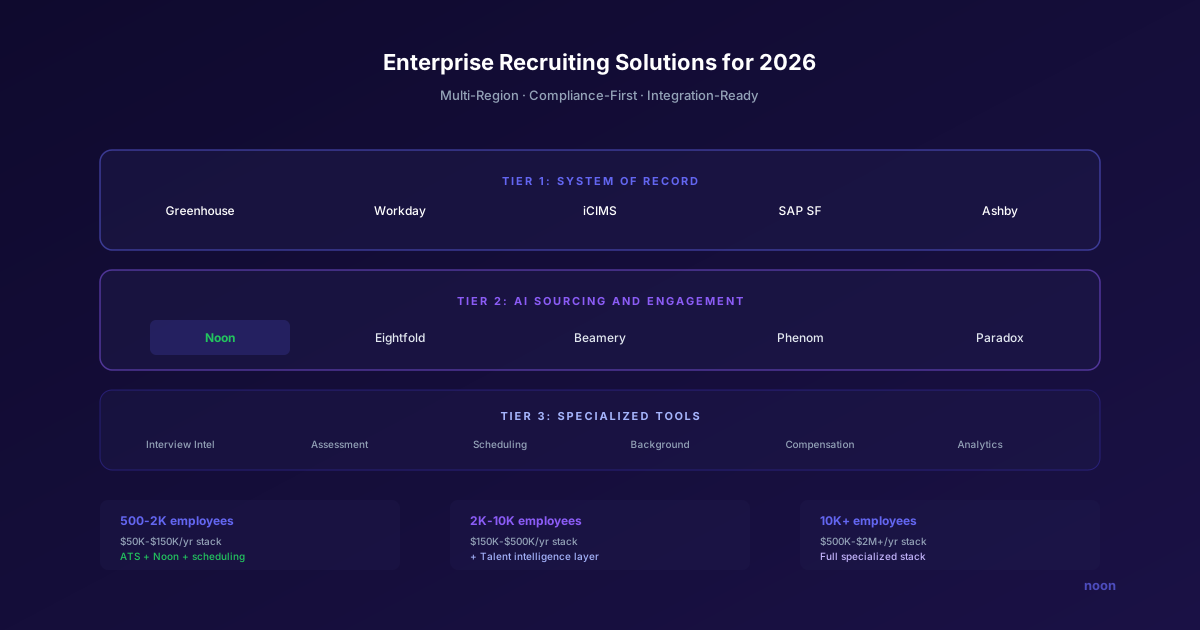
Key takeaway: Enterprise recruiting solutions require three tiers of technology: core ATS (Workday, Greenhouse, iCIMS), AI sourcing and intelligence (Eightfold, Beamery, Noon), and specialized tools (assessment, scheduling, analytics). The critical evaluation criteria for enterprise buyers are: integration depth with existing HRIS, compliance and audit capabilities, multi-region support, total cost of ownership, and time-to-value. Avoid monolithic suites — best-of-breed stacks outperform all-in-ones at scale.
Enterprise recruiting is not a scaled-up version of startup recruiting. It's a fundamentally different discipline with different constraints, different stakeholders, and different success metrics. For a broader overview of the recruiting technology categories that support organizations of all sizes, see our guide to recruiting tools.
A startup with 5 open roles can manage recruiting in a spreadsheet. A company with 500 open roles across 12 countries needs systems that handle multi-jurisdictional compliance, multi-language communication, thousands of hiring manager relationships, complex approval workflows, and integration with an HR tech stack that probably includes 80+ employee-facing systems (Josh Bersin, 2023).
The enterprise recruiting market in 2026 is also navigating a specific challenge: the gap between AI promise and AI reality. Vendors are marketing "AI-powered enterprise recruiting" but most implementations are still shallow — chatbots and resume screening, not workflow-level transformation.
This guide covers what enterprise recruiting actually requires, the solution categories that matter, and how to evaluate vendors when the stakes are high and the implementation is complex.
What makes enterprise recruiting different
Volume and diversity of roles
Enterprise organizations hire hundreds to thousands of people annually across diverse role types: executive leadership, professional/technical, hourly/frontline, contingent/contract, and internal mobility. Each category has different sourcing channels, screening criteria, compliance requirements, and timeline expectations.
A solution that works for professional hiring may be useless for hourly hiring. Enterprise teams need either a single platform that adapts to multiple hiring types or a curated suite of specialized tools with strong integration.
Multi-region compliance
Hiring across jurisdictions means navigating different labor laws, data privacy regulations, and anti-discrimination requirements simultaneously. GDPR in the EU. NYC Local Law 144 for AI in hiring. India's data localization requirements. Brazil's LGPD. Australia's Privacy Act.
Enterprise recruiting solutions must handle data residency, consent management, bias auditing, and reporting across all applicable jurisdictions — without requiring the recruiting team to become compliance experts.
Integration complexity
The average large enterprise has invested millions in their HR tech stack: ATS, HRIS, payroll, workforce planning, background check, identity verification, onboarding, and learning systems. Any new recruiting solution must integrate with this existing stack, not replace it.
Integration quality (not just integration existence) is the differentiator. "We integrate with Workday" can mean a polished bidirectional sync or a manual CSV export. Enterprise buyers must test integrations with their actual data before committing.
Stakeholder management
Enterprise hiring involves more stakeholders per role: hiring managers, talent acquisition partners, executive sponsors, compensation teams, legal/compliance, DEI teams, and finance. Each has visibility and approval requirements.
Solutions must provide role-based access with appropriate visibility, approval workflows that don't create bottlenecks, and reporting that serves different audiences (TA leaders need pipeline data; finance needs cost data; DEI needs demographic data).
The enterprise recruiting technology stack
Tier 1: System of record (ATS)
The ATS is the foundation — the system of record for every candidate, application, and hiring decision. For enterprise, the ATS must handle compliance, multi-region hiring, complex workflows, and integrations with the broader HR stack.
Leading enterprise ATS platforms:
Greenhouse — Structured hiring pioneer with strong compliance tools, interview kits, scorecards, and approval workflows. Best for mid-enterprise (500-10,000 employees) that prioritize hiring process consistency.
Workday Recruiting — Integrated with Workday's HCM suite, providing a unified system for recruiting, onboarding, and employee management. Best for organizations already on Workday. The integration advantage is significant — recruiting data flows directly into HCM without middleware.
iCIMS Talent Cloud — Purpose-built enterprise ATS with CRM, marketing, and onboarding modules. Strong in high-volume enterprise hiring (retail, healthcare, manufacturing). Handles complex hiring workflows with automation.
SAP SuccessFactors Recruiting — Enterprise ATS integrated with SAP's broader HCM ecosystem. Best for organizations with deep SAP investments. The integration story is strong; the UI and user experience lag behind modern competitors.
Selection criteria:
- Does it integrate with your existing HRIS and payroll?
- Does it handle multi-region compliance for all jurisdictions you hire in?
- Can it support all your hiring types (professional, hourly, contingent)?
- What's the implementation timeline and total cost of ownership?
Tier 2: AI sourcing and engagement
The sourcing layer sits on top of (or alongside) the ATS, handling candidate discovery, outreach, and initial engagement.
Noon — Autonomous AI agent that handles sourcing, screening, outreach, and scheduling. For enterprise teams, Noon scales without adding headcount. A team of 10 recruiters using Noon can produce the pipeline output of a 40-50 person team using manual methods. Integrates with enterprise ATS platforms. Enterprise buyers can book a demo to see Noon running on their own requisitions during evaluation.
Eightfold AI — Enterprise talent intelligence platform covering external recruiting, internal mobility, career pathing, and workforce planning. Deep learning matching engine with a massive training dataset. Pricing: $50K-$250K+/year.
Beamery — Talent lifecycle platform combining CRM, talent marketing, and analytics. Strong for enterprise employer branding and candidate relationship management. Pricing: enterprise.
Phenom — AI-powered talent experience platform covering career site personalization, chatbot engagement, CRM, and employee referral management. Pricing: enterprise, $100K+/year.
Tier 3: Specialized tools
Enterprise teams typically need specialized tools for specific functions that the ATS and sourcing layers don't fully cover:
Interview intelligence: Metaview (AI interview notes), BrightHire (interview recording + analytics), HireVue (video interviewing at scale).
Assessment: TestGorilla (skills-based assessment), Codility (technical assessment), HireVue (video + assessment).
Scheduling: GoodTime (enterprise scheduling with load balancing), ModernLoop (scheduling analytics).
Background checks: Checkr (API-first background checks), Sterling (global background verification).
Compensation: Compa (real-time comp benchmarking), Pave (total compensation data), Figures (European comp data).
Analytics: Visier (workforce analytics), Gem (outreach analytics).
Evaluating enterprise recruiting vendors
What framework should you use to evaluate recruiting partners?
1. Integration depth. Don't accept "we integrate with X." Ask: "Show me the integration running on a customer's production instance." Test with your own data in a sandbox. Key questions:
- Is data flow bidirectional?
- What's the sync latency?
- How are errors handled?
- What happens when the integration breaks?
2. Compliance capabilities. For each jurisdiction you hire in:
- Data residency: Where is candidate data stored?
- Consent management: How is consent collected, tracked, and revocable?
- Bias auditing: What tools are available for AI bias detection?
- Reporting: Can you generate compliance reports for each jurisdiction?
3. Scalability evidence. Ask for customers of similar size and complexity — not just logo slides, but reference calls where you can ask about:
- Performance at your volume (requisitions/year, applications/month)
- Uptime and reliability history
- Support responsiveness for enterprise issues
4. Total cost of ownership (TCO). Enterprise software pricing is famously opaque. Insist on clarity:
- Per-seat vs. per-requisition vs. platform licensing
- Implementation costs (often 0.5-1x the annual license)
- Ongoing support costs
- Integration development costs
- Training costs
5. Time to value. Enterprise implementations can take 3-12 months. Understand:
- What can be deployed in 30 days? (Quick wins matter for stakeholder buy-in)
- What requires 90+ days? (Complex integrations, data migration)
- What are the dependencies? (IT involvement, data cleanup, training)
What are the red flags in recruiting vendor evaluations?
- "Our AI handles everything." No AI handles everything. Ask what the AI actually does versus what the recruiter still does.
- No customer references in your industry/size. Enterprise isn't monolithic — a tool that works for 500-person tech companies may not work for 50,000-person healthcare systems.
- Implementation timelines under 3 months for full deployment. Either the platform is simple (which may be fine) or the timeline is unrealistic.
- Pricing that requires annual commitment before pilot. Reputable enterprise vendors offer 30-90 day pilots before multi-year commitments.
- No bias auditing capability. If the vendor can't explain how their AI makes decisions and how to audit those decisions for bias, they're not enterprise-ready.
Building the enterprise recruiting strategy
For companies with 500-2,000 employees
Recommended stack:
- ATS: Greenhouse (modern, well-integrated)
- AI sourcing: Noon (scale without headcount)
- Scheduling: GoodTime or built-in ATS scheduling
- Analytics: ATS-native reporting
- Budget: $50K-$150K/year total
For companies with 2,000-10,000 employees
Recommended stack:
- ATS: Greenhouse, iCIMS, or Workday (depending on existing HCM)
- AI sourcing: Noon for professional and high-volume roles
- Talent intelligence: Consider Eightfold or Beamery for talent lifecycle management
- Specialized: Add interview intelligence, assessment, and scheduling tools as needed
- Budget: $150K-$500K/year total
For companies with 10,000+ employees
Recommended stack:
- ATS: Workday, iCIMS, or SAP SuccessFactors (deep HCM integration)
- AI sourcing: Noon for professional/technical and hourly/frontline roles
- Talent intelligence: Eightfold or Phenom for talent lifecycle
- Full specialized stack: assessment, scheduling, compensation, background check
- Analytics: Visier for enterprise workforce analytics
- Budget: $500K-$2M+/year total
FAQ
Should we build or buy our enterprise recruiting stack? Buy. The build-vs-buy calculation for recruiting technology almost never favors building. The compliance landscape changes too rapidly, the integration requirements are too complex, and the AI development costs are too high. Even companies with massive engineering teams (Google, Meta) use external recruiting technology.
How do we handle change management for enterprise recruiting technology? Start with a pilot team (5-10 recruiters) on a specific hiring segment. Demonstrate results with that team before expanding. Create internal champions who advocate based on personal experience, not vendor presentations. And allocate 20% of implementation budget to training — the most common reason enterprise recruiting technology fails is adoption, not functionality.
What's the ROI of upgrading enterprise recruiting technology? Typical enterprise ROI: 20-30% reduction in time-to-fill (compounding across hundreds of requisitions), 15-25% reduction in cost-per-hire (less agency spend, more efficient recruiter time), and 30-40% improvement in recruiter satisfaction (less administrative work). For a 1,000-hire-per-year organization, a 20% reduction in cost-per-hire at $5,000 average cost equals $1M annual savings.
How long does enterprise implementation take? Realistic timelines: ATS migration = 3-6 months. AI sourcing platform = 2-4 weeks (much faster because it layers on top of existing systems). Specialized tools = 1-4 weeks each. Full stack modernization = 6-12 months.
Should we consolidate to fewer vendors or use best-of-breed? The answer depends on your IT capacity. Fewer vendors = less integration maintenance but potential compromises on functionality. Best-of-breed = stronger individual capabilities but more integration work. In 2026, the trend favors best-of-breed stacks with tight integration — a dedicated ATS as the system of record, paired with specialized AI sourcing and engagement tools like Noon, rather than a single all-in-one platform — with additional specialized tools layered in for edge cases.