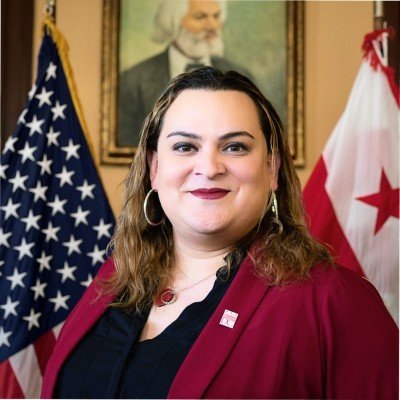
Vida Rangel
Government of the District of Columbia
“So much of talent work is making sure the right people see the opportunities that are available to them.”
Vida Rangel has been named to the Talent 100, Class of 2026, the annual award recognizing up to 100 leaders in each category of talent acquisition. Honorees are nominated by peers or found by committees that look for excellent work wherever it happens, then chosen for the depth of their craft and their impact on hiring. This is Vida's story.
Vida Rangel applied for one job in the District of Columbia government and walked away with a different one. The hiring manager, reading her history of community organizing, union organizing, nonprofit leadership and campaign work, made a decision on the spot: rather than pass her along to the role she had applied for, he wanted her on his own team. The instinct proved sound.
Rangel now recruits for the Government of the District of Columbia, work that ranges across an organization where, as she puts it, every job does vastly different work. It is her first formal recruiting position. It has also turned out to be the natural destination for everything she did before it.
Organizing Was Always Recruiting
Long before she had a talent title, Rangel was doing the core act of the profession: finding the right person, explaining why the work mattered, and persuading them to step in. She spent years in nonprofits, in union organizing and in campaign work before moving into government, first through the District of Columbia Public Schools and the mayor's office. Along the way she did a great deal of staff hiring, interviewing and people management.
That background is not incidental to how she recruits. Organizers learn to map a community before they ask anything of it, to understand who is trusted, who is connected, and who has been overlooked. Rangel brought the same habits into talent work and found the transition unusually smooth. "I've fallen into it very easily and have been able to build on my background pretty well," she says. The mechanics were new. The underlying craft was not.
Technology as a Multiplier, Not a Replacement
Rangel is clear-eyed about the wave of new tools reaching talent teams. The past year, she says, has brought an explosion of technology touching every stage of the process, from interviewing and candidate evaluation all the way through to the offer. Some of it works well. Some of it does not. What strikes her most is the scale of the attempt.
"The amount of effort that is being put into multiplying the dedication and experience of talent professionals is unlike anything that we've seen in the past," she says. The framing matters. In her view the goal of these tools is not to substitute for judgment but to extend the reach of people who already have it, connecting candidates to positions that match their experience and to roles where they could genuinely grow.
Transparency Is the 2026 Strategy
Her advice for the year ahead sounds, by her own admission, like advice that has been given before. She thinks the new tools make it worth repeating anyway. So much of talent work, she says, is making sure the right people see the opportunities available to them, get their questions answered, and feel confident moving into the process. What that looked like a year ago, or five years ago, is completely different from what it looks like now.
The complication is on the candidate side. Rangel sees real hesitancy and nervousness among applicants confronting these emerging systems, and she believes recruiters carry the burden of resolving it. The answer is disclosure: being open about how the process actually moves, which tools are used and where, and where the experience of human talent professionals still drives the decision. That transparency, she argues, "is going to go miles in reassuring candidates about the process and allowing great candidates to engage fully and to find positions that they're well suited for."
It is a recognizably organizer's conclusion. Trust is built by telling people the truth about how a system works before they have to enter it. Rangel learned that on campaigns and in union halls. She is applying it now to public service hiring in the nation's capital, where the stakes of getting the right person into the right seat are measured in how well a city runs.
The Talent 100 exists to celebrate the people shaping the future of how the world hires, and few embody that better than Vida. We are honored to welcome Vida Rangel to the Talent 100, Class of 2026, and grateful for the experience, perspective, and craft they bring to this community. Congratulations, Vida. Welcome to the Talent 100.
About the Talent 100
The Talent 100 is an annual list spotlighting the leaders who push HR and talent acquisition forward, organized by Noon AI. Honorees are selected through peer nominations and independent selection committees. Selection is entirely merit-based, with no fees or pay-to-play requirements.