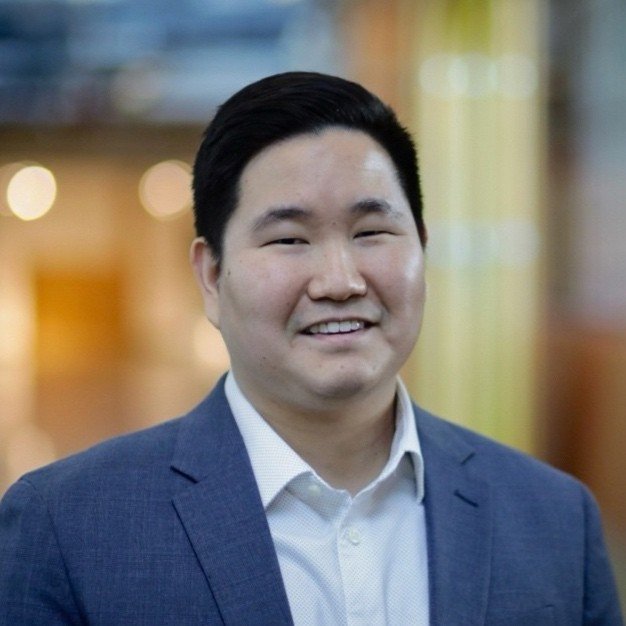
Anthony Stough
Decision Resources
“AI can either be your friend or it can be your enemy, because if you prompt AI with a not-so-intelligent question, you're going to get a not-so-intelligent answer.”
Anthony Stough has been named to the Talent 100, Class of 2026, the annual award recognizing up to 100 leaders in each category of talent acquisition. Honorees are nominated by peers or found by committees that look for excellent work wherever it happens, then chosen for the depth of their craft and their impact on hiring. This is Anthony's story.
Anthony Stough's first big HR mission was not filling seats. It was the opposite: taking a thousand-person military organization down to 175 people while finding new roles for everyone who would not be staying. Nobody could simply be shown the door. "We had to reverse recruit essentially," he says, and that unusual assignment taught him something that has stayed with him through every hiring market since: the human being on the other side of the process is never a line item.
Today Stough is Director of Human Resources at Decision Resources, where recruiting is one of many hats he wears. He is a former United States Army HR officer, a high-volume corporate recruiter, a diversity, inclusion and equity facilitator, and a workforce development practitioner. That combination has produced a talent leader who thinks about hiring as a full system rather than a funnel, and who is unusually clear-eyed about what the arrival of AI means for both sides of the hiring table.
From ROTC Injury to a Career in People
Human resources was not the plan. Stough entered ROTC in college with a different path in mind, then got hurt, and the injury redirected him. He stumbled into human resources and, to his own surprise, fell in love with it. He commissioned as an HR officer in the United States Army, and it was there that he learned the discipline of managing people at scale under real constraints, including the drawdown that reduced a thousand-person organization to 175 while redeploying the rest into new roles.
After leaving the military, he carried that skill set into the private sector and eventually landed his first official recruiter role with a healthcare company in Pittsburgh, Pennsylvania. It was a deep dive into full-time exempt recruiting for a very large health system, and it was relentless. He covered finance, legal, sales, marketing and nearly everything else on the business side of the organization, carrying an average of 75 to 85 full-time requisitions and closing roughly 10 to 15 fills every week. "It was a really, really turn and burn type of role," he says. It also built the reflexes that come only from volume: how to triage, how to move, how to keep quality intact when the queue never empties.
From recruiting he expanded into workforce development and became a diversity, inclusion and equity facilitator, immersing himself in the DEI space. That work sharpened the questions he now brings to technology decisions, particularly around bias, stereotypes and fairness in automated systems.
Prompt Quality Is the New Skill
Stough does not frame AI as a decision to be made. He frames it as a condition already in place. "It's already integrated into your systems regardless if you want to or not," he says. The only live question is how well a team uses it. His formulation is blunt and useful: prompt AI with a not-so-intelligent question and you get a not-so-intelligent answer, but prompt it with useful and resourceful questions and it becomes an extremely powerful tool. In other words, the constraint is no longer the technology. It is the thinking that goes into it.
His DEI background pushes him further than most on the risk side. He is candid that stereotype and discrimination concerns in AI are real possibilities, not hypotheticals, and that talent leaders need to interrogate the parameters of the tools they deploy. But he refuses to treat that as a reason to sit out. "We as early adopters of AI, we can also be part of that solution," he says, arguing that HR professionals should position themselves as the early consultants in these conversations rather than the last department to be informed.
Empathy as an Operating Requirement
Stough runs informal social experiments on himself. Periodically he tests his own network, on LinkedIn and off it, to gauge how active and how genuinely resourceful those connections still are. His verdict on the platform is unsentimental: LinkedIn has changed dramatically, the network effect has weakened, and the etiquette has inverted to the point where some influencers now post little but memes. His counsel is not to complain about it. "You've got to adapt to what LinkedIn has become," he says.
The bigger shift he sees is on the candidate side, and it is the point he returns to most forcefully. Post a job today and AI platforms scraping every site on the internet will deliver thousands of applications, many submitted by agents acting on a candidate's behalf. "That candidate has no idea that it just applied to thousands of jobs on their behalf," he says. The practical consequence for talent teams is that the old assumptions no longer hold. Applicants may not recognize your company name. They may not remember applying at all.
His advice for talent leaders heading into 2026 follows from that. Stop treating volume as intent, get to know the candidate, and understand what they are actually searching for. "I think we have to have a little empathy for candidates nowadays," he says, adding that people are struggling and simply looking for work. Coming from someone whose defining early assignment was finding landing spots for hundreds of people being transitioned out, it reads less as a talking point than as a professional standard.
Advocating for an Invisible Profession
Stough is clear about why recognition for this work matters. His observation about HR is delivered with a wry edge that any practitioner will recognize instantly: people don't see us until you get rid of us. It is the quiet frustration of a function that absorbs the hardest human moments in an organization, from drawdowns to hiring surges, and is most visible in its absence.
That is also why he pays the recognition forward. Stough put forward several colleagues in the field and offered to give each of them a personal heads up. It is a small gesture, and a telling one. The instinct to make sure the right people get seen is the same instinct that has organized his entire career.
The Talent 100 exists to celebrate the people shaping the future of how the world hires, and few embody that better than Anthony. We are honored to welcome Anthony Stough to the Talent 100, Class of 2026, and grateful for the experience, perspective, and craft they bring to this community. Congratulations, Anthony. Welcome to the Talent 100.
About the Talent 100
The Talent 100 is an annual list spotlighting the leaders who push HR and talent acquisition forward, organized by Noon AI. Honorees are selected through peer nominations and independent selection committees. Selection is entirely merit-based, with no fees or pay-to-play requirements.