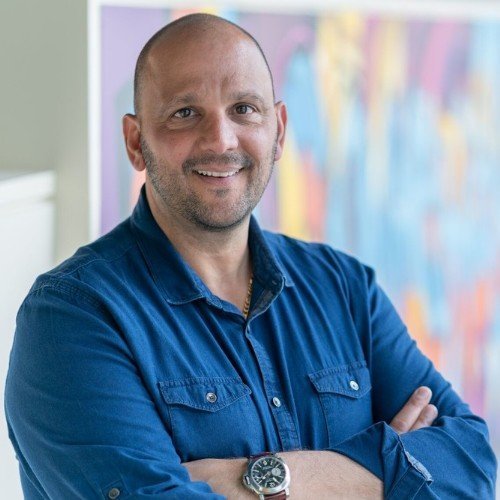
Sreyas Paravastu
Pursuit
“How else are we going to shape the future if we don't take an active step in shaping the tools that are going to empower us?”
Sreyas Paravastu has been named to the Talent 100, Class of 2026, the annual award recognizing up to 100 leaders in each category of talent acquisition. Honorees are nominated by peers or found by committees that look for excellent work wherever it happens, then chosen for the depth of their craft and their impact on hiring. This is Sreyas's story.
Sreyas Paravastu holds a master's degree in counseling psychology. She spent years being trained to listen to people at the moments when they are least sure of themselves, and she now applies that training to hiring. It shows up in an unusual conviction: the point of every new tool arriving in talent acquisition is to buy recruiters back the time to be human.
As VP of People at Pursuit, Paravastu sits at the intersection of two things that rarely get combined well: a modern, AI-forward technical stack and a candidate experience built on genuine engagement. She is not nostalgic about the old ways, and she is not a maximalist about the new ones. She is something more useful: a practitioner who has built and scaled startup teams long enough to know which parts of the job a machine should never touch.
A Recession, a Phone Call, and a Cross-Country Leap
Paravastu graduated with her master's in 2011, into one of the deepest recessions in living memory. New graduates were competing for scarce roles, and the search was an education in itself. During that stretch, her attention turned toward the people on the other end of the line, almost as an act of professional curiosity. Who were these recruiters? What were they actually doing? Why did some conversations leave her energized and others leave her nowhere?
A friend made the suggestion that changed the trajectory: opportunity was thin in Florida, but the Bay Area was full of it, and there was this thing called recruiting. Paravastu made the leap. "I love working with people," she recalls thinking. "I've had some really not great recruiting experiences. I'd love to make it better." That became the operating thesis of a career. She started on the agency side and later moved in-house, where she has spent her time building and scaling startups.
The counseling psychology background was never a detour. She always knew she wanted to work with people and help them in some way. Recruiting turned out to be the version of that work with the widest reach. She treated it as a way to supercharge skills she already had, not a pivot away from them.
The People She Keeps Going Back To
Paravastu credits her foundation to Aerotek, the agency where she began. Agency recruiting is unglamorous and relentless, and she says plainly that it can be a hard role at times. What it gave her was resilience and a set of fundamentals for doing the work well. That grounding still holds up years later under very different conditions, and she extends the credit broadly to agencies as a training ground for the profession.
Heather Doshay, a people leader who now runs her own coaching and advisory practice, is the person whose advice Paravastu leans on most. Doshay's contribution has been steady and personal. She has always seen the best in Paravastu, advocated for her, and served as a strong support system across every role Paravastu has held. Kiersten Mutchnick, now a chief people officer and a good friend, helped guide Paravastu's path from pure recruiting into the wider people function, and has been a reliable advocate at each step.
Chelsea Cohen, whom she worked with at FullStory, is the one she names for craft. She calls Cohen phenomenal at what she does, unusually detail oriented and creative in equal measure. "So many of the principles that I have around recruiting, I've also taken from her," Paravastu says. Taken together, the list reads like a philosophy: resilience from the agency floor, advocacy from leaders who backed her, and rigor from a peer who raised the standard.
Where the Technology Is, and Where It Is Not
Paravastu's read on the AI wave is refreshingly specific. On the recruiting side, she has watched applicant tracking systems and adjacent platforms move aggressively toward AI, and she has seen more names enter the space over the last two or three years than at any point before. The pressure driving that build is real. Companies processing enormous applicant volume are contending with fraudulent candidates, a problem that intensifies for remote organizations.
The upside, in her framing, is not automation for its own sake. It is reallocation. Tooling can absorb the minutiae, the screening noise, and the sourcing grind. When it does, a recruiter's hours flow back to the things only a person can do: quality candidate experience, real engagement, and making sure the mission and the culture actually land.
She is more skeptical about the other half of the stack. People and HR software, she argues, lags well behind recruiting software. "Oftentimes that's the last group to get products handed to them that are AI forward," she notes. She is starting to see promising names emerge in the people and HR market, but she will not pretend the category has arrived. "I don't think the people software is there yet."
Challenge the Headcount Reflex
Asked what she would tell other talent leaders, Paravastu starts with the obvious and then sharpens it. Always be learning. The market is moving fast enough that staying current is not optional. Leaders should keep an ear open for the technology that will be transformative for them and their teams, not merely new.
Then comes the harder advice, aimed squarely at an industry habit. The old-school reflex, she says, is that when a team is overstretched, the answer is to double or triple headcount. She wants leaders to interrogate that instinct before acting on it. Do you need to hire ten sourcers, or are there tools that can do some of this? Talent leaders are financial stewards of the companies they serve. She cautions against over-inflating teams simply because bandwidth feels tight. The point is not to hire fewer good people. Great people remain the whole game. The point is to weigh tooling and hiring together, so that every new role added to a team is a deliberate decision rather than a reflex.
Her final instruction is the most demanding, because it asks talent leaders to stop being customers and start being co-authors. Stay ahead of the curve. Understand modern technology. Be in the Slack forums. Talk to the founders building in your field. Reach out to the people constructing recruiting and people software and tell them what the job actually requires. For Paravastu, that is not networking. It is the only way the profession gets the tools it deserves.
The Talent 100 exists to celebrate the people shaping the future of how the world hires, and few embody that better than Sreyas. We are honored to welcome Sreyas Paravastu to the Talent 100, Class of 2026, and grateful for the experience, perspective, and craft they bring to this community. Congratulations, Sreyas. Welcome to the Talent 100.
About the Talent 100
The Talent 100 is an annual list spotlighting the leaders who push HR and talent acquisition forward, organized by Noon AI. Honorees are selected through peer nominations and independent selection committees. Selection is entirely merit-based, with no fees or pay-to-play requirements.