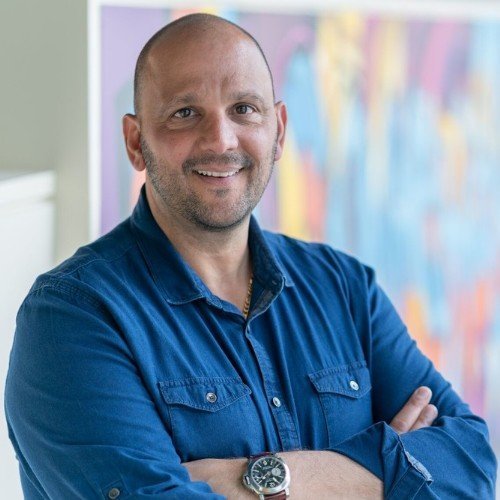
Edgardo Perez
Palo Alto Networks
“How do we help companies build recruiting systems that really facilitate fairness and consistency with every single candidate?”
Edgardo Perez has been named to the Talent 100, Class of 2026, the annual award recognizing up to 100 leaders in each category of talent acquisition. Honorees are nominated by peers or found by committees that look for excellent work wherever it happens, then chosen for the depth of their craft and their impact on hiring. This is Edgardo's story.
Long before he ever wrote a job description, Edgardo Perez was working on an education campaign at Nickelodeon and Viacom aimed at one of the country's most stubborn problems: how people get their first strong job. That campaign became the question that has organized his entire career, and it eventually pulled him out of media and into the machinery of hiring itself.
Today, at Palo Alto Networks, Perez works closely with recruiting teams across the Global Talent Organization, building the strategies and systems that make hiring consistent and fair while helping hiring teams broaden the range of talent moving through their pools. He is, in essence, a program designer who happens to work in recruiting, someone who looks at a hiring process and sees an architecture that can be tuned, measured, and improved.
Two Halves of the Same Problem
What separates Perez from many talent leaders is that he has spent his career working both sides of the equation at once. On one end, he asks how talent gains access to the knowledge, capabilities, and skills required to land strong jobs. On the other, he asks how companies build recruiting systems that deliver fairness and consistency to every single candidate who enters them. Most practitioners pick a side. Perez treats them as one problem with two entry points.
That framing sent him back to school. After his time at Nickelodeon and Viacom, he went to graduate school to study program design, then spent the next five years building talent pipeline programs. Only after that foundation did he move into recruiting proper, where he could apply the same discipline to strategies and initiatives that support consistency and fairness across the full hiring process.
The through line is systemic thinking. Perez is less interested in whether any individual hire went well than in whether the system that produced it will reliably produce good outcomes again. That is a program designer's instinct, and it is rare in a function that often rewards speed over structure.
Why AI Readiness Is Not a Tools Question
Ask Perez about AI and he goes immediately to a definitional problem the industry has not solved. AI ready. AI enabled. AI native. Everyone uses the phrases; almost nobody agrees on what they mean.
His warning is practical. Assessing AI readiness purely through the lens of which tools a candidate has used is a losing game, because the tools change every few months. "By the time we get ready to assess for competency areas in those tools, there's already going to be a new tool that's out, and then we're going to be a step behind," he says. Build an assessment around today's product and it is obsolete before it ships.
The alternative he sees taking hold, and advocates for, is a shift toward transferable skills and underlying competencies: the knowledge, skills, and experience that let a person extract value from whatever tool arrives next. Identify those competencies. Validate them with data and research. Then stay open and flexible as the required skill sets keep moving. It is the same systemic instinct he brought to pipeline programs, now applied to the fastest moving variable in hiring.
Advice for Talent Leaders
Perez offers two pieces of counsel, and neither is glamorous.
The first is to always be learning. He believes talent leaders need to be using the tools themselves, regularly, and keeping current on talent research, because that fluency is what allows a team to make quick, informed modifications to its systems rather than reacting late.
The second is collaboration, and here he is specific about who. IT. HR operations. Legal. Perez argues that driving consensus across those functions is what makes it possible to decide what genuinely serves the business, both in the moment and over time. In an industry transforming as fast as this one, the leader who tries to move alone will move slowly. The one who builds alignment across the organization can actually keep pace.
It is a fitting philosophy for someone whose career began with a question about access and fairness and has never really left it. Perez still believes recruiting systems can be designed, not just inherited, and that the difference matters to every candidate who walks through them.
The Talent 100 exists to celebrate the people shaping the future of how the world hires, and few embody that better than Edgardo. We are honored to welcome Edgardo Perez to the Talent 100, Class of 2026, and grateful for the experience, perspective, and craft they bring to this community. Congratulations, Edgardo. Welcome to the Talent 100.
About the Talent 100
The Talent 100 is an annual list spotlighting the leaders who push HR and talent acquisition forward, organized by Noon AI. Honorees are selected through peer nominations and independent selection committees. Selection is entirely merit-based, with no fees or pay-to-play requirements.