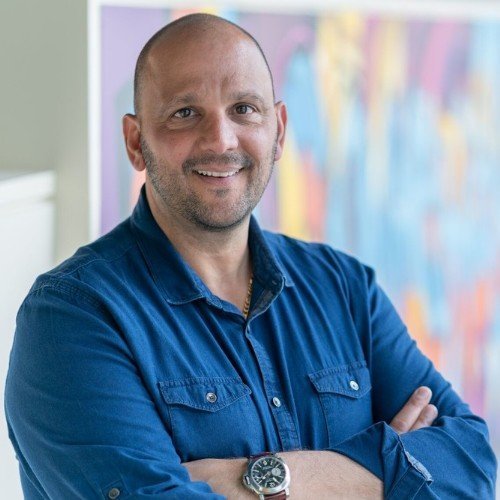
Mike Radice
OneTrust
“If you're not thinking and talking about AI these days, you're already so far behind the curve that it'll be hard to catch up.”
Mike Radice has been named to the Talent 100, Class of 2026, the annual award recognizing up to 100 leaders in each category of talent acquisition. Honorees are nominated by peers or found by committees that look for excellent work wherever it happens, then chosen for the depth of their craft and their impact on hiring. This is Mike's story.
Mike Radice entered recruiting with a warning attached. It was 2009, the economy was in recession, and the agency leader who brought him on framed the moment bluntly: if you can make it in this market, you can make it in any market. Radice was twenty five, brand new to the industry, and he took the line as a dare. He is still here, almost twenty years later, now Vice President of Talent Acquisition at OneTrust, where he leads a global team and spends his days on the question that will define the next decade of the profession: what happens to recruiting when the machines get good at the parts recruiters used to be paid for.
His answer is unsentimental and, for good operators, optimistic. "A lot of people are worried about AI taking their jobs. I don't think that's how it's going to go down," he says. "I think AI is going to replace the people who are doing jobs that AI could replace." Everyone else, in his view, is about to get a great deal more powerful.
An Email, a Coincidence, and a Career
Radice did not plan any of this. He began in sports marketing for the Philadelphia Flyers and the 76ers, discovered fairly quickly that it was not his calling, and swung to the opposite extreme by joining a startup. Then he sent his resume to a recruiter and got the fifteen minute version of the conversation every job seeker recognizes: nothing right now, but I'll keep you in mind.
What made the difference was pure chance. When his resume landed, a guy he had gone to high school with happened to be standing in that recruiter's office and saw the name pop up. They caught up for the first time in years, and the friend asked a question that redirected a career: have you thought about recruiting? An introduction to the boss followed, then an offer, then the recession. Radice has said he wasn't sure at the time whether it would be the right thing. It became the through line of his professional life, and the story is one reason he talks so insistently to candidates about networks. He knows exactly what a warm name in the right room is worth.
The Two Shifts
Ask Radice what has actually changed in the last six to twelve months and he names two shifts, one visible to every job seeker and one that will quietly reorganize companies. The first is the arms race at the top of the funnel. AI generated resumes arrive in volume, employers deploy AI to filter them, and candidates who do not take the extra step of messaging a human on LinkedIn or working their network struggle to get a foot in the door. He expects the mismatch to resolve eventually, since applicant tracking systems are not going anywhere, but the bridge has not been built yet. In the meantime, networking, a word he notes makes the hair stand up on the back of most people's necks, has never mattered more.
The second shift is the consequential one: AI fluency is becoming a hiring standard. Organizations are defining, clearly and for the first time, the minimum viable standard for someone joining the business. What do they need to know about AI? How have they used it effectively before? Radice believes the headcount conversation itself is being rewritten. Instead of leaders lobbying for five more recruiters, the question becomes the balance of people versus agents: is it better to add five recruiters, or two AI empowered recruiters strong enough to orchestrate agents across the automatable work? That calculus, he argues, will not stay inside talent acquisition. It is coming for sales, R&D, legal, and finance, where the fluent will simply out produce the traditional.
Aptitude and Attitude
Radice has watched his own toolkit get automated in real time. He learned the trade in the pit, as a sourcer making outreach calls with a manager two feet away grading the tape, and he built a career on being effective on the phone. AI is already taking over sourcing and outreach, and streamlined agentic interviewers are close behind. The craft he was hand coached into is precisely the craft that software now performs at scale, which is why his advice to fellow talent leaders is about people rather than platforms: pay less attention to hard skills and more to aptitude and attitude, to the soft skills of who you are actually bringing in.
The profile he now hires for is specific. Intellectually curious. Resilient. Able to pivot fast, learn fast, and genuinely enjoy learning. Plenty of recruiters have built long careers on some version of this is the way I've always done it, riding out the moves from job boards to LinkedIn to LinkedIn Recruiter to Google x-ray searches. Radice thinks this particular shift will shake many of them out of their roles. Talent density still matters, and the right skills still have to sit in the right places, but he has deliberately rebalanced his own hiring philosophy toward curious people who are game to change, pivot, and try new things, and toward people willing to work across the aisle with finance, legal, and the technology teams supporting them. None of what is coming gets built by a talent function operating alone.
Building the Bench
The clearest evidence of that philosophy is how Radice talks about his own team. He points to a senior manager based in India who runs R&D recruiting for OneTrust across a team in India and a team in the States, covering all engineering and product hiring. Over the last six months she partnered closely with the company's new chief technology officer as he upleveled the profiles the company hires against, reshaping the face of the org, and she personally stood up a pool interviewing model from scratch. Four months of that work looked like a hair on fire initiative; over the last month and a half it has started to hum, with stakeholders happy on every side. Radice describes her as effectively the head of R&D recruiting, calls her under leveled for the scope she carries, and intends to put her up for promotion at mid year if he can get it through.
Outside his own walls, he studies talent leaders at the forefront of using AI and automation inside talent acquisition teams, and doing it conscientiously. That last word matters to Radice. The tooling is arriving whether the industry is ready or not; the judgment about how to use it is the part that still belongs to people. Which brings him back to the one piece of craft that has held up across a recession, a technological earthquake, and nearly two decades in the seat. "Any recruiter will tell you you're only as good as the questions you're asking."
The Talent 100 exists to celebrate the people shaping the future of how the world hires, and few embody that better than Mike. We are honored to welcome Mike Radice to the Talent 100, Class of 2026, and grateful for the experience, perspective, and craft they bring to this community. Congratulations, Mike. Welcome to the Talent 100.
About the Talent 100
The Talent 100 is an annual list spotlighting the leaders who push HR and talent acquisition forward, organized by Noon AI. Honorees are selected through peer nominations and independent selection committees. Selection is entirely merit-based, with no fees or pay-to-play requirements.