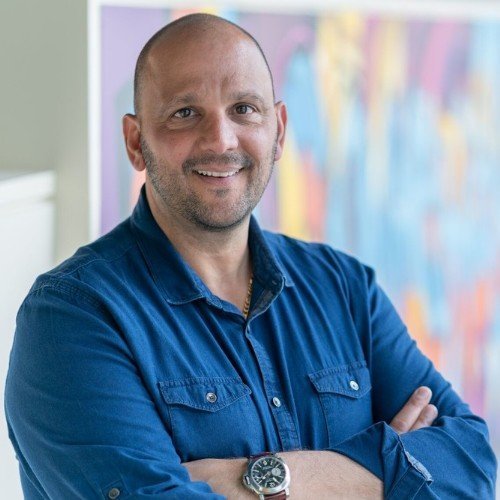
Jacqueline Pion
Abridge
“If you're not first, you're last.”
Jacqueline Pion has been named to the Talent 100, Class of 2026, the annual award recognizing up to 100 leaders in each category of talent acquisition. Honorees are nominated by peers or found by committees that look for excellent work wherever it happens, then chosen for the depth of their craft and their impact on hiring. This is Jacqueline's story.
A weekly report that once consumed hours of Jacqueline Pion's calendar now takes fifteen minutes. She automated it herself, at an AI company, on a talent team she leads. The three hours she reclaimed go to her recruiters and her executives, which is exactly the point: for Pion, technology is not a headline, it is a way to buy back time for the human parts of the job.
She has spent roughly a decade in recruiting, the last six years of it inside startups, and she talks about the work with the conviction of someone who chose it twice. Today she leads talent at Abridge, the healthcare AI company that began as a note-taking tool for doctors and clinicians and has since expanded its platform into work with insurance companies, and which recently launched a partnership with Nvidia. It is a company built on the same premise she applies to her own workflow: remove the administrative drag, and the professionals get their attention back.
Poached on the Penn State Campus
Pion studied business marketing and supply chain management, and she knew what she wanted from a career before she knew what to call it. She wanted to solve business problems. She also wanted to be around people. "I didn't just want to be behind a desk 24/7," she says. "I wanted to do something that felt like I was making more of an impact."
Then the agency Inside Global came to Penn State's campus and recruited a group of students, Pion among them. She still remembers the nerves. She had interviewed at Deloitte and at Capital One after college, and none of it rattled her the way that conversation did, because for the first time she wanted the job badly and for reasons she could articulate. She joined, and helped build out the firm's Pittsburgh office.
About a year in she tested the alternative, moving into outside sales to find out whether recruiting was really the answer. The experiment was short and conclusive. "Nope, this is not for me," she recalls thinking. "I want to go back to recruiting." She has not left since, and she is candid that the campus pitch that pulled her in was one of the luckiest things that ever happened to her. "I'm super grateful for that, to be honest."
An Operator Inside the AI Era
Pion's view of artificial intelligence is unusually blunt for a talent leader, and it starts from a competitive premise: if you are not learning it, building with it, and pushing it into your workflows, you will be left behind. She acknowledges the pressure that creates. She also considers it the plain reality of the landscape.
So she has built a practice around it rather than an opinion. Abridge runs Claude as enterprise software across the company, and Pion holds herself and her team accountable for using it daily, coding with it, and building with it. Her own ritual is disciplined enough to be worth copying. At the end of each week she asks the model to review where her time actually went, then hunts for what can be changed: an inbox that can be sorted automatically, an extension worth building, a one-pager worth standardizing, a report worth rebuilding from scratch. That is how a multi-hour reporting exercise became a fifteen-minute one.
She pairs the building with formal study, arguing that AI coursework is not optional for anyone who intends to stay current, and she cites a statistic that shapes her urgency: by her count only a fraction of a percent of people, roughly 0.05%, genuinely know how to use these tools well today. Her conclusion is opportunistic rather than fearful. Learn to prompt it properly, learn to build with it, and "you are going to be so far ahead of the game in your normal day-to-day job."
There is a coaching dimension too. When members of her team say they want to become managers, Pion treats prompting as an early rehearsal for leadership: learning to direct work with a leadership voice rather than a demanding one, and learning to get outcomes efficiently. "Very transformative way of working," she says. She expects the tools to keep getting smarter, and she intends for her team to keep pace.
Advice for 2026
Pion's guidance for the year ahead has two halves, and the first surprised her to arrive at. Networking, she says, used to be treated as a way to get a foot in the door and pad a contact list. In a market where AI is rewriting recruiting and new companies are forming around it constantly, she now sees it as the fastest available education. Bring something to the table, stay curious about the people around you, and the industry becomes cohesive instead of fragmented. Whether you are a leader or an individual contributor, she argues, the learning happens laterally.
The second half is simpler: keep learning. Keep mastering your craft through AI, whether you sit in recruiting, leadership, or recruiting operations. Find the gaps in your processes, design better workflows, then share them rather than hoarding them. And identify what makes you distinctive. "Finding your own competitive advantage in this market," she says, "is going to be super important too."
It is advice that reads like a description of her own trajectory: recruited off a college campus, briefly unconvinced, then all in for ten years, and now leading a team at the frontier of the technology reshaping her profession. The tools changed. Her reason for being in the work did not.
The Talent 100 exists to celebrate the people shaping the future of how the world hires, and few embody that better than Jacqueline. We are honored to welcome Jacqueline Pion to the Talent 100, Class of 2026, and grateful for the experience, perspective, and craft they bring to this community. Congratulations, Jacqueline. Welcome to the Talent 100.
About the Talent 100
The Talent 100 is an annual list spotlighting the leaders who push HR and talent acquisition forward, organized by Noon AI. Honorees are selected through peer nominations and independent selection committees. Selection is entirely merit-based, with no fees or pay-to-play requirements.