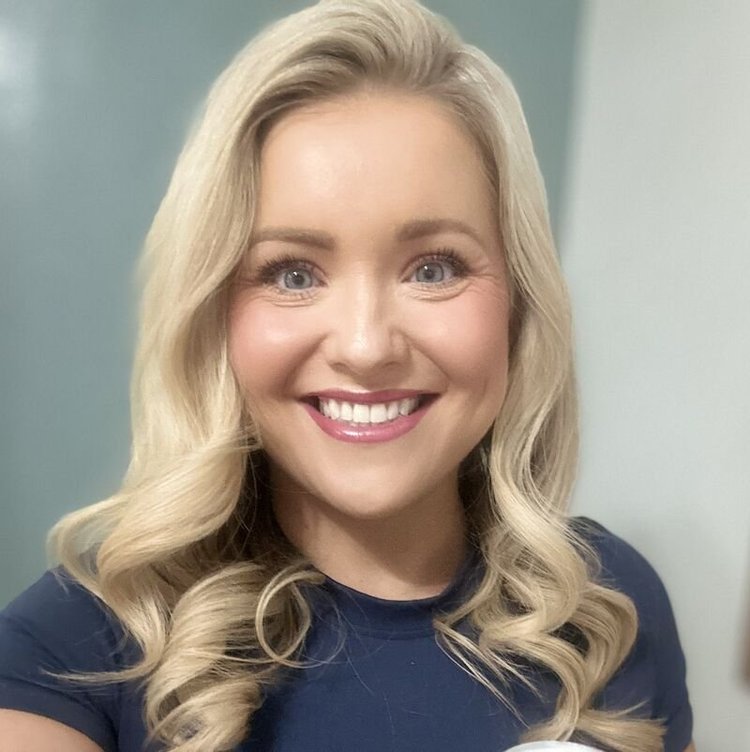
Nerida Rooney
Voyse
“I've always been in talent acquisition. I've never done anything else.”
Nerida Rooney has been named to the Talent 100, Class of 2026, the annual award recognizing up to 100 leaders in each category of talent acquisition. Honorees are nominated by peers or found by committees that look for excellent work wherever it happens, then chosen for the depth of their craft and their impact on hiring. This is Nerida's story.
On her very first day of work, before she knew what HR even stood for, Nerida Rooney was pulled into an interview room to shadow the HR director at the University of Newcastle. Someone asked the candidate about salary expectations. This was more than 20 years ago, when the question was considered startlingly forward, and Rooney remembers thinking she could not believe you were allowed to ask it. She was hooked. Twelve months later, she was sitting on the panel that promoted that same candidate.
"I remember thinking, wow, this is a full circle moment," she says. It set the pattern for a career that has never veered off course. Now Head of Talent Acquisition at Voyse, Rooney has spent her entire working life in one discipline, developing a single craft across two decades and two continents.
The Traineeship That Became a Career
Rooney is Australian, and when she finished school she knew university was not for her, even though her mother worked at the University of Newcastle. She simply wanted to earn money. The job she landed was an Indigenous traineeship in the university's HR department, an opportunity connected to her Aboriginal heritage, and she took it without the faintest idea what the department actually did. Before that, her only work experience had been at a go-kart centre.
What she found was a natural fit for a temperament she cheerfully describes as inquisitive. "I am a bit nosy," she says, and the curiosity about what people earn, what they want, and where they are going next never faded. What grew alongside it was something deeper: a genuine appetite for watching careers develop, for being present at the moment someone's trajectory changes.
She has stayed in talent acquisition ever since, which makes her an unusual figure in a profession where almost everyone arrives by accident. "I don't think I'm the typical person that fell into recruitment because I've always done it," she says. That longevity gives her an uncommon vantage point on how much has changed. When she started, everything lived on a spreadsheet and CVs arrived on paper. Watching the transformation unfold, she says, has been genuinely exciting rather than merely disorienting.
The Saturation Problem
Rooney has a sharp read on the current AI moment, informed by being on the receiving end of it. Over the past year she has been pitched more than at any point in her entire career, each vendor arriving with the next big thing. Her assessment is refreshingly free of cynicism. Many of the products genuinely impress her. She can see how they would revolutionise what a team can deliver for the business and reshape how talent acquisition is perceived by stakeholders, because they allow teams to do considerably more with considerably less.
Her worry is saturation. When there are so many strong products, how does a talent leader know which one will still serve the need in three to five years, not just this quarter? And implementation, she stresses, is never a plug in and go exercise. It requires patient nurturing with the TA team, with stakeholders, with the board. In a market moving this fast, the risk is a leader trapped in a cycle of perpetually implementing whichever shiny new toy has just landed. "I would want to make sure that the solution that we bring in isn't just something that's going to fix the problem now," she says, "but is going to fix a problem that we've got potentially in three to five years' time."
Your Network Is Free Google Reviews
Her advice to other talent leaders is practical and, characteristically, social. Talk to your peers, and talk to the ones whose situation actually mirrors yours. If you are small and looking to scale, seek out the leaders who were small and have already scaled, and ask precisely which tools carried them through it.
The metaphor she reaches for is her best line of the conversation. Your network, she says, is "like free Google reviews, but rather than them being censored, you're getting the true picture as to what worked for them, what didn't work for them." That intelligence does two things. It helps you challenge suppliers directly, asking what happens in specific scenarios, so you can judge whether a product has genuinely evolved past its known problems and whether the roadmap contains real solutions. And it arms you with data before the harder conversation with a CEO or a board about why something did or did not work.
That instinct for community shows up in how she thinks about recognition, too. Asked to nominate peers, she was careful about the standard she would apply. She wanted people who had made an impact not just on her, but on the industry. "There are definitely some change makers out there," she says.
The Talent 100 exists to celebrate the people shaping the future of how the world hires, and few embody that better than Nerida. We are honored to welcome Nerida Rooney to the Talent 100, Class of 2026, and grateful for the experience, perspective, and craft they bring to this community. Congratulations, Nerida. Welcome to the Talent 100.
About the Talent 100
The Talent 100 is an annual list spotlighting the leaders who push HR and talent acquisition forward, organized by Noon AI. Honorees are selected through peer nominations and independent selection committees. Selection is entirely merit-based, with no fees or pay-to-play requirements.