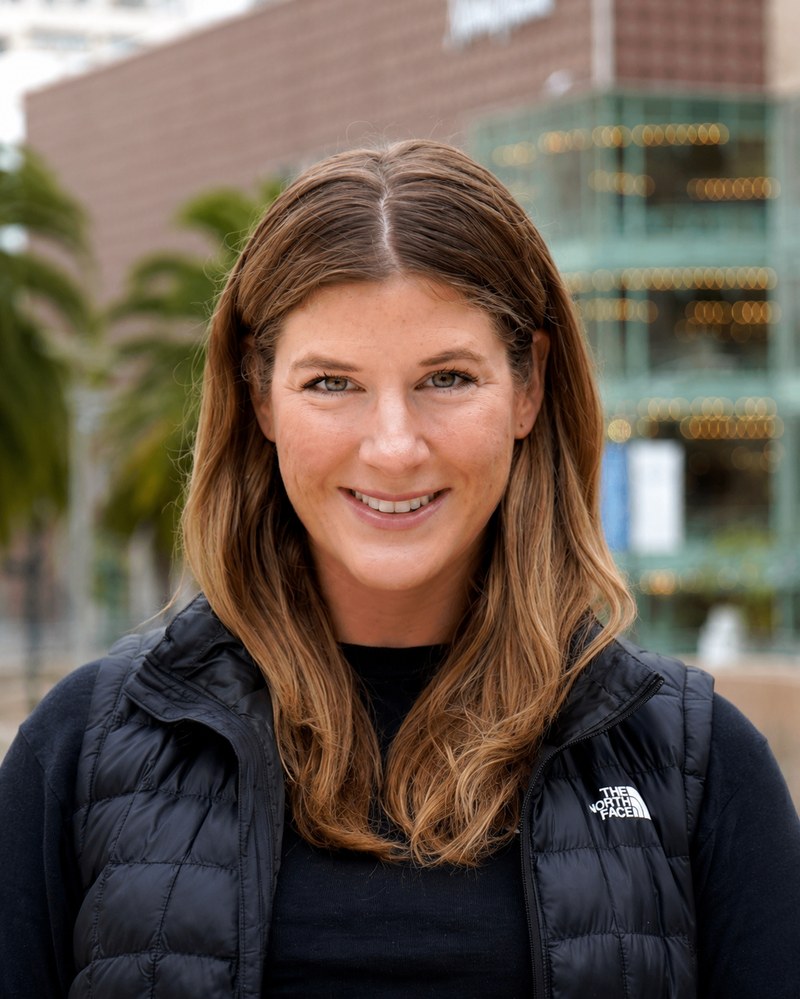
Colette Turner
Stripe
“There's nothing like extending an offer to a candidate, changing someone's world, changing someone's life. That to me is what matters.”
Colette Turner has been named to the Talent 100, Class of 2026, the annual award recognizing up to 100 leaders in each category of talent acquisition. Honorees are nominated by peers or found by committees that look for excellent work wherever it happens, then chosen for the depth of their craft and their impact on hiring. This is Colette's story.
Before Colette Turner ever ran a full cycle search for a go to market team, she was booking models, actors and voiceover artists for clients across the Bay Area. The job was to find people who matched an exact set of parameters, skills and requirements, and to do it fast. She has been doing a version of that ever since, including a little over eight years across Google and YouTube.
That lineage matters, because it explains the conviction running through everything Turner says about the work: the resume is not the person, and the person is the point. In a market awash in tooling, automation and record application volume, she has built a career on the opposite instinct, which is to keep the conversation human and to widen the definition of who gets to be considered great.
From Music Rooms to the Tech Mecca
Turner's path into talent acquisition was, in her own description, nonlinear. She began her career in entertainment and media, spending roughly four years working in music in Los Angeles after school. A move north to the Bay Area brought a job as a talent agent, where she spent about a year and a half sourcing models and actors and serving clients' modeling, acting and voiceover needs.
She calls it the groundwork. Understanding a client's brief, translating it into a search, and knowing what separates a plausible candidate from the right one are skills that do not change much when the roles change from on camera to on payroll. Being in the Bay Area meant being in what she calls the tech mecca, and in 2017 she landed at Google as a contractor, joining just as the company was standing up its hardware product area: devices and services, wearables, all of it.
That stint became a second boot camp, a live test of how talent agent instincts translated into tech and sourcing. Within about six months she moved into full cycle recruiting, and she stayed with Google for a little over eight years in total. After two years at Google proper she moved across to YouTube, where she spent roughly six years running full cycle recruiting for go to market and business operations. Along the way she became an internal advocate for the kind of candidate she once was: capable, curious, and not credentialed in the expected way.
The Manager Who Uncomplicated Everything
Ask Turner about influence and she will name Grant Rose, the manager who was the reason she moved to YouTube in the first place. Rose came from his own nontraditional background, having spent much of his career in investment banking along the Goldman Sachs route before joining tech, and Turner credits him with making a famously intricate environment legible.
"He did a really good job of uncomplicating the tech landscape for me," she says, describing a leader who helped her navigate the complex and sometimes nuanced politics of a major tech company without ever losing his candor. He was in her corner when clients were difficult and when candidate situations got complicated. He was also, crucially, hands off. The message she absorbed was trust: you've got this, tell me how I can help, and then go do your thing.
What stuck most was the discipline of restraint. Rose was highly effective without over engineering anything and without trying to fix what was not broken. That phrase, over engineering, resurfaces constantly in Turner's thinking, and it has become the lens through which she now evaluates the entire wave of technology reshaping her profession.
AI, Empathy, and the Barriers to Conversation
Turner sees the industry at an inflection point, with practitioners scattered across wildly different levels of AI fluency. Some are still at the starting line. Others are aggressively pushing the boundaries of what the technology can do. Meanwhile the macro market has produced a huge influx of people looking, driven by churn at major companies, and recruiters are contending with record volumes while trying to absorb an avalanche of new tools.
Her position is neither dismissive nor breathless. She keeps her own use of AI deliberately tactical: sifting volume, and matching what a job description says and what a team actually wants against the available talent pool. Where she draws the line is at the human layer. Candidates now routinely face two initial interviews with an AI chatbot, and Turner is blunt about the cost of that. "I think we lose a lot of the humanity and I think we lose a lot of the empathy in the process," she says. She frames such steps as barriers to conversation, and by extension barriers to hire.
She is equally focused on the ethics the industry has not settled. Is the use of AI transparent? Do candidates know when it is in play? Is there enough candor to simply say, I'm going to use this to record our meeting, let me know if that's okay. A great deal of debunking, she believes, still has to happen around how these tools are actually being leveraged, particularly given the swirl of claims and questionable practices she watches circulate on LinkedIn.
For all that, she is an optimist about the durability of her craft. Recruiters worried that AI is quietly learning their workflow should remember, in her view, what the technology cannot assess. The moment of extending an offer, of changing someone's world, is not a workflow. "Everybody has challenges. Everybody has a backstory," she says. Her favorite part of the job remains the simplest: getting on a call and learning what gets someone up in the morning.
Broadening the Aperture
Turner's advice to fellow talent leaders begins with a posture rather than a tactic. Treat the business as a living, breathing entity and treat the talent pool the same way. Do not get so stuck on the brass tacks that you lose sight of who is actually behind the resume.
From there she makes a case for a different kind of hire. She looks for creative, dynamic problem solvers rather than people content to do one job in a silo for the next ten years. She looks for low ego, for candidates not consumed by leveling and titles or a forever upward mobility mindset, for people hungry to jump in and roll their sleeves up. Hiring narrowly against a fixed set of core competencies, she argues, limits both the person and the team. Look at somebody as a whole, she says, and find the people comfortable flexing into a variety of different spaces.
Throughout her Google years she pushed hiring leaders to see past their own MBA program and past referrals from their previous company. Great candidates, she points out, do not all come from a thing, and they did not all do the Wharton MBA. The payoff, in her experience, is consistent: people hired out of smaller companies and industries outside big tech bring more creativity and a genuine breath of fresh air in how they approach problem solving and relationship management. Broadening the aperture of who counts as a top caliber candidate is not charity. It is a competitive advantage, and it has been a throughline of Turner's career since the days she was sourcing talent of an entirely different kind.
The Talent 100 exists to celebrate the people shaping the future of how the world hires, and few embody that better than Colette. We are honored to welcome Colette Turner to the Talent 100, Class of 2026, and grateful for the experience, perspective, and craft they bring to this community. Congratulations, Colette. Welcome to the Talent 100.
About the Talent 100
The Talent 100 is an annual list spotlighting the leaders who push HR and talent acquisition forward, organized by Noon AI. Honorees are selected through peer nominations and independent selection committees. Selection is entirely merit-based, with no fees or pay-to-play requirements.