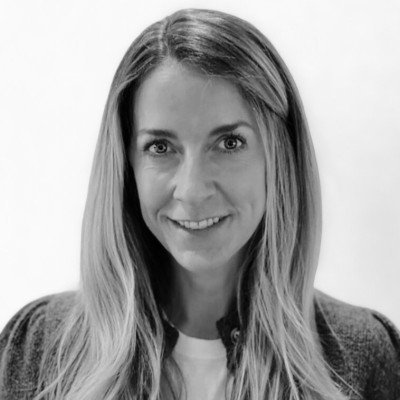
Kaitlyn Borea
Vivrelle
“Everything is in pencil. You're allowed to experiment.”
Kaitlyn Borea has been named to the Talent 100, Class of 2026, the annual award recognizing up to 100 leaders in each category of talent acquisition. Honorees are nominated by peers or found by committees that look for excellent work wherever it happens, then chosen for the depth of their craft and their impact on hiring. This is Kaitlyn's story.
The bookkeeper Kaitlyn Borea hired on the first search she ever volunteered for is still in that job today, roughly 15 years later. It is a fitting fact for a career that was never mapped so much as accepted, one raised hand at a time. Borea, VP of Human Resources at Vivrelle, has moved from a financial services firm to Chanel to startup land on curiosity rather than a plan, and she has arrived with one of the sharper reads in the industry on what artificial intelligence is actually doing to hiring.
The moment itself was unglamorous. In an HR team meeting at Barnum Financial Group, her second HR job, a search came up for a bookkeeper on the CFO's team. Her boss asked if anyone wanted to try it. Borea was one or two months in, the newest person in the room, and nobody was raising a hand. She took it, found the CFO someone she loved, and set the rest of her career in motion.
An Accidental Volunteer With Very Good Timing
Borea has a piece of early-career advice that sounds like a joke and isn't: if you want your trajectory to change, please a CFO. The finance leader whose team she had filled was thrilled with the result, and word traveled. Not long after, the CEO of Barnum Financial Group walked over to Borea's desk and told her he thought she would make a great recruiter, and suggested she focus on it.
That conversation converted an HR generalist into a campus recruiter, her first formal recruitment role, and she has done a little bit of everything since. Barnum Financial Group, Chanel, TOMO. Big company environments and then startups. She describes the origin of all of it as "a full accidental volunteer success," a phrase that undersells the pattern it established: raise your hand, learn the thing in public, deliver a result someone still remembers 15 years later.
The Mentors Who Changed the Trajectory
Ask Borea who shaped her and two names arrive immediately. The first is Kim Rodgers, now CHRO at Shift4, who hired Borea to run the talent function at TOMO. It was a genuine bet. Borea had spent her career at large companies and had no startup experience at all, and Rodgers put her in startup land anyway. "I think it totally changed the trajectory of my career," Borea says. The relationship outlasted the job. Rodgers is the person she reaches for when a situation gets sticky or a day goes sideways, someone she connects with not only professionally but on a human level, and whom she trusts "deeply and innately" to guide her in the right direction.
The second is Jamal Pierre, whom she worked with at Chanel and who took her under his wing. Eight years later they still keep in touch. What she admires in him is how entrepreneurial he is, a quality she believes talent professionals are too rarely permitted to claim. "Sometimes HR and talent professionals sort of get put into this box," she says, expected to be one very specific thing. Pierre showed her the opposite, time and again: that a career can evolve, that you can deliberately metamorphose it. Now, when she is stuck on a project or building something from scratch, she replays those conversations and asks the more entrepreneurial version of the question.
AI Is Playing on Both Teams
Borea's most useful observation about the current market is one she believes almost nobody is naming out loud. Recruiting is a two-sided market, candidates on one side and recruiters on the other, and for the first time the same technology is deployed on both. An applicant tracking system was only ever a company tool, used by a business and its recruitment team. Generative AI is not. Candidates are automating their applications, so volume has surged. Recruiters are automating screening and dispositioning, so the response has accelerated too. "AI is literally playing on both teams," she says. "So the game has gotten a little bit more complicated, and a little bit heavier because of volume."
What makes the arithmetic unforgiving is that nothing is reducing the inflow. More people are on the job market, applying has never been easier, and recruitment teams, in Borea's observation, seem smaller than they have ever been. That leaves leverage as the only real answer. Recruiters have to lean on tools to be more effective and more efficient, not as a preference but as a condition of the job.
She is equally attentive to the policy vacuum this has opened. Some job descriptions now tell candidates they are not allowed to use AI in an application. Others explicitly encourage using it on a resume. The split, she notes, comes down to each company's philosophy, its security posture, and the vision it holds for AI usage inside the business. Her guidance to talent leaders is two-sided by design: be thoughtful about how you use the technology, and be just as thoughtful about how you assess other people's use of it. As for what comes next, she is refreshingly unwilling to pretend. "I don't know that anybody has a crystal ball."
Keeping the Human In It
For all her fluency with the tooling, Borea's advice to talent leaders begins somewhere else. Prioritize keeping the human in the recruitment process, because at the end of the day the work is hiring humans. That means staying aligned on the north stars that actually matter: candidate experience, talent density, and profile. Know what you are hunting for, stay focused, and do not lose sight of the human aspect of what the function does.
She rejects the prevailing doom and gloom. Her view is that AI will elevate excellent recruiters precisely because it absorbs the mundane and hands back the hours that matter: understanding the person on the other side of the table, connecting deeply with hiring managers, working a network to genuinely understand a search. Recruiters have always had technology, she points out. What is different is how much of the workload it can carry now.
Everything Is in Pencil
The last thing Borea wanted to add was about temperament. Talent leaders, she argues, have to be innately curious and cannot afford to be intimidated by change. "Everything is in pencil," she says. "You're allowed to experiment." She offers exactly one guardrail: do not upload your company's 2025 compensation agreements.
It is advice she earned. Borea admits she was intimidated by some of these AI tools herself and had to get over that hump of fear before anything else was possible. On the other side of it, the work became fun. Now she can play with the technology, test it, and keep going. That spirit of curiosity and experimentation, she believes, matters as much as any framework a talent leader can adopt, and it is the same instinct that once made her the only person in the room willing to take an unclaimed search.
The Talent 100 exists to celebrate the people shaping the future of how the world hires, and few embody that better than Kaitlyn. We are honored to welcome Kaitlyn Borea to the Talent 100, Class of 2026, and grateful for the experience, perspective, and craft they bring to this community. Congratulations, Kaitlyn. Welcome to the Talent 100.
About the Talent 100
The Talent 100 is an annual list spotlighting the leaders who push HR and talent acquisition forward, organized by Noon AI. Honorees are selected through peer nominations and independent selection committees. Selection is entirely merit-based, with no fees or pay-to-play requirements.