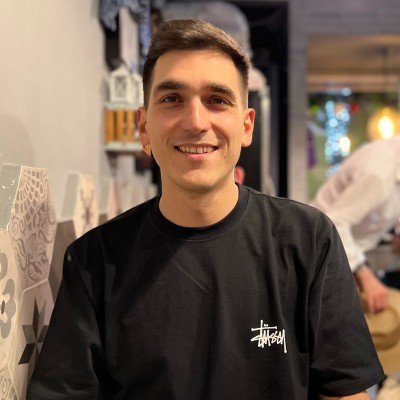
Andrea Carenini
Europe & Pacific, Reckitt
“I always wanted to do this job, already in high school.”
Andrea Carenini has been named to the Talent 100, Class of 2026, the annual award recognizing up to 100 leaders in each category of talent acquisition. Honorees are nominated by peers or found by committees that look for excellent work wherever it happens, then chosen for the depth of their craft and their impact on hiring. This is Andrea's story.
Ask a room full of talent leaders how they got into recruiting and nearly every one of them will describe an accident: a temp job, a redundancy, a favor for a friend. Andrea Carenini decided in high school. He is, by his own account, one of the few exceptions in an industry built almost entirely of career detours, and he says so without apology.
Today he leads talent acquisition at Reckitt, and the deliberateness of that early choice still shows. He talks about hiring the way an engineer talks about a system: the data behind it, the admin under it, the tools around it, and the human judgment that all of that infrastructure is supposed to protect.
A Career Chosen on Purpose
The interest surfaced in high school and hardened into a plan at the start of university. What caught him was the idea of being able to select people, to find the right match, and to contribute to an organization through that match. Most practitioners discover that appeal years into a career they never intended. Carenini built his education around it before he had done the work at all.
He went straight into a master's degree in human resources, wrote his thesis on recruitment, and began his working life in in-house recruiting rather than agency. That sequence matters. It meant he learned the craft inside organizations, accountable to hiring managers and to the business, from the first day forward. Every role since has been an extension of a decision he made as a student.
What AI Is Actually Doing to Recruiting
Carenini calls the AI question a loaded one, the kind that deserves an hour rather than a minute, and his read on it is refreshingly unromantic. The clearest gain, he argues, is subtraction: AI is taking a large volume of admin work off recruiters' desks, which frees them to do the part machines cannot do, namely building genuine partnership and relationship with both the business and candidates. The second gain is sourcing, where the technology is increasingly effective at surfacing the diamonds in the rough and filling the niche roles that used to consume weeks of manual searching.
Then comes the complication, and he believes the industry is only beginning to reckon with it. It is no longer clear, he says, what is a human interaction and what is an AI interaction. At his company the questions have already started arriving: candidates asking whether their application was genuinely screened by a person or simply handled by a bot. He does not dress that up as a crisis. He treats it as a signal, and one worth acting on early.
The Transparency Standard
His prescription is specific and aimed squarely at companies of his own scale. Large enterprises, he argues, need to start thinking seriously about what he calls AI ethics, and then do the unglamorous follow-through: re-look at their policies, their guidelines, and their communication toward both candidates and the business so that it is unambiguous at every stage what is handled by a human and what is handled by AI.
"If you are clear up front, then the experience for everyone is much better," he says. "If it's not clear, it can really create some frictions along the journey." He expects much of the industry conversation this year to circle that question, and he would rather his function arrive ahead of it than react to it. It is a characteristically structural answer from a leader who has spent his career believing that the quality of a hiring decision depends on the quality of the machinery around it.
For a practitioner who chose this profession before he had ever set foot in an office, the through-line is consistent. The tools change constantly. The obligation does not: be clear with candidates, build the operational discipline that lets recruiters do real work, and bet on people the way somebody once bet on him.
The Talent 100 exists to celebrate the people shaping the future of how the world hires, and few embody that better than Andrea. We are honored to welcome Andrea Carenini to the Talent 100, Class of 2026, and grateful for the experience, perspective, and craft they bring to this community. Congratulations, Andrea. Welcome to the Talent 100.
About the Talent 100
The Talent 100 is an annual list spotlighting the leaders who push HR and talent acquisition forward, organized by Noon AI. Honorees are selected through peer nominations and independent selection committees. Selection is entirely merit-based, with no fees or pay-to-play requirements.