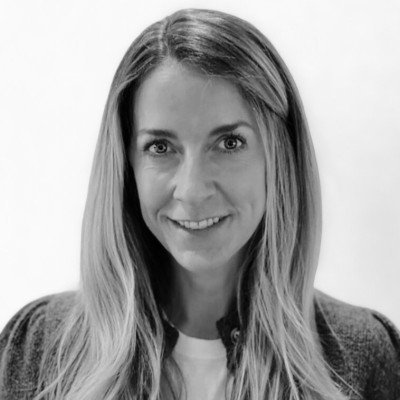
Malak C.
Canada, Skip
“The tool that you have to feed information is never going to replace you.”
Malak C. has been named to the Talent 100, Class of 2026, the annual award recognizing up to 100 leaders in each category of talent acquisition. Honorees are nominated by peers or found by committees that look for excellent work wherever it happens, then chosen for the depth of their craft and their impact on hiring. This is Malak's story.
At the height of the pandemic hiring surge, Malak Chihab and a team of eight were extending roughly 160 offers a week. There was no playbook waiting for them. Skip was still operating like a startup, structured hiring strategies were thin on the ground, and the volume was climbing faster than the process could carry it. That pressure became the making of a leader: rather than absorbing the chaos, Chihab redesigned around it, introducing and scaling structured models that lifted hiring efficiency without letting candidate experience slip. Today she oversees talent acquisition across Canada for Skip, leading a team of four that manages full cycle recruitment at every level, with some roles posted into Europe.
The Message She Almost Ignored
Chihab did not set out to become a recruiter. She arrived at Skip as a training specialist, and she nearly never arrived at all. The first contact came through a LinkedIn message, and her instinct was to pass. "I first thought that I don't want to deliver food," she recalls. "I thought this is what it was."
What changed her mind was a habit that has since defined her career: she slowed down and read the actual details. She went through the job description properly, looked into what the company was really building, and recognized that she already used the platform herself to order food. The role turned out to involve training restaurant owners in multiple languages. Chihab speaks three. "So why not?" she says. She took it.
Seven months later, HR came back to her. The talent acquisition team needed a bilingual specialist, and they wanted her. It was a different discipline, a different rhythm, and a company still young enough that much of the infrastructure had yet to be invented. Chihab learned fast and built as she went, helping construct hiring processes from the ground up. When COVID hit and demand scaled rapidly, that improvisational muscle became the whole job. She has since grown from that specialist role into leadership of the function nationally.
AI as Leverage, Never as a Substitute
Chihab is emphatic on the subject. "I love AI," she says, twice, and she has little patience for the anxiety around it. Her argument is disarmingly simple: a tool you have to feed information is not going to replace you.
But her enthusiasm is deliberately bounded. Her team does not run AI inside the recruitment decision itself. Resumes are reviewed manually, specifically so the process stays fair. That is a deliberate line drawn on purpose rather than by default.
Where AI earns its place, in her view, is in clearing the plate. Following Skip's acquisition, Chihab and her colleagues gained access to an internal AI tool, and she recently put it to work on real time compensation and benefits questions, including calculating bonuses by level. The scenario is familiar to every recruiter: a candidate asks about bonus structure mid conversation, and the honest answer requires checking grade, compensation bands and a document nobody has memorized yet because the structure is new. Rather than pausing the call or leaving the candidate waiting, she asks the tool and has the answer in seconds. "It's a small change, but it significantly improves both recruiter efficiency and candidate experience," she says. The agent does not have the conversation on her behalf. It helps her have a better one.
Advice for Talent Leaders Heading Into the Next Phase
Chihab's counsel to peers is direct, and she does not soften it. AI is here whether the profession likes it or not, and companies are optimizing for efficiency, which in practice means technology. Recruiters who refuse to engage with it are narrowing their own options in the market.
Her framing of the replacement fear is the sharpest thing she says. If you believe AI will replace you, she argues, you are wrong. And if it does replace you, that is a signal about the nature of the work you were doing, not about the tool. Her prescription is practical rather than defensive: work on your skills, learn a new tool, build the capability that lets you use AI to your benefit instead of standing at a distance from it.
It is a philosophy consistent with everything else in her career. Read the details before you decide. Hear both sides. Keep the human judgment where fairness demands it, and automate the friction that never needed a human in the first place. From a LinkedIn message she almost ignored to national leadership of a talent function, Chihab has built her track record on exactly that kind of clear thinking under pressure.
The Talent 100 exists to celebrate the people shaping the future of how the world hires, and few embody that better than Malak. We are honored to welcome Malak C. to the Talent 100, Class of 2026, and grateful for the experience, perspective, and craft they bring to this community. Congratulations, Malak. Welcome to the Talent 100.
About the Talent 100
The Talent 100 is an annual list spotlighting the leaders who push HR and talent acquisition forward, organized by Noon AI. Honorees are selected through peer nominations and independent selection committees. Selection is entirely merit-based, with no fees or pay-to-play requirements.