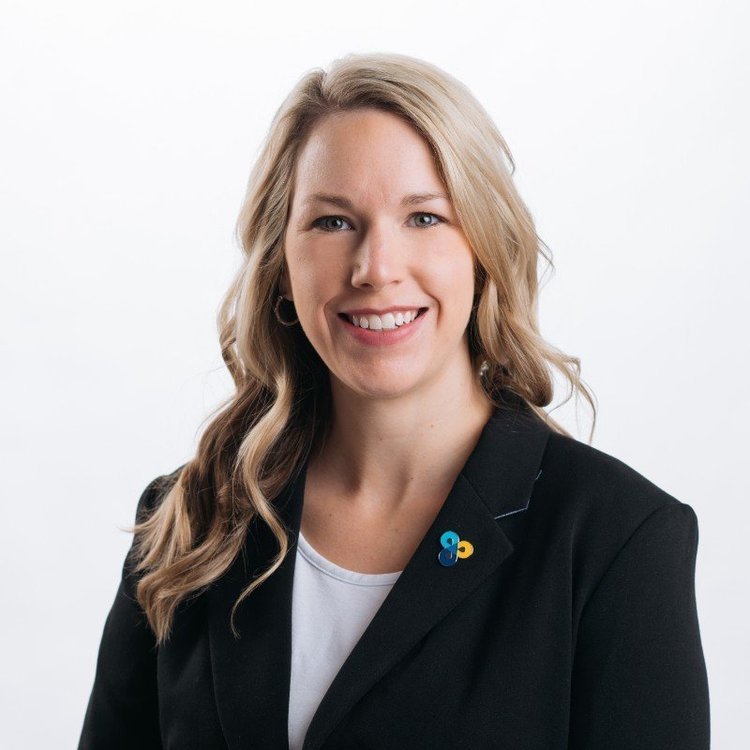
Elizabeth Diley
Medtronic
“You're not looking around the next corner. You're looking around the corner that's around the corner.”
Elizabeth Diley has been named to the Talent 100, Class of 2026, the annual award recognizing up to 100 leaders in each category of talent acquisition. Honorees are nominated by peers or found by committees that look for excellent work wherever it happens, then chosen for the depth of their craft and their impact on hiring. This is Elizabeth's story.
Early in her career, Elizabeth Diley wrote newspaper ads for open positions. Today she leads the early career talent acquisition team at Medtronic, where the job is to anticipate not just the next wave of recruiting technology but the wave after that. She describes the arc between those two points, without hesitation, as her life's passion and her life's work.
What connects them is not a job title but a conviction: that hiring is fundamentally a study of how people work, how they fit together, and what a business actually needs from them. Diley built her career on the belief that the recruiter who understands the enterprise is worth more than the recruiter who only understands the requisition. That philosophy carried her from consumer packaged goods into medical technology, and from booking candidate travel to shaping how a global company meets the next generation of talent.
A Business Major Who Fell in Love With People
Diley was a first-generation college student. Corporate life was not something she saw modeled at home, and talent acquisition was not a profession she knew existed. She majored in business and then filled the margins of her schedule with psychology and sociology courses, drawn to organizational structure and to the mechanics of how people interact with one another. "I really fell in love with just the way people work," she says.
Her first job out of school was in operations, where hiring occupied only a sliver of her responsibilities: coordinating candidate schedules, writing those newspaper ads. It was enough. When a talent acquisition coordinator role opened at General Mills, she applied and got it, and started, in her words, at the very bottom, reaching out to candidates and booking travel. The passion arrived almost immediately. That entry-level job turned out to be the place where her business training and her fascination with human behavior finally met.
Responsibility compounded from there, year after year, until about a year and a half ago, when she left General Mills for Medtronic. It was a deliberate leap into unfamiliar territory: a new industry, a different talent profile, a differently structured early career function. "Kind of fell into it and haven't looked back," she says of the profession that found her.
Talent Advisors, Not Task Managers
Diley sees AI reshaping talent acquisition from both directions at once, and she refuses to treat only one of them as the story. Candidates, especially the students she works with, are using AI to build resumes and cover letters and to rehearse for the conversations that follow. Where that rehearsal once required another person on the other side of the table, it no longer does. Her view is not defensive. Candidates should embrace those tools, she argues, the same way every generation of job seeker has embraced the technology available to it.
On the recruiting side, the shift is more consequential. The tasks that once defined her own first role, coordinating schedules, booking travel, sending turndown notes, preparing offer letters, are increasingly automated. That, to her, is the opportunity. "It has helped elevate recruiters to be more talent advisors versus task managers," she says, describing a change she has watched build over the past couple of years and accelerate sharply in the last year specifically. Freed from administration, recruiters can do the work that actually grows a business.
She is equally clear about what technology cannot replace. The candidate experience is, in her framing, the thing that matters most, alongside finding top talent for the organization. Much of the future will be technology-driven; the discipline is figuring out how to bring the human and the technological together so that the experience improves rather than erodes.
Looking Around the Corner That's Around the Corner
Her advice to other talent leaders begins with mindset. Growth versus fixed is not an abstraction to Diley, it is a diagnostic. "If you're battling technology, you really need to think about what that means and how you're showing up then for your leaders and for your team," she says. The leaders who stay curious, who keep educating themselves on what is coming, are the ones who will still be useful in five years.
That is where her favorite formulation comes in. Anticipation cannot stop at the obvious next step. You look around the corner that's around the corner, and then the one after that, and you prepare your teams now to embrace that future while protecting the human touch. She applies the same logic to people development, particularly for less tenured employees building careers in an environment shifting under their feet. What excites her about the years ahead is exactly what unsettles others: talent acquisition and HR operating models, she notes, keep evolving at a rapid speed.
The rest of her counsel is simpler. Do what you love, because that is where the great work comes from. Believe in yourself. Find mentors and sponsors who will help you reach not only your career goals but your life goals. Have fun doing it.
Ask what sustains her and she points to the moments that never appear on a dashboard: standing in front of a group of students, welcoming an internship class, sitting with someone on campus who has no idea what they want to do and helping them assess their own skills. "I get to help people find their dream job," she says. "I get to build teams that get to go out and educate students about companies, about jobs, and to help them think about their careers and their first jobs differently." She is convinced she has one of the best jobs there is. On the evidence, it is hard to argue.
The Talent 100 exists to celebrate the people shaping the future of how the world hires, and few embody that better than Elizabeth. We are honored to welcome Elizabeth Diley to the Talent 100, Class of 2026, and grateful for the experience, perspective, and craft they bring to this community. Congratulations, Elizabeth. Welcome to the Talent 100.
About the Talent 100
The Talent 100 is an annual list spotlighting the leaders who push HR and talent acquisition forward, organized by Noon AI. Honorees are selected through peer nominations and independent selection committees. Selection is entirely merit-based, with no fees or pay-to-play requirements.