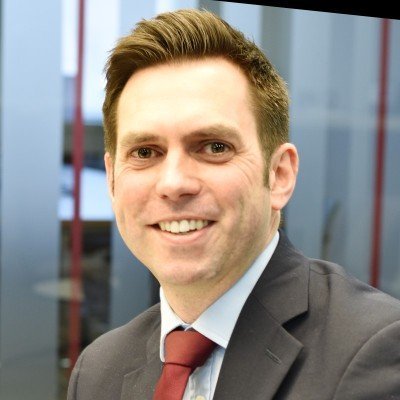
Steven Dilworth
Fortrea
“I see it as more than just a search feature. It's definitely part of the team.”
Steven Dilworth has been named to the Talent 100, Class of 2026, the annual award recognizing up to 100 leaders in each category of talent acquisition. Honorees are nominated by peers or found by committees that look for excellent work wherever it happens, then chosen for the depth of their craft and their impact on hiring. This is Steven's story.
When Labcorp spun its contract research business out into a standalone company, someone had to stand up the talent engine that would carry it forward. Steven Dilworth got that call. As Head of Talent Acquisition at Fortrea, he now leads a talent strategy group that reaches well past requisitions into learning and development, talent management, and the capability strategies a global clinical research organization needs to win work and deliver it.
His operating model reflects a market that does not hand recruiters easy wins. Recruitment partners are aligned either to a specific business unit or to a part of the world, in some cases chosen for the language capabilities that let them work their own networks. Behind them sit three sourcing hubs. That structure exists because of a hard truth about life sciences hiring: "It's an industry that isn't heavily reliant on inbound applications," Dilworth notes. "You've got to build networks and build pipelines for it to be successful."
From Dental Sciences to the Life Sciences Frontline
Dilworth studied dental sciences, and the path it was opening for him was not the one he wanted. What stayed with him was the subject matter itself: science, life sciences, human health. The question was how to bridge the gap into the sector without the credential that normally buys the ticket.
The answer came through personality as much as planning. His first role was direct, customer facing agency recruitment, the kind of work that rewards people who like people and thrive on variety. From there he moved in-house at a clinical research organization, and that single opportunity became the foundation of everything since. Colleagues around him who had worked in the sector and in HR gave him the confidence to make the leap. "I found my calling, for want of a better phrase, by working in the pharmaceutical industry," he says. Two decades of context in clinical research now sits underneath every hiring conversation he has, which in an industry this technical is not a soft advantage.
Building AI Into the Team, Not Around It
Dilworth works remotely inside a meeting heavy, email heavy business, and he is candid about what AI has done for the shape of his day. It functions as a sounding board that is always in the room, whether the problem is an operational transformation, a large scale recruitment initiative, or workforce planning. That framing is deliberate. He does not treat the technology as a better search box.
Inside his talent strategy group, adoption is being driven by design rather than hope. Individuals across the group serve as AI champions, largely on Copilot, carrying a remit alongside their day jobs to help colleagues actually use the tools. The team has also built its own agents internally: market insights agents that ingest intelligence and formulate reports for the business, plus support for customer conversations and business proposals. The point is not speed for its own sake. It is that recruiters here are accountable for the headcount solution, and their job is more than that. Push the market intel in, get consultative insight out, and let it work around the clock when the team is offline.
He is equally clear on the limits. There is a great deal of noise about what AI can and cannot do, and early enthusiasm centered on whether it could automate interviews, record and prompt them, and generate packs for hiring managers. Much of that is technically possible. The compliance dimension, he cautions, is a reason to stay wary rather than dazzled, and the hype itself can become a distraction.
The Thing Recruiters Cannot Afford to Lose
Dilworth's advice to other talent leaders lands on a tension he has already watched play out. Some recruitment professionals, he has observed, are becoming a little more insular because of the technology. That is the failure mode nobody puts in a business case.
"There's tried and tested traditional techniques that made you such a good recruiter in the first place and made you memorable with candidates," he says. "You can't lose that because you suddenly got this tool that does a lot of the work for you." His prescription is balance: use the technology to level up stakeholder engagement and to buy back the time that makes a recruiter consultative rather than transactional, and spend that time on people. In a sector where pipelines are built by hand and reputation travels through networks, the recruiter who remains memorable is still the one who wins.
The Talent 100 exists to celebrate the people shaping the future of how the world hires, and few embody that better than Steven. We are honored to welcome Steven Dilworth to the Talent 100, Class of 2026, and grateful for the experience, perspective, and craft they bring to this community. Congratulations, Steven. Welcome to the Talent 100.
About the Talent 100
The Talent 100 is an annual list spotlighting the leaders who push HR and talent acquisition forward, organized by Noon AI. Honorees are selected through peer nominations and independent selection committees. Selection is entirely merit-based, with no fees or pay-to-play requirements.